Kitajima Kazuhiro, Abe Kazuo, Takeda Masanaka, Yoshikawa Hiroo, Ohigashi Mana, Osugi Keiko, Koyama Hidenori, Yamakado Koichiro
Department of Radiology.
Department of Neurology, Hyogo College of Medicine.
Medicine (Baltimore). 2021 Jan 22;100(3):e23969. doi: 10.1097/MD.0000000000023969.
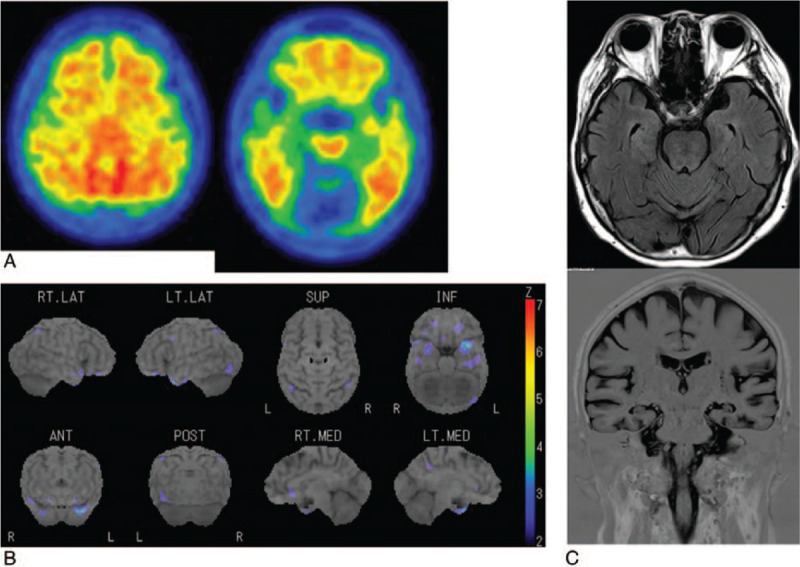
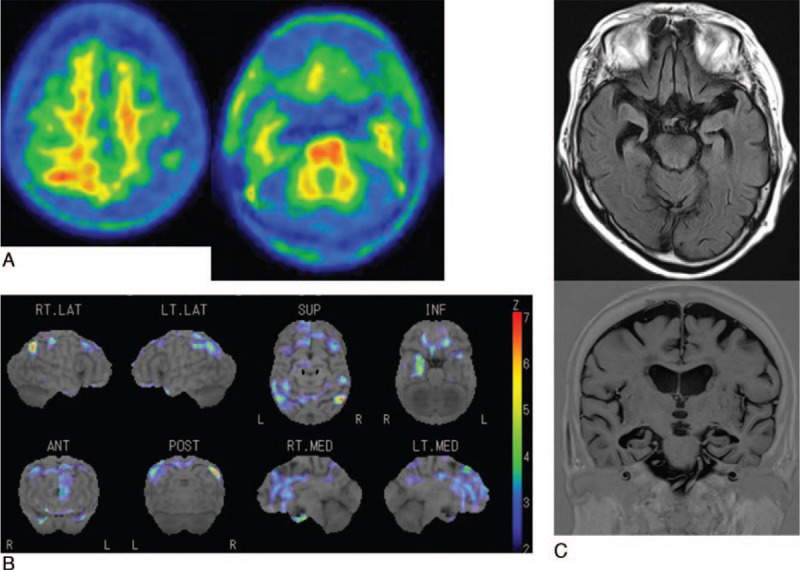
This study aimed to evaluated the clinical impact of adding [11C] Pittsburgh compound-B (11C-PiB) PET for clinical diagnosis of mild cognitive impairment (MCI) to Alzheimer's disease (AD) dementia.Twenty six (mean age 78.5 ± 5.18 years, 21 females) AD (n = 7), amnestic MCI (n = 12), non-amnestic MCI (n = 3), vascular dementia, progressive supranuclear palsy (PSP) with frontotemporal dementia (FTD), FTD (n = 1 each), and normal (n = 1) patients underwent 11C-PiB-PET, MRI, and SPECT scanning. 11C-PiB-PET was compared with MRI and SPECT for clinical impact.11C-PiB-PET showed positivity in 6, 9, and 0 of the AD, amnestic MCI, and non-amnestic MCI patients, respectively, and 0 of those with another disease. Parahippocampal atrophy at VSASD was observed in 5 AD patients, 6 amnestic and PiB-positive MCI patients, 1 amnestic and PiB-negative MCI patient, and 1 vascular dementia patient. Parietal lobe hypoperfusion in SPECT findings was observed in 6, 4, and 2 of those, respectively, as well as 1 each of non-amnestic MCI, vascular dementia, and normal cases. Sensitivity/specificity/accuracy for selecting PiB-positive patients among the 15 MCI patients for 11C-PiB-PET were 100% (9/9)/100% (6/6)/100% (15/15), for VSRAD were 66.7% (6/9)/83.3% (5/6)/73.3% (11/15), and for SPECT were 44.4% (4/9)/50.0% (3/6)/46.7% (7/15), while those were 88.9% (8/9)/33.3% (2/6)/66.7% (10/15)/for combined VSRAD and SPECT. 11C-PiB-PET accuracy was significantly higher than that of SPECT.11PiB-PET alone may be useful for selecting patients who will progress from MCI to AD in the future, although follow-up study is necessary to clarify the outcome of MCI patients.
本研究旨在评估添加[11C]匹兹堡化合物-B(11C-PiB)PET用于轻度认知障碍(MCI)向阿尔茨海默病(AD)痴呆临床诊断的临床影响。26例患者(平均年龄78.5±5.18岁,21例女性),包括AD患者(n = 7)、遗忘型MCI患者(n = 12)、非遗忘型MCI患者(n = 3)、血管性痴呆患者、伴有额颞叶痴呆(FTD)的进行性核上性麻痹(PSP)患者、FTD患者(各1例)以及正常患者(1例)接受了11C-PiB-PET、MRI和SPECT扫描。将11C-PiB-PET与MRI和SPECT的临床影响进行比较。11C-PiB-PET在AD患者、遗忘型MCI患者和非遗忘型MCI患者中的阳性率分别为6例、9例和0例,其他疾病患者均为0例。在VSASD中,5例AD患者、6例遗忘型且PiB阳性的MCI患者、1例遗忘型且PiB阴性的MCI患者以及1例血管性痴呆患者观察到海马旁萎缩。在SPECT检查结果中,分别有6例、4例和2例上述患者出现顶叶灌注不足,非遗忘型MCI患者、血管性痴呆患者和正常病例各有1例出现顶叶灌注不足。对于11C-PiB-PET,在15例MCI患者中选择PiB阳性患者的敏感性/特异性/准确性分别为100%(9/9)/100%(6/6)/100%(15/15),VSRAD分别为66.7%(6/9)/83.3%(5/6)/73.3%(11/15),SPECT分别为44.4%(4/9)/50.0%(3/6)/46.7%(7/15),而VSRAD和SPECT联合检测分别为88.9%(8/9)/33.3%(2/6)/66.7%(10/15)。11C-PiB-PET的准确性显著高于SPECT。单独使用11PiB-PET可能有助于选择未来将从MCI进展为AD的患者,不过需要进行随访研究以明确MCI患者的转归情况。