Masomi-Bornwasser Julia, Heimann Axel, Schneider Christian, Klodt Tristan, Elmehdawi Hammoud, Kronfeld Andrea, Krenzlin Harald, Tanyildizi Yasemin, Kreitner Karl-Friedrich, Kempski Oliver, Sommer Clemens, Ringel Florian, Keric Naureen
Department of Neurosurgery, University Medical Center of the Johannes Gutenberg University, 55131 Mainz, Germany.
Institute for Neurosurgical Pathophysiology, University Medical Center of the Johannes Gutenberg University, 55131 Mainz, Germany.
J Clin Med. 2021 Feb 3;10(4):563. doi: 10.3390/jcm10040563.
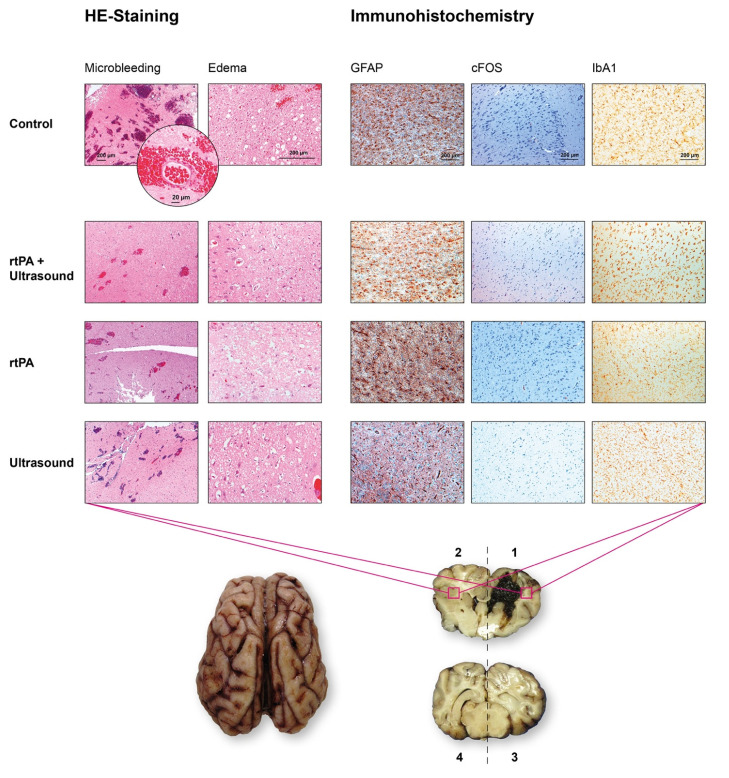
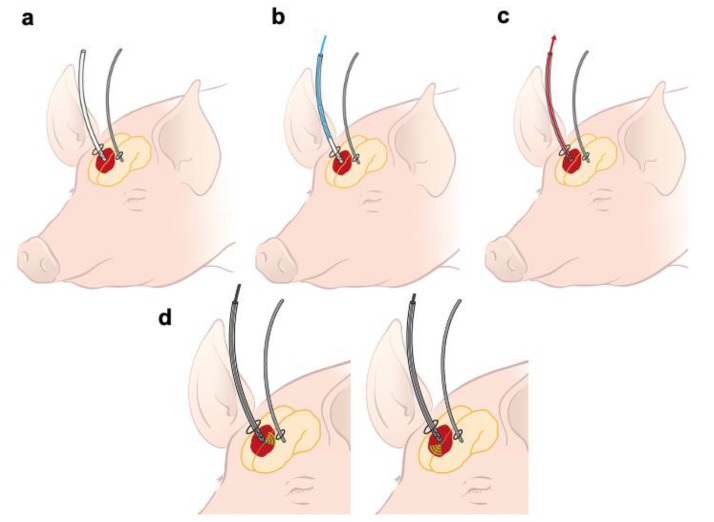
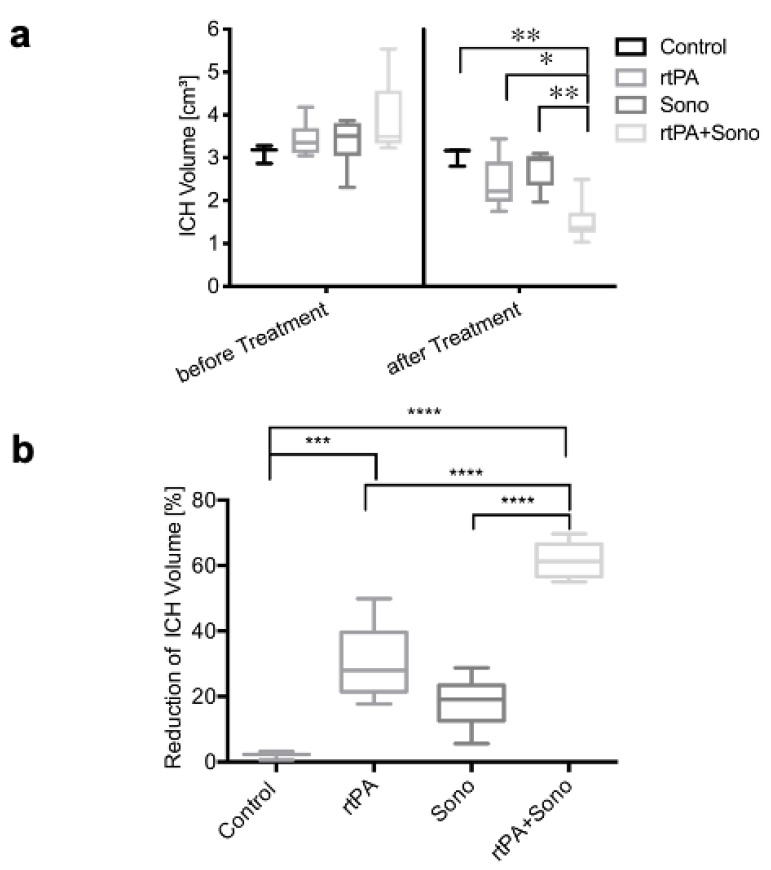
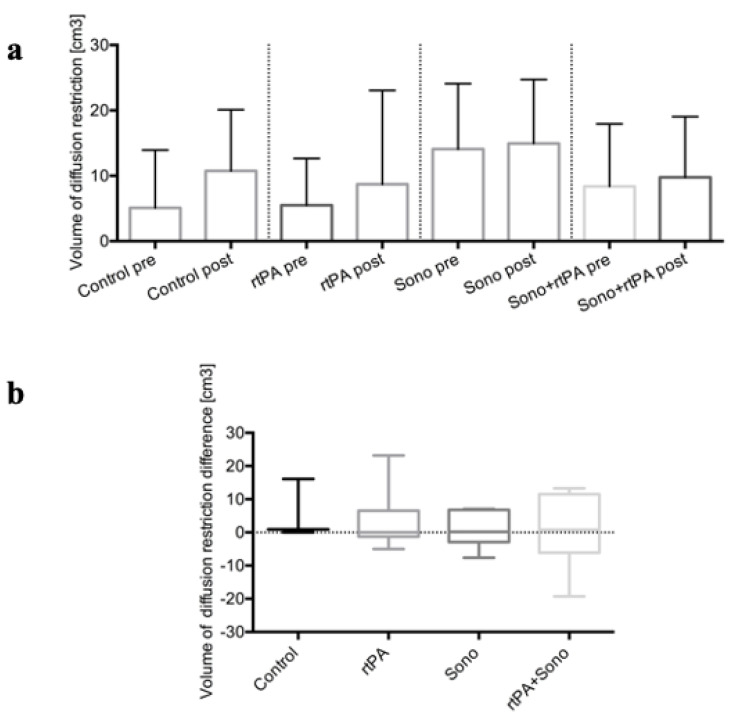
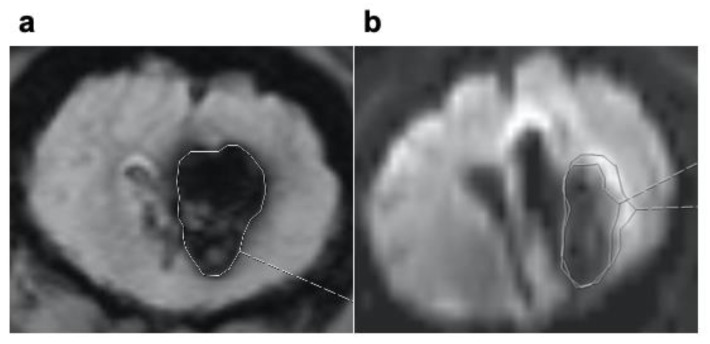
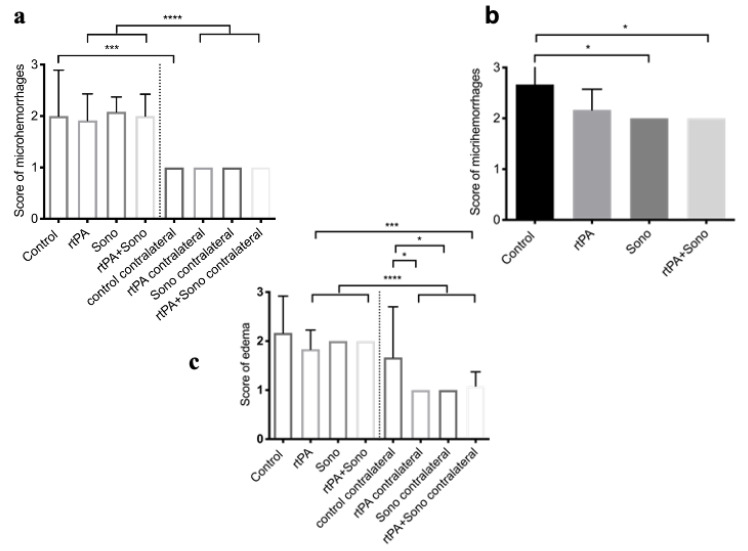
Catheter-based ultrasound-thrombolysis has been successfully used in a small clinical trial in order to enhance recombinant tissue plasminogen activator (rtPA)-fibrinolysis, for the treatment of spontaneous intracerebral hemorrhages (ICHs). The aim of this study was to investigate the ultra-early effects of ultrasound on hematoma and the surrounding brain tissue in a porcine ICH-model. To achieve this, 21 pigs with a right frontal ICH were randomly assigned to four groups: (1) drainage ( = 3), (2) drainage + rtPA ( = 6), (3) drainage + ultrasound ( = 6), and (4) drainage + ultrasound + rtPA ( = 6). The hematoma volume assessment was performed using cranial MRI before and after the treatments. Subsequently, the brain sections were analyzed using HE-staining and immunohistochemistry. The combined treatment using rtPA and ultrasound led to a significantly higher hematoma reduction (62 ± 5%) compared to the other groups (Group 1: 2 ± 1%; Group 2: 30 ± 12%; Group 3: 18 ± 8% ( < 0.0001)). In all groups, the MRI revealed an increase in diffusion restriction but neither hyper- or hypoperfusion, nor perihematomal edema. HE stains showed perihematomal microhemorrhages were equally distributed in each group, while edema was more pronounced within the control group. Immunohistochemistry did not reveal any ultra-early side effects. The combined therapy of drainage, rtPA and ultrasound is a safe and effective technique for hematoma-reduction and protection of the perihematomal tissue in regard to ultra-early effects.
基于导管的超声溶栓已成功应用于一项小型临床试验,以增强重组组织型纤溶酶原激活剂(rtPA)的纤维蛋白溶解作用,用于治疗自发性脑出血(ICH)。本研究的目的是在猪ICH模型中研究超声对血肿及周围脑组织的超早期影响。为此,将21只右侧额叶ICH猪随机分为四组:(1)引流组(n = 3),(2)引流 + rtPA组(n = 6),(3)引流 + 超声组(n = 6),以及(4)引流 + 超声 + rtPA组(n = 6)。在治疗前后使用头颅MRI进行血肿体积评估。随后,使用苏木精-伊红(HE)染色和免疫组织化学分析脑切片。与其他组相比,rtPA和超声联合治疗导致血肿减少显著更高(62 ± 5%)(第1组:2 ± 1%;第2组:30 ± 12%;第3组:18 ± 8%(P < 0.0001))。在所有组中,MRI显示扩散受限增加,但既无高灌注或低灌注,也无血肿周围水肿。HE染色显示血肿周围微出血在每组中分布均匀,而水肿在对照组中更明显。免疫组织化学未显示任何超早期副作用。就超早期影响而言,引流、rtPA和超声联合治疗是一种安全有效的减少血肿和保护血肿周围组织的技术。