Hopf Maximilian, Kloos Christof, Wolf Gunter, Müller Ulrich Alfons, Müller Nicolle
Department of Internal Medicine III, University Hospital Jena, 07747 Jena, Germany.
Practice for Endocrinology and Diabetology, Centre for Ambulatory Medicine, Jena University Hospital, 07743 Jena, Germany.
J Clin Med. 2021 Feb 3;10(4):571. doi: 10.3390/jcm10040571.
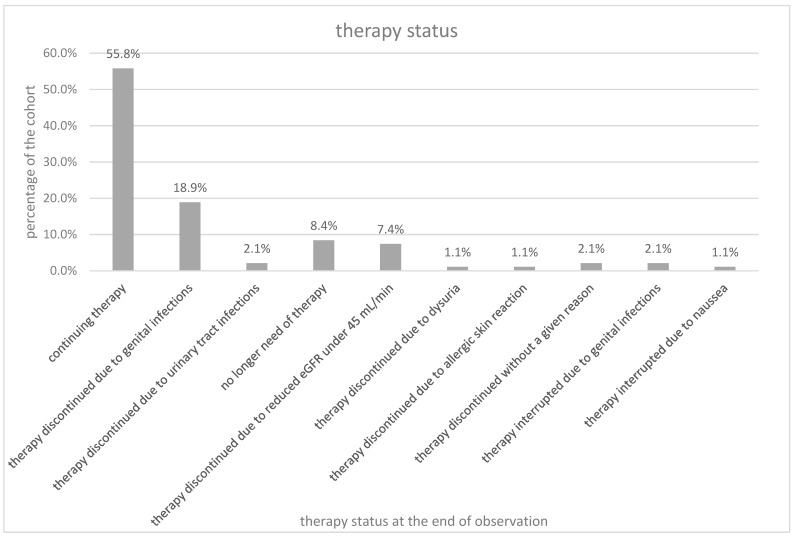
The aim of this study was to investigate the effectiveness of SGLT2 inhibitors with regard to metabolic parameters and patient safety under routine ambulatory conditions. Retrospective longitudinal study of 95 patients with type 2 diabetes (diabetes duration 13.3 y; HbA1c 8.9%; eGFR 80.1 mL/min) receiving SGLT-2-inhibitors. Metabolic control and adverse event profile were evaluated. The mean follow-up time was 1.2 ± 0.8 years. The following changes were observed: HbA1c -1.0% ± 1.9 ( < 0.001), eGFR -7.0 mL/min ± 13.3 ( < 0.001), albuminuria -23.9 mg/g creatinine ± 144.5 ( = 0.118), bodyweight -3.0 kg ± 5.8 ( < 0.001), systolic blood pressure -6 mmHg ± 22 ( = 0.01), diastolic blood pressure -2 mmHg ± 14 ( = 0.243). 53 participants continuously applied the therapy. Twenty-eight participants discontinued SGLT-2-inhibitors due to various reasons: 20 participants because of genital- or urinary tract infections. One for dysuria, seven due to reduced eGFR below 45 mL/min. This study showed a considerable reduction of HbA1c and a modest reduction of eGFR, bodyweight and systolic blood pressure under clinical routine conditions. Genital infections occurred markedly more often than in randomized controlled trials. To apply SGLT-2-inhibitors more safely in clinical routine individual risks for genital and urinary tract infections should be considered and re-evaluated during therapy.
本研究的目的是在常规门诊条件下,研究钠-葡萄糖协同转运蛋白2(SGLT2)抑制剂在代谢参数和患者安全性方面的有效性。对95例接受SGLT-2抑制剂治疗的2型糖尿病患者(糖尿病病程13.3年;糖化血红蛋白[HbA1c]8.9%;估算肾小球滤过率[eGFR]80.1 mL/min)进行回顾性纵向研究。评估代谢控制情况和不良事件谱。平均随访时间为1.2±0.8年。观察到以下变化:HbA1c降低1.0%±1.9(P<0.001),eGFR降低7.0 mL/min±13.3(P<0.001),尿白蛋白排泄率降低23.9 mg/g肌酐±144.5(P=0.118),体重降低3.0 kg±5.8(P<0.001),收缩压降低6 mmHg±22(P=0.01),舒张压降低2 mmHg±14(P=0.243)。53名参与者持续应用该治疗。28名参与者因各种原因停用SGLT-2抑制剂:20名参与者是因为生殖器或尿路感染。1名因排尿困难,7名因eGFR降至45 mL/min以下。本研究表明,在临床常规条件下,HbA1c显著降低,eGFR、体重和收缩压适度降低。生殖器感染的发生率明显高于随机对照试验。为了在临床常规中更安全地应用SGLT-2抑制剂,应考虑个体发生生殖器和尿路感染的风险,并在治疗期间重新评估。