Guan Yun, Xiong Ji, Pan Mingyuan, Shi Wenyin, Li Jing, Zhu Huaguang, Gong Xiu, Li Chao, Mei Guanghai, Liu Xiaoxia, Pan Li, Dai Jiazhong, Wang Yang, Wang Enmin, Wang Xin
CyberKnife Center, Department of Neurosurgery, Huashan Hospital, Fudan University, 12 Wulumuqi Road (M), Shanghai, 200040, China.
Neurosurgical Institute of Fudan University, 12 Wulumuqi Road (M), Shanghai, 200040, China.
BMC Cancer. 2021 Feb 5;21(1):123. doi: 10.1186/s12885-021-07856-y.
The optimal treatment for recurrent high-grade gliomas (rHGGs) remains uncertain. This study aimed to investigate the efficacy and safety of hypofractionated stereotactic radiosurgery (HSRS) as a first-line salvage treatment for in-field recurrence of high-grade gliomas.
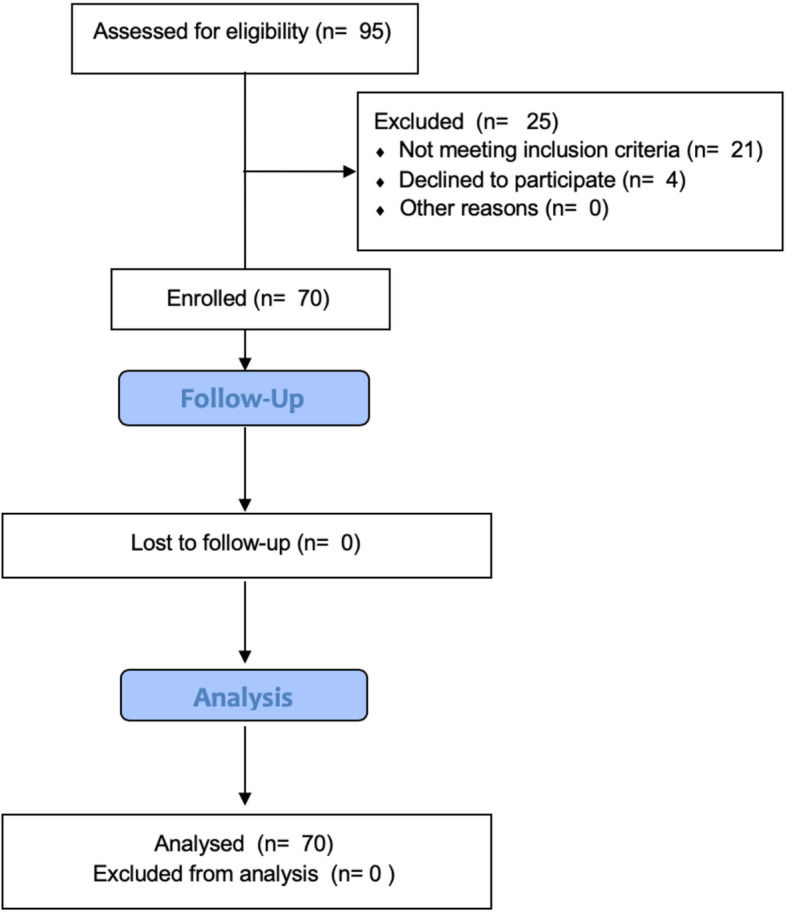
Between January 2016 and October 2019, 70 patients with rHGG who underwent HSRS were retrospectively analysed. The primary endpoint was overall survival (OS), and secondary endpoints included both progression-free survival (PFS) and adverse events, which were assessed according to Common Toxicity Criteria Adverse Events (CTCAE) version 5. The prognostic value of key clinical features (age, performance status, planning target volume, dose, use of bevacizumab) was evaluated.
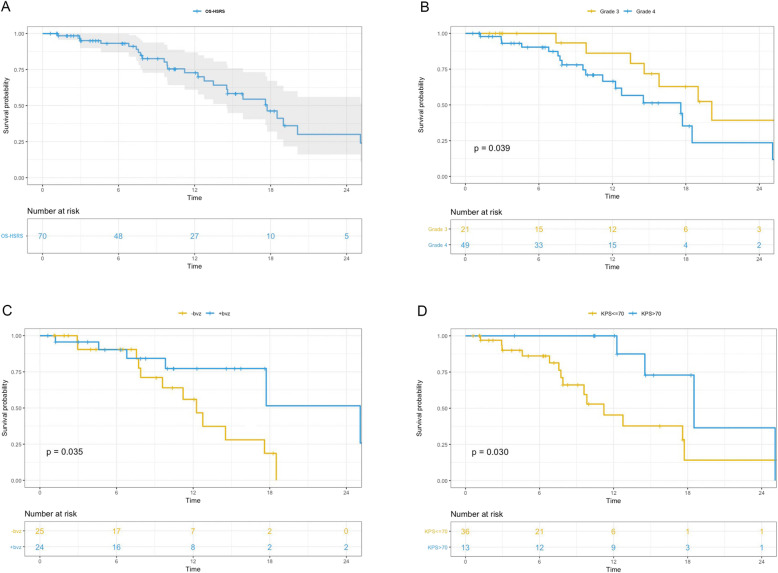
A total of 70 patients were included in the study. Forty patients were male and 30 were female. Forty-nine had an initial diagnosis of glioblastoma (GBM), and the rest (21) were confirmed to be WHO grade 3 gliomas. The median planning target volume (PTV) was 16.68 cm (0.81-121.96 cm). The median prescribed dose was 24 Gy (12-30 Gy) in 4 fractions (2-6 fractions). The median baseline of Karnofsky Performance Status (KPS) was 70 (40-90). With a median follow-up of 12.1 months, the median overall survival after salvage treatment was 17.6 months (19.5 and 14.6 months for grade 3 and 4 gliomas, respectively; p = .039). No grade 3 or higher toxicities was recorded. Multivariate analysis showed that concurrent bevacizumab with radiosurgery and KPS > 70 were favourable prognostic factors for grade 4 patients with HGG.
Salvage HSRS showed a favourable outcome and acceptable toxicity for rHGG. A prospective phase II study (NCT04197492) is ongoing to further investigate the value of hypofractionated stereotactic radiosurgery (HSRS) in rHGG.
复发性高级别胶质瘤(rHGG)的最佳治疗方案仍不明确。本研究旨在探讨超分割立体定向放射外科(HSRS)作为高级别胶质瘤瘤床复发一线挽救治疗的疗效和安全性。
回顾性分析2016年1月至2019年10月期间接受HSRS治疗的70例rHGG患者。主要终点为总生存期(OS),次要终点包括无进展生存期(PFS)和不良事件,根据《常见不良反应评价标准》第5版(CTCAE v5)进行评估。评估关键临床特征(年龄、体能状态、计划靶体积、剂量、贝伐单抗使用情况)的预后价值。
本研究共纳入70例患者。男性40例,女性30例。49例最初诊断为胶质母细胞瘤(GBM),其余21例确诊为WHO 3级胶质瘤。计划靶体积(PTV)中位数为16.68 cm³(0.81 - 121.96 cm³)。处方剂量中位数为24 Gy(12 - 30 Gy),分4次给予(2 - 6次)。卡氏功能状态评分(KPS)基线中位数为70(40 - 90)。中位随访12.1个月,挽救治疗后的中位总生存期为17.6个月(3级和4级胶质瘤分别为19.5个月和14.6个月;p = 0.039)。未记录到3级或更高等级的毒性反应。多因素分析显示,放射外科联合贝伐单抗以及KPS>70是4级HGG患者的有利预后因素。
挽救性HSRS对rHGG显示出良好的疗效和可接受的毒性。一项前瞻性II期研究(NCT04197492)正在进行,以进一步研究超分割立体定向放射外科(HSRS)在rHGG中的价值。