Ribeiro Luciana C, Benites Bruno Deltreggia, Ulaf Raisa G, Nunes Thyago A, Costa-Lima Carolina, Addas-Carvalho Marcelo, Proenca-Modena José Luiz, Granja Fabiana, da Costa Vitor Antonio, Duarte Adriana da Silva Santos, Zangirolami Audrey Basso, Amaro Emerson Clayton, Mansour Eli, Zollner Ricardo L, Velloso Licio A
Department of Internal Medicine, School of Medical Sciences, University of Campinas, Campinas, SP, 13083-887, Brazil.
Hematology and Transfusion Medicine Center, University of Campinas, Campinas, Brazil.
Allergy Asthma Clin Immunol. 2021 Feb 5;17(1):14. doi: 10.1186/s13223-021-00518-5.
Common variable immunodeficiency is the most prevalent symptomatic primary immunodeficiency in adults. Affected patients fail to mount an appropriate humoral response against community acquired infectious diseases and recent reports have provided data supporting the increased susceptibility of these patients to severe SARS-CoV-2 infections. In this context, the infusion of COVID-19 convalescent plasma could represent an effective therapeutic strategy.
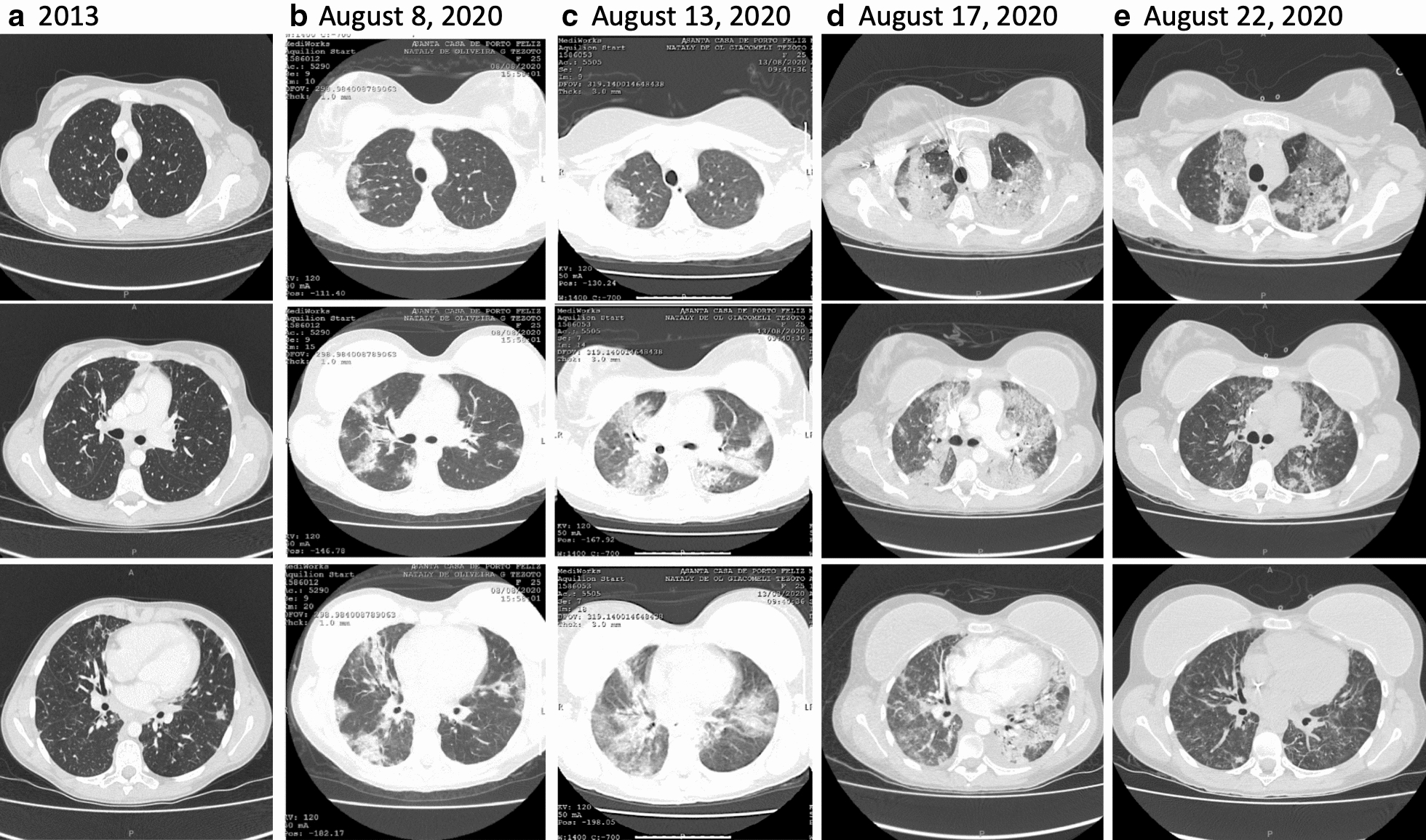
25-year old woman diagnosed with common variable immunodeficiency in 2013, developed severe COVID-19 that rapidly progressed to pneumonia presenting with multiple bilateral lung opacities that were both central and peripheral and presented as ground-glass and consolidation types involving all lobes, bilaterally. As blood oxygen saturation decayed and lung abnormalities were not responsive to large spectrum antibiotics and corticosteroids, patient was placed on mechanical ventilation and compassionate-use of approved COVID-19 convalescent donor plasma was introduced. The patient presented a rapid response to the approach and mechanical ventilation could be interrupted 24 h after first dose of COVID-19 convalescent donor plasma. As a whole, the patient received four doses of 200 mL convalescent plasma during a period of 6 days. There was rapid improvement of clinical status, with interruption of supplemental oxygen therapy after 6 days and reduction of lung abnormalities as evidence by sequential computed tomography scans.
This is a single patient report that adds to other few reports on common variable immunodeficiency and agammaglobulinemia, suggesting that COVID-19 convalescent donor plasma could be a valuable therapeutic approach to treat patients affected by dysgammaglobulinemias and presenting severe COVID-19.
常见变异型免疫缺陷是成人中最普遍的有症状的原发性免疫缺陷。受影响的患者无法对社区获得性传染病产生适当的体液免疫反应,最近的报告提供的数据支持这些患者对严重的SARS-CoV-2感染易感性增加。在这种情况下,输注新冠康复者血浆可能是一种有效的治疗策略。
一名25岁女性于2013年被诊断为常见变异型免疫缺陷,感染了严重的新冠病毒,迅速发展为肺炎,表现为双侧多发肺部混浊,中央和外周均有,呈磨玻璃样和实变样,累及双侧所有肺叶。由于血氧饱和度下降且肺部异常对广谱抗生素和皮质类固醇无反应,患者接受了机械通气,并使用了经批准的新冠康复者供体血浆进行同情用药。患者对该方法反应迅速,在首次输注新冠康复者供体血浆后24小时即可中断机械通气。总体而言,患者在6天内共接受了4剂200毫升康复者血浆。临床状况迅速改善,6天后中断补充氧气治疗,连续计算机断层扫描显示肺部异常减少。
这是一份单一患者报告,补充了其他关于常见变异型免疫缺陷和无丙种球蛋白血症的少数报告,表明新冠康复者供体血浆可能是治疗受异常球蛋白血症影响并患有严重新冠的患者的一种有价值的治疗方法。