Department of Nephrology, Osaka University Graduate School of Medicine, Suita, Japan.
Department of Nephrology, Nagoya City University Graduate School of Medical Sciences, Nagoya, Japan.
J Am Soc Nephrol. 2021 Mar;32(3):723-735. doi: 10.1681/ASN.2020050598. Epub 2021 Feb 5.
In patients on maintenance dialysis, cardiovascular mortality risk is remarkably high, which can be partly explained by severe coronary artery calcification (CAC). Hyperphosphatemia has been reported to be associated with the severity of CAC. However, the optimal phosphate range in patients on dialysis remains unknown. This study was planned to compare the effects on CAC progression of two types of noncalcium-based phosphate binders and of two different phosphate target ranges.
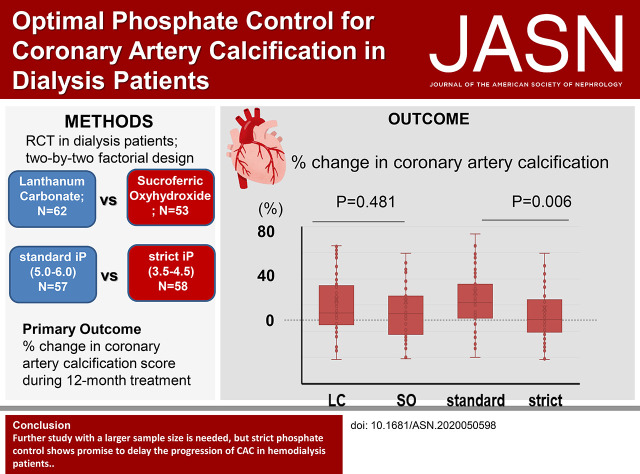
We conducted a randomized, open-label, multicenter, interventional trial with a two by two factorial design. A total of 160 adults on dialysis were enrolled and randomized to the sucroferric oxyhydroxide or lanthanum carbonate group, with the aim of reducing serum phosphate to two target levels (3.5-4.5 mg/dl in the strict group and 5.0-6.0 mg/dl in the standard group). The primary end point was percentage change in CAC scores during the 12-month treatment.
The full analysis set included 115 patients. We observed no significant difference in percentage change in CAC scores between the lanthanum carbonate group and the sucroferric oxyhydroxide group. On the other hand, percentage change in CAC scores in the strict group (median of 8.52; interquartile range, -1.0-23.9) was significantly lower than that in the standard group (median of 21.8; interquartile range, 10.0-36.1; =0.006). This effect was pronounced in older (aged 65-74 years) versus younger (aged 20-64 years) participants ( value for interaction =0.003). We observed a similar finding for the absolute change in CAC scores.
Further study with a larger sample size is needed, but strict phosphate control shows promise for delaying progression of CAC in patients undergoing maintenance hemodialysis.
Evaluate the New Phosphate Iron-Based Binder Sucroferric Oxyhydroxide in Dialysis Patients with the Goal of Advancing the Practice of EBM (EPISODE), jRCTs051180048.
在维持性透析患者中,心血管死亡率风险显著升高,这在一定程度上可以用严重的冠状动脉钙化(CAC)来解释。高磷血症与 CAC 的严重程度有关。然而,透析患者的最佳磷范围仍不清楚。本研究旨在比较两种非钙基磷结合剂和两种不同磷靶范围对 CAC 进展的影响。
我们进行了一项随机、开放标签、多中心、干预性试验,采用 2×2 析因设计。共纳入 160 名透析成人,并随机分为蔗糖铁氧羟化物或碳酸镧组,旨在将血清磷降低到两个目标水平(严格组 3.5-4.5mg/dl,标准组 5.0-6.0mg/dl)。主要终点是 12 个月治疗期间 CAC 评分的变化百分比。
全分析集包括 115 例患者。我们没有观察到碳酸钙组和蔗糖铁氧羟化物组 CAC 评分变化百分比有显著差异。另一方面,严格组 CAC 评分变化百分比(中位数 8.52;四分位距,-1.0-23.9)明显低于标准组(中位数 21.8;四分位距,10.0-36.1;=0.006)。这种影响在年龄较大(65-74 岁)与年龄较小(20-64 岁)的参与者中更为显著(交互值=0.003)。我们观察到 CAC 评分绝对值的变化也有类似的发现。
需要进一步进行更大样本量的研究,但严格的磷控制有望延缓维持性血液透析患者 CAC 的进展。
评估新型磷铁基结合剂蔗糖铁氧羟化物在透析患者中的应用,以推进 EBM 实践(EPISODE),jRCTs051180048。