West China Hospital of Sichuan University, Chengdu, China; University of Cincinnati, Ohio.
University of Cincinnati, Ohio.
J Am Acad Child Adolesc Psychiatry. 2021 Oct;60(10):1309-1318. doi: 10.1016/j.jaac.2020.11.023. Epub 2021 Feb 4.
Amygdala-ventrolateral prefrontal cortex (VLPFC) circuitry is disrupted in pediatric anxiety disorders, yet how selective serotonin reuptake inhibitors (SSRIs) affect this circuitry is unknown. We examined the impact of the SSRI escitalopram on functional connectivity (FC) within this circuit, and whether early FC changes predicted treatment response in adolescents with generalized anxiety disorder (GAD).
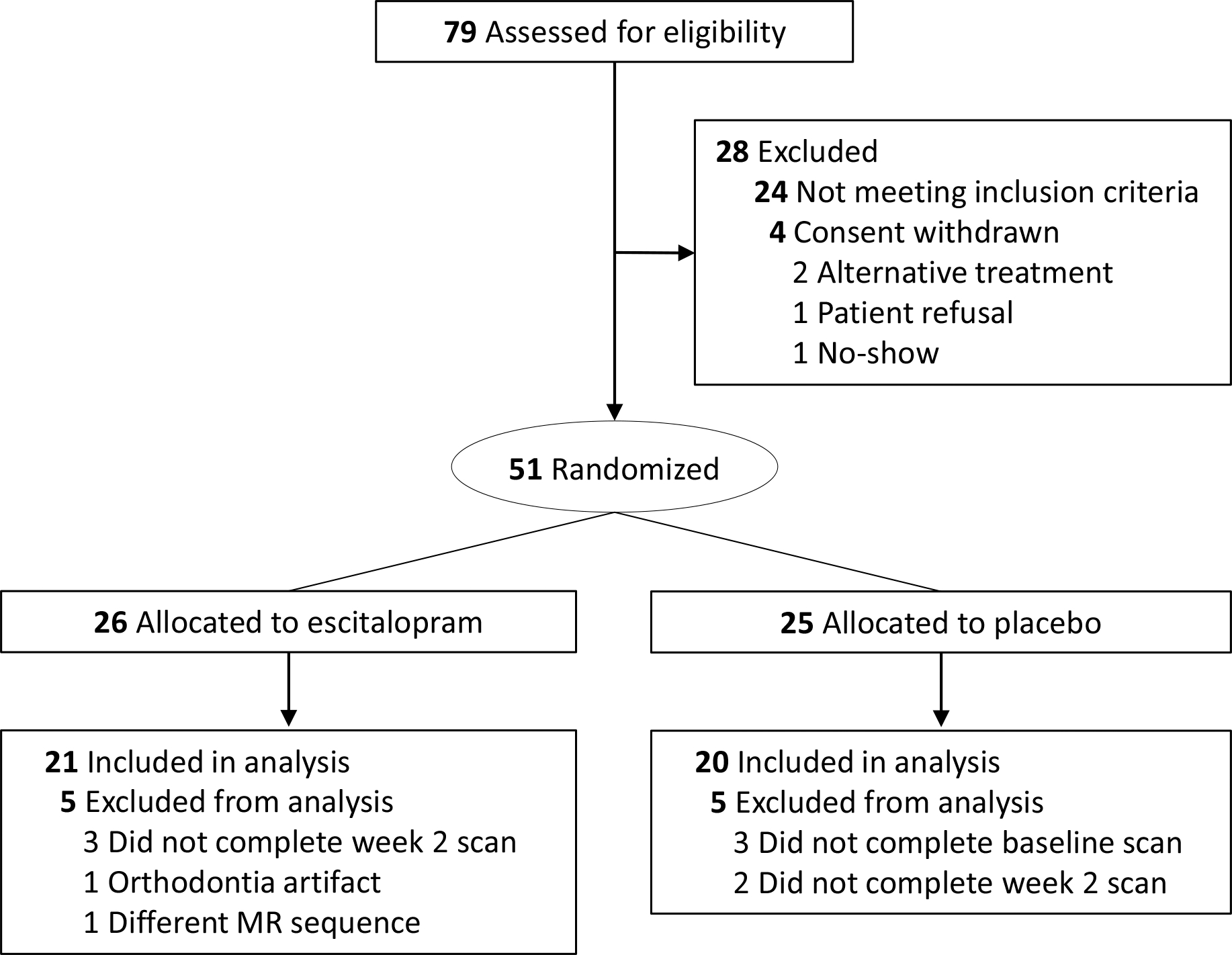
Resting-state functional magnetic resonance (MR) images were acquired before and after 2 weeks of treatment in 41 adolescents with GAD (12-17 years of age) who received double-blind escitalopram or placebo for 8 weeks. Change in amygdala-based whole-brain FC and anxiety severity were analyzed.
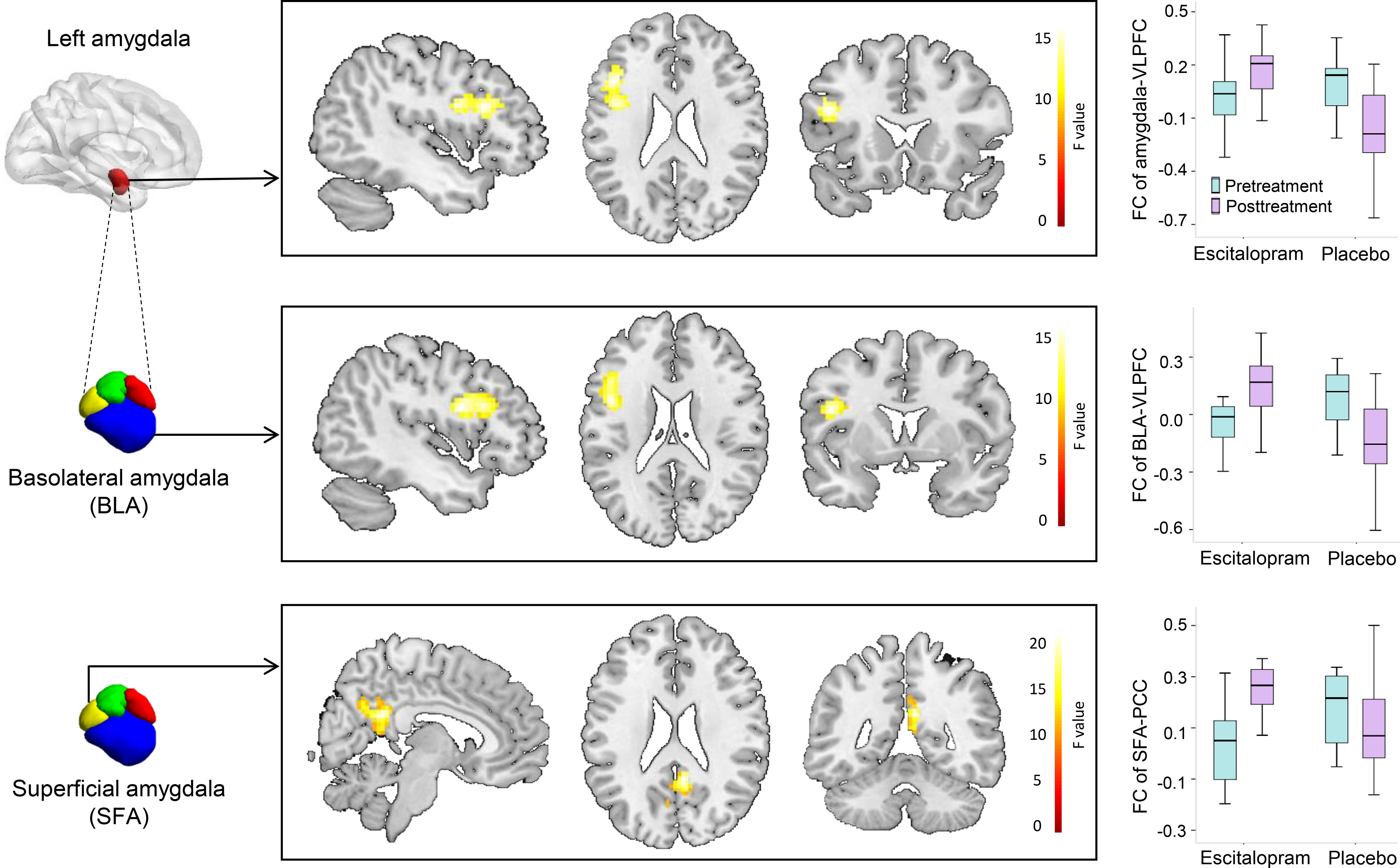
Controlling for age, sex, and pretreatment anxiety, escitalopram increased amygdala-VLPFC connectivity compared to placebo (F = 17.79, p = .002 FWE-corrected). This early FC change predicted 76.7% of the variability in improvement trajectory in patients who received escitalopram (p < .001) but not placebo (p = .169); the predictive power of early amygdala-VLPFC FC change significantly differed between placebo and escitalopram (p = .013). Furthermore, this FC change predicted improvement better than baseline FC or clinical/demographic characteristics. Exploratory analyses of amygdala subfields' FC revealed connectivity of left basolateral amygdala (BLA) -VLPFC (F = 19.64, p < .001 FWE-corrected) and superficial amygdala-posterior cingulate cortex (F = 22.92, p = .001 FWE-corrected) were also increased by escitalopram, but only BLA-VLPFC FC predicted improvement in anxiety over 8 weeks of treatment.
In adolescents with GAD, escitalopram increased amygdala-prefrontal connectivity within the first 2 weeks of treatment, and the magnitude of this change predicted subsequent clinical improvement. Early normalization of amygdala-VLPFC circuitry might represent a useful tool for identifying future treatment responders as well as a promising biomarker for drug development.
Neurofunctional Predictors of Escitalopram Treatment Response in Adolescents With Anxiety; https://www.clinicaltrials.gov/; NCT02818751.
杏仁核-腹外侧前额叶皮质(VLPFC)回路在儿科焦虑症中被破坏,但选择性 5-羟色胺再摄取抑制剂(SSRIs)如何影响该回路尚不清楚。我们研究了 SSRI 依地普仑对该回路中功能连接(FC)的影响,以及青少年广泛性焦虑症(GAD)中早期 FC 变化是否预测治疗反应。
41 名患有 GAD(12-17 岁)的青少年在接受 8 周的依地普仑或安慰剂双盲治疗的 2 周前和后进行了静息状态功能磁共振(MR)成像。分析了基于杏仁核的全脑 FC 和焦虑严重程度的变化。
控制年龄、性别和治疗前的焦虑,与安慰剂相比,依地普仑增加了杏仁核-VLPFC 连接(F=17.79,p=0.002 FWE 校正)。这种早期 FC 变化预测了接受依地普仑治疗的患者改善轨迹的 76.7%的可变性(p<0.001),但不预测安慰剂(p=0.169);早期杏仁核-VLPFC FC 变化的预测能力在安慰剂和依地普仑之间有显著差异(p=0.013)。此外,这种 FC 变化比基线 FC 或临床/人口统计学特征更好地预测了改善。对杏仁核亚区 FC 的探索性分析表明,左基底外侧杏仁核(BLA)-VLPFC(F=19.64,p<0.001 FWE 校正)和浅层杏仁核-后扣带回皮层(F=22.92,p=0.001 FWE 校正)的连接也被依地普仑增强,但只有 BLA-VLPFC FC 预测了 8 周治疗期间焦虑的改善。
在患有 GAD 的青少年中,依地普仑在治疗的前 2 周内增加了杏仁核-前额叶的连接,而这种变化的幅度预测了随后的临床改善。杏仁核-VLPFC 回路的早期正常化可能是识别未来治疗反应者的有用工具,也是药物开发的有前途的生物标志物。
依地普仑治疗青少年焦虑症的神经功能预测因子;https://www.clinicaltrials.gov/;NCT02818751。