Department of Neurosurgery, New Royal Infirmary, Edinburgh, UK.
Department of Neurosurgery, King's College Hospital, London, UK.
Acta Neurochir (Wien). 2021 Apr;163(4):1191-1198. doi: 10.1007/s00701-021-04735-0. Epub 2021 Feb 7.
Isolated acute bilateral foot drop due to degenerative spine disease is an extremely rare neurosurgical presentation, whilst the literature is rich with accounts of chronic bilateral foot drop occurring as a sequela of systemic illnesses. We present, to our knowledge, the largest case series of acute bilateral foot drop, with trauma and relevant systemic illness excluded.
Data from three different centres had been collected at the time of historic treatment, and records were subsequently reviewed retrospectively, documenting the clinical presentation, radiological level of compression, timing of surgery, and degree of neurological recovery.
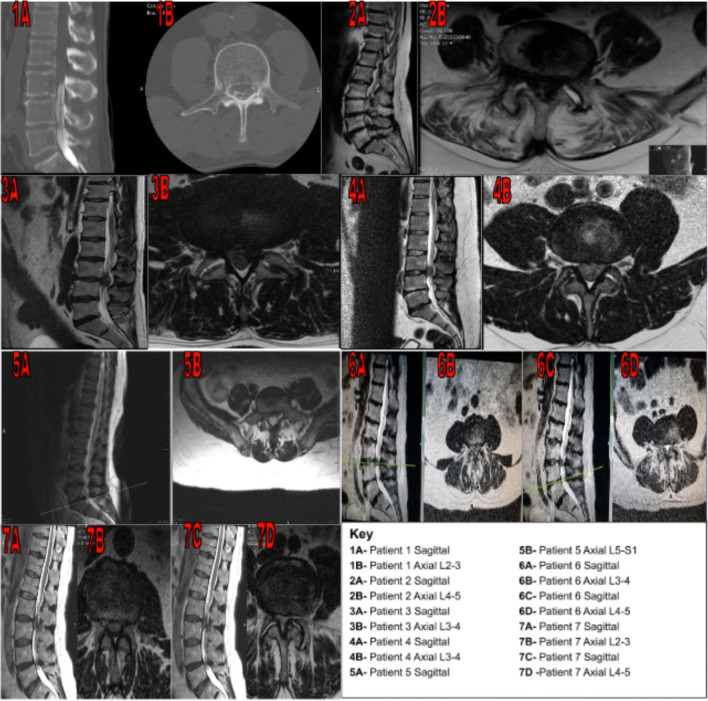
Seven patients are presented. The mean age at presentation was 52.1 years (range 41-66). All patients but one were male. All had a painful radiculopathic presentation. Relevant discopathy was observed from L2/3 to L5/S1, the commonest level being L3/4. Five were treated within 24 h of presentation, and two within 48 h. Three had concomitant cauda equina syndrome; of these, the first two made a full motor recovery, one by 6 weeks follow-up and the second on the same-day post-op evaluation. Overall, five out of seven cases had full resolution of their ankle dorsiflexion pareses. One patient with 1/5 power has not improved. Another with 1/5 weakness improved to normal on the one side and to 3/5 on the other.
When bilateral foot drop occurs acutely, we encourage the consideration of degenerative spinal disease. Relevant discopathy was observed from L2/3 to L5/S1; aberrant innervation may be at play. Cauda equina syndrome is not necessarily associated with acute bilateral foot drop. The prognosis seems to be pretty good with respect to recovery of the foot drop, especially if partial at presentation and if treated within 48 h.
孤立性急性双侧足下垂由于退行性脊柱疾病是一种极其罕见的神经外科表现,而文献中充满了慢性双侧足下垂作为全身疾病后遗症的报道。我们提出了,据我们所知,最大的急性双侧足下垂病例系列,排除了创伤和相关的全身疾病。
在历史治疗时收集了来自三个不同中心的数据,随后回顾性地审查了记录,记录了临床表现、压迫的放射学水平、手术时机和神经恢复程度。
提出了 7 例患者。发病时的平均年龄为 52.1 岁(范围 41-66 岁)。除 1 例外,所有患者均为男性。所有患者均表现为疼痛性神经根病。观察到从 L2/3 到 L5/S1 的相关椎间盘病,最常见的水平为 L3/4。5 例在发病后 24 小时内接受治疗,2 例在 48 小时内接受治疗。3 例伴有马尾综合征;其中前 2 例完全恢复运动功能,1 例在 6 周随访时,另 1 例在术后当天评估时。总体而言,7 例中有 5 例完全解决了踝背屈无力。1 例 1/5 肌力的患者没有改善。另 1 例 1/5 肌力的患者在一侧改善至正常,另一侧改善至 3/5。
当双侧足下垂急性发作时,我们鼓励考虑退行性脊柱疾病。观察到从 L2/3 到 L5/S1 的相关椎间盘病;异常神经支配可能起作用。马尾综合征不一定与急性双侧足下垂相关。如果部分表现且在 48 小时内治疗,足下垂的恢复预后似乎相当好。