Gonzalez-Cano Rafael, Montilla-García Ángeles, Perazzoli Gloria, Torres Jesús M, Cañizares Francisco J, Fernández-Segura Eduardo, Costigan Michael, Baeyens José M, Cobos Enrique J
Department of Pharmacology, Faculty of Medicine, University of Granada, Granada, Spain.
Institute of Neuroscience, Biomedical Research Center, University of Granada, Granada, Spain.
Front Pharmacol. 2021 Jan 21;11:613068. doi: 10.3389/fphar.2020.613068. eCollection 2020.
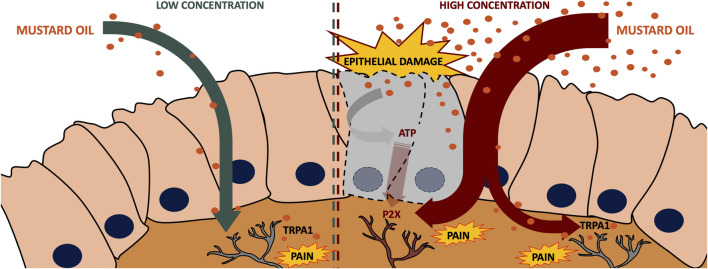
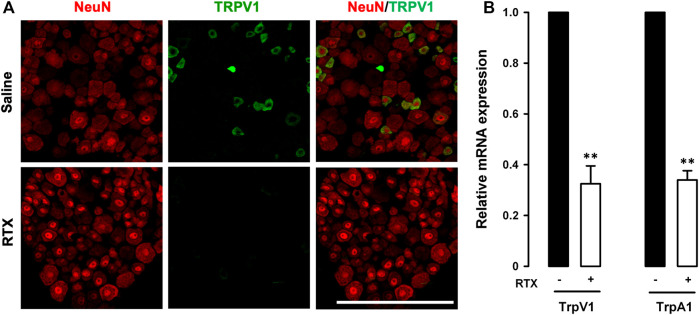
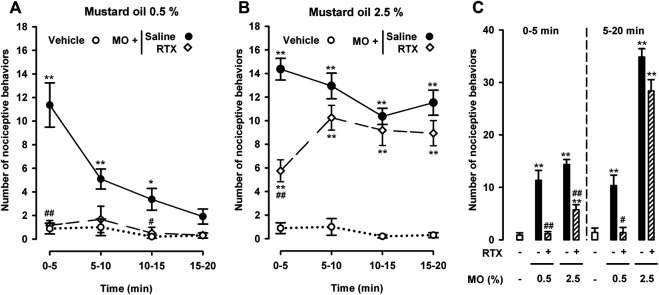
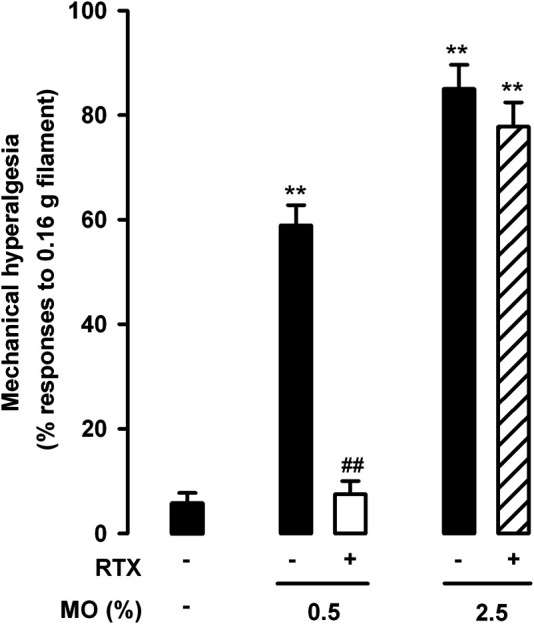
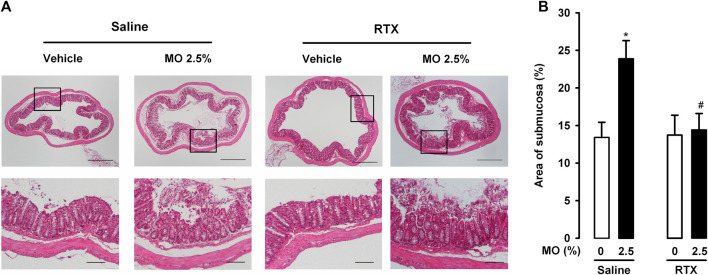
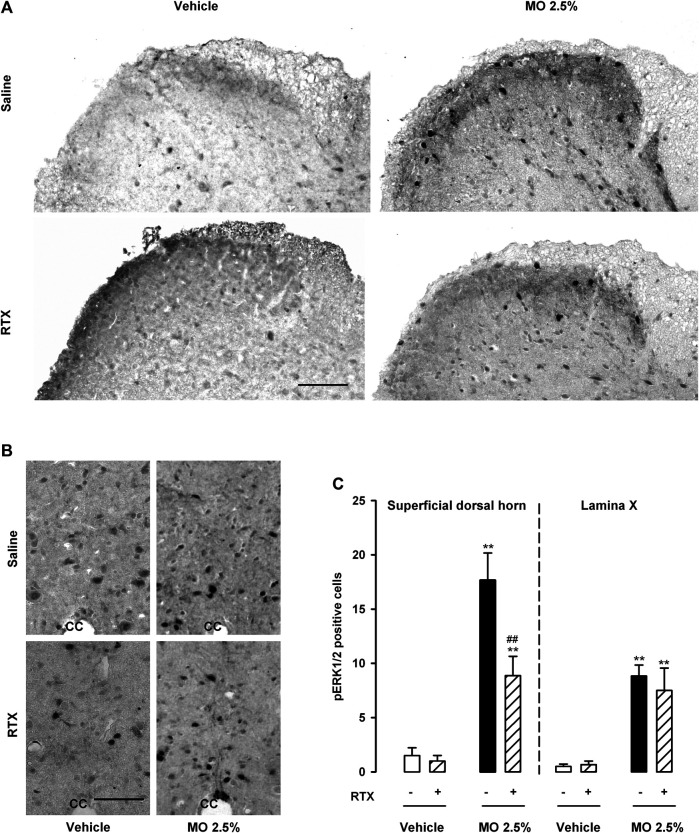
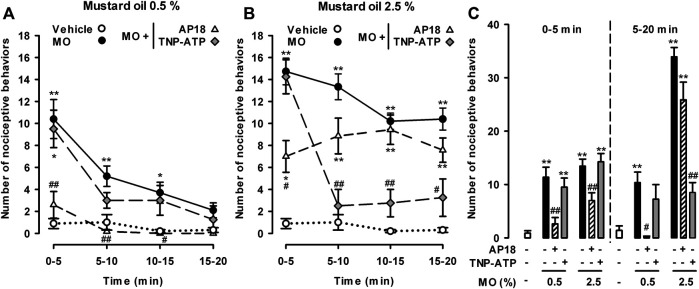
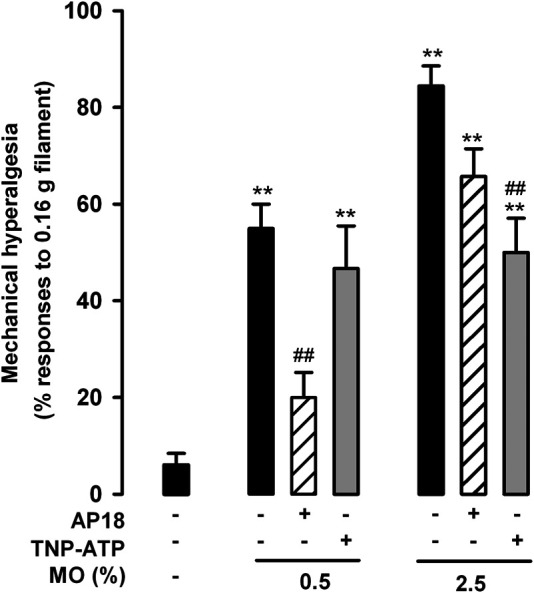
Both TRPA1 and purinergic P2X receptors have been proposed as potential targets for the treatment of visceral pain. We found that the intracolonic administration of a low dose mustard oil (0.5%), a well-known TRPA1 agonist, produced nociceptive responses and abdominal wall referred mechanical hyperalgesia, without inducing apparent tissue damage. Both nociceptive responses and referred hyperalgesia were abolished by the ablation of TRPV1-expressing neurons (and the consequent ablation of TRPA1+ nociceptors) by resiniferatoxin (RTX) treatment, and by the TRPA1 antagonist AP18. However, a higher dose of mustard oil (2.5%) damaged the colonic epithelium and induced pERK activation in the spinal cord, and these processes were clearly independent of TRPV1-expressing neurons ablated by RTX. This higher dose of mustard oil induced nociceptive responses and referred mechanical hyperalgesia which were insensitive or only slightly sensitive to resiniferatoxin or AP18, but were markedly reduced by the P2X antagonist TNP-ATP, which is known to inhibit nociceptive actions induced by ATP released from injured tissues. In conclusion, whereas a low dose of intracolonic mustard oil induces visceral pain in a manner fully dependent on TRPA1 actions, when a high dose of this chemical irritant is used, visceral pain becomes mostly independent of TRPA1 activation but clearly enhanced by ATP purportedly released by the damaged colonic epithelium. Therefore, TRPA1 inhibition is not sufficient to substantially decrease visceral pain during tissue injury, whereas purinergic antagonism appears to be a more effective strategy.
TRPA1和嘌呤能P2X受体都被认为是治疗内脏痛的潜在靶点。我们发现,结肠内给予低剂量芥子油(0.5%),一种众所周知的TRPA1激动剂,会产生伤害性反应和腹壁牵涉性机械性痛觉过敏,且不会引起明显的组织损伤。伤害性反应和牵涉性痛觉过敏都可通过树脂毒素(RTX)处理消除表达TRPV1的神经元(以及随之消除TRPA1+伤害感受器),以及通过TRPA1拮抗剂AP18消除。然而,较高剂量的芥子油(2.5%)会损伤结肠上皮并诱导脊髓中pERK激活,并且这些过程明显独立于被RTX消融的表达TRPV1的神经元。这种较高剂量的芥子油诱导的伤害性反应和牵涉性机械性痛觉过敏对树脂毒素或AP18不敏感或仅稍有敏感,但被P2X拮抗剂TNP-ATP显著降低,已知该拮抗剂可抑制由受损组织释放的ATP诱导的伤害性作用。总之,低剂量结肠内芥子油以完全依赖TRPA1作用的方式诱导内脏痛,而当使用高剂量这种化学刺激物时,内脏痛大多独立于TRPA1激活,但明显因受损结肠上皮据称释放的ATP而增强。因此,抑制TRPA1不足以在组织损伤期间大幅降低内脏痛,而嘌呤能拮抗作用似乎是一种更有效的策略。