Wiedmann Felix, Beyersdorf Christoph, Zhou Xiao-Bo, Kraft Manuel, Foerster Kathrin I, El-Battrawy Ibrahim, Lang Siegfried, Borggrefe Martin, Haefeli Walter E, Frey Norbert, Schmidt Constanze
Department of Cardiology, Heidelberg University, Heidelberg, Germany.
DZHK (German Center for Cardiovascular Research), Partner Site Heidelberg/Mannheim, Heidelberg University, Heidelberg, Germany.
Front Physiol. 2021 Jan 21;11:629421. doi: 10.3389/fphys.2020.629421. eCollection 2020.
Upregulation of the two-pore-domain potassium channel TASK-1 (hK 3.1) was recently described in patients suffering from atrial fibrillation (AF) and resulted in shortening of the atrial action potential. In the human heart, TASK-1 channels facilitate repolarization and are specifically expressed in the atria. In the present study, we tested the antiarrhythmic effects of the experimental ion channel inhibitor A293 that is highly affine for TASK-1 in a porcine large animal model of persistent AF.
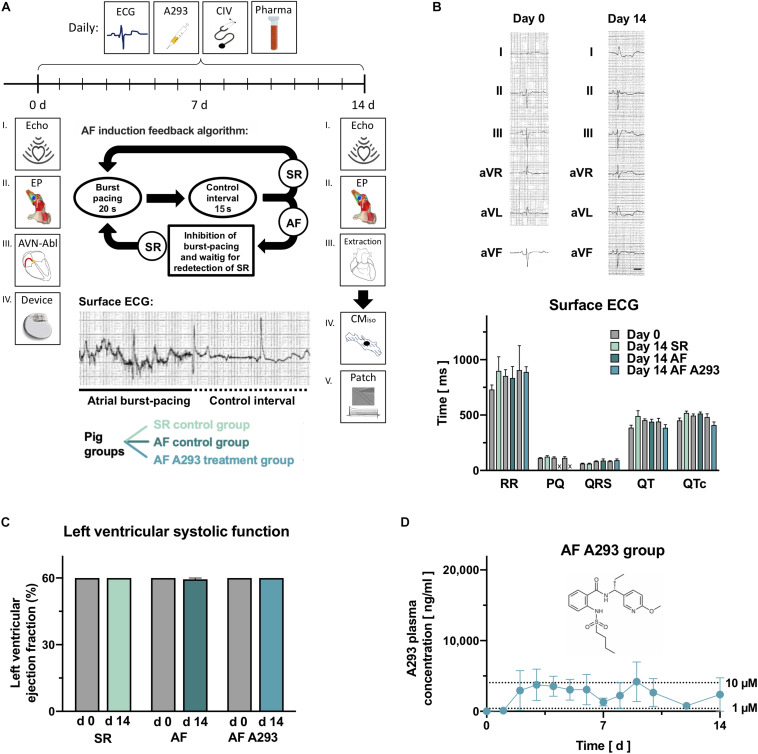
Persistent AF was induced in German landrace pigs by right atrial burst stimulation via implanted pacemakers using a biofeedback algorithm over 14 days. Electrophysiological and echocardiographic investigations were performed before and after the pharmacological treatment period. A293 was intravenously administered once per day. After a treatment period of 14 days, atrial cardiomyocytes were isolated for patch clamp measurements of currents and atrial action potentials. Hemodynamic consequences of TASK-1 inhibition were measured upon acute A293 treatment.
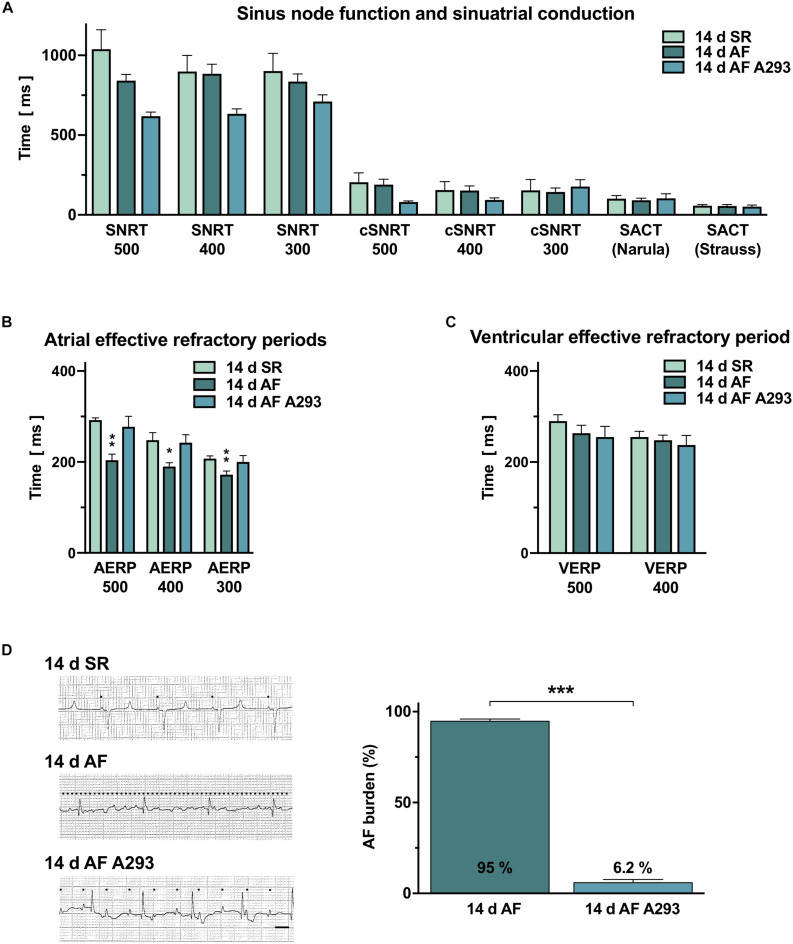
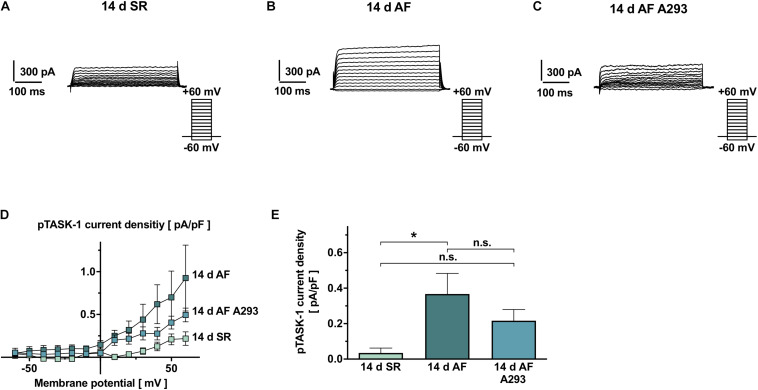
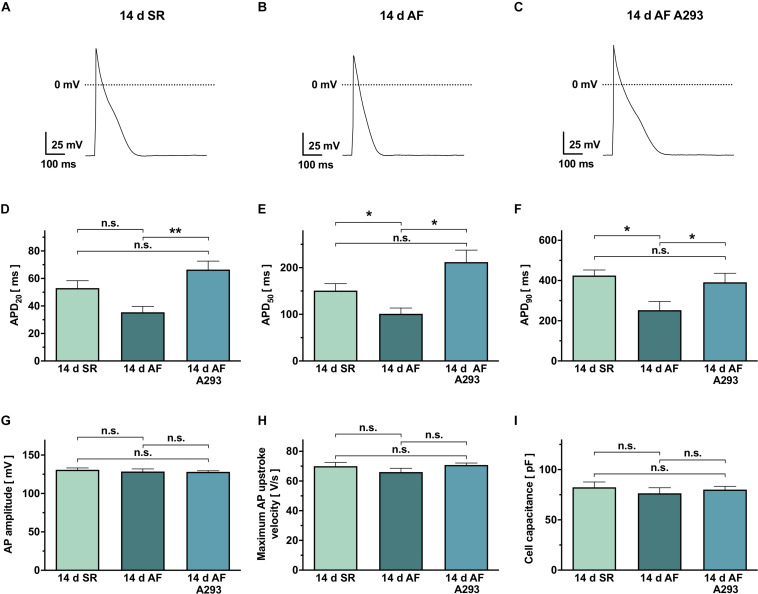
In animals with persistent AF, the A293 treatment significantly reduced the AF burden (6.5% vs. 95%; < 0.001). Intracardiac electrophysiological investigations showed that the atrial effective refractory period was prolonged in A293 treated study animals, whereas, the QRS width, QT interval, and ventricular effective refractory periods remained unchanged. A293 treatment reduced the upregulation of the TASK-1 current as well as the shortening of the action potential duration caused by AF. No central nervous side effects were observed. A mild but significant increase in pulmonary artery pressure was observed upon acute TASK-1 inhibition.
Pharmacological inhibition of atrial TASK-1 currents exerts antiarrhythmic effects that can be employed for rhythm control in a porcine model of persistent AF. Care has to be taken as TASK-1 inhibition may increase pulmonary artery pressure levels.
最近在心房颤动(AF)患者中发现了双孔钾通道TASK-1(hK3.1)的上调,这导致心房动作电位缩短。在人类心脏中,TASK-1通道促进复极化,并在心房中特异性表达。在本研究中,我们在猪的持续性AF大型动物模型中测试了对TASK-1具有高亲和力的实验性离子通道抑制剂A293的抗心律失常作用。
通过植入起搏器,使用生物反馈算法,在德国长白猪的右心房进行14天的爆发刺激,诱导持续性AF。在药物治疗期前后进行电生理和超声心动图检查。A293每天静脉注射一次。经过14天的治疗期后,分离心房心肌细胞进行膜片钳电流和心房动作电位测量。在急性A293治疗时测量TASK-1抑制的血流动力学后果。
在持续性AF动物中,A293治疗显著降低了AF负担(6.5%对95%;P<0.001)。心内电生理检查显示,A293治疗的研究动物心房有效不应期延长,而QRS波宽度、QT间期和心室有效不应期保持不变。A293治疗减少了TASK-1电流的上调以及AF引起的动作电位时程缩短。未观察到中枢神经副作用。急性TASK-1抑制时观察到肺动脉压轻度但显著升高。
心房TASK-1电流的药理学抑制发挥抗心律失常作用,可用于猪持续性AF模型的节律控制。必须注意的是,TASK-1抑制可能会增加肺动脉压水平。