Reid Jane M, Arcese Peter, Nietlisbach Pirmin, Wolak Matthew E, Muff Stefanie, Dickel Lisa, Keller Lukas F
Centre for Biodiversity Dynamics NTNU Trondheim Norway.
School of Biological Sciences University of Aberdeen Aberdeen UK.
Evol Lett. 2021 Jan 15;5(1):48-60. doi: 10.1002/evl3.214. eCollection 2021 Feb.
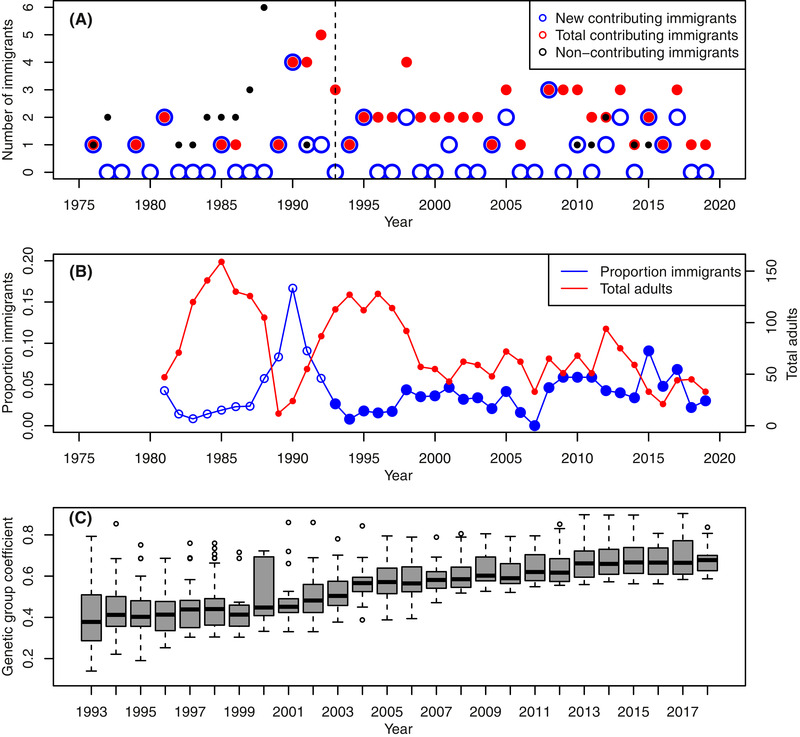
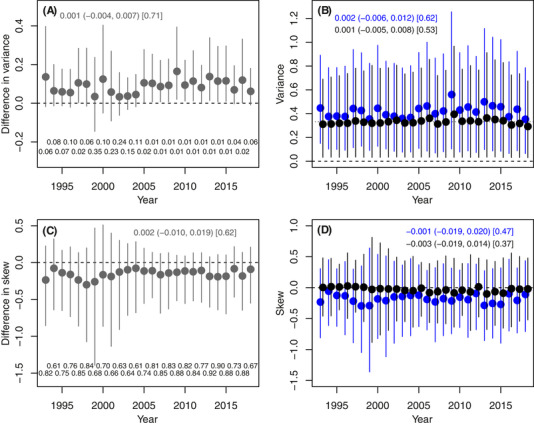
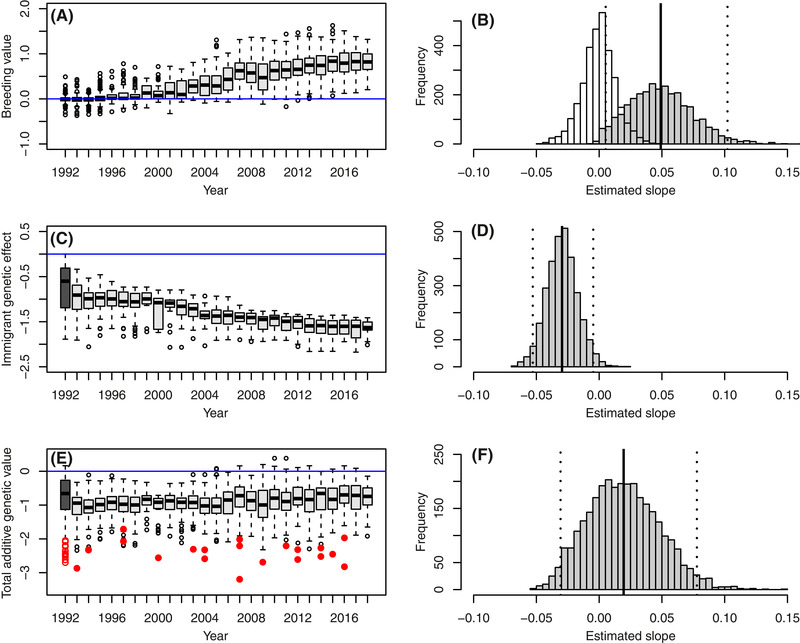
Ongoing adaptive evolution, and resulting "evolutionary rescue" of declining populations, requires additive genetic variation in fitness. Such variation can be increased by gene flow resulting from immigration, potentially facilitating evolution. But, gene flow could in fact constrain rather than facilitate local adaptive evolution if immigrants have low additive genetic values for local fitness. Local migration-selection balance and micro-evolutionary stasis could then result. However, key quantitative genetic effects of natural immigration, comprising the degrees to which gene flow increases the total local additive genetic variance yet counteracts local adaptive evolutionary change, have not been explicitly quantified in wild populations. Key implications of gene flow for population and evolutionary dynamics consequently remain unclear. Our quantitative genetic analyses of long-term data from free-living song sparrows () show that mean breeding value for local juvenile survival to adulthood, a major component of fitness, increased across cohorts more than expected solely due to drift. Such micro-evolutionary change should be expected given nonzero additive genetic variance and consistent directional selection. However, this evolutionary increase was counteracted by negative additive genetic effects of recent immigrants, which increased total additive genetic variance but prevented a net directional evolutionary increase in total additive genetic value. These analyses imply an approximate quantitative genetic migration-selection balance in a major fitness component, and hence demonstrate a key mechanism by which substantial additive genetic variation can be maintained yet decoupled from local adaptive evolutionary change.
持续的适应性进化以及由此对数量下降种群的“进化拯救”需要适合度上的加性遗传变异。这种变异可通过移民导致的基因流动而增加,这可能会促进进化。但是,如果移民对于当地适合度的加性遗传值较低,那么基因流动实际上可能会限制而非促进当地的适应性进化。这样就可能导致局部迁移 - 选择平衡和微进化停滞。然而,自然移民的关键数量遗传效应,包括基因流动增加当地总加性遗传方差但抵消当地适应性进化变化的程度,在野生种群中尚未得到明确量化。因此,基因流动对种群和进化动态的关键影响仍不明确。我们对自由生活的歌带鹀()长期数据的数量遗传分析表明,当地幼鸟存活至成年的平均育种值(适合度的一个主要组成部分)在各代之间的增加幅度超过了仅由遗传漂变所预期的幅度。鉴于存在非零的加性遗传方差和一致的定向选择,这种微进化变化是可以预期的。然而,这种进化增加被近期移民的负加性遗传效应所抵消,这些移民增加了总加性遗传方差,但阻止了总加性遗传值的净定向进化增加。这些分析意味着在一个主要适合度组成部分中存在近似的数量遗传迁移 - 选择平衡,因此证明了一种关键机制,通过该机制可以维持大量的加性遗传变异,但使其与当地适应性进化变化脱钩。