Dorantes-Acosta Elisa, Ávila-Montiel Diana, Klünder-Klünder Miguel, Juárez-Villegas Luis, Márquez-González Horacio
Biobanco de Investigación en Células Leucémicas, Hospital Infantil de México Federico Gómez, México City, Mexico.
Subdirección de Investigación, Hospital Infantil de México Federico Gómez, México City, Mexico.
Front Oncol. 2021 Jan 21;10:608282. doi: 10.3389/fonc.2020.608282. eCollection 2020.
The pandemic caused by the novel severe acute respiratory syndrome coronavirus 2 (SARS-CoV-2) has affected all age groups, including the pediatric population, in 3-5% of all cases. We performed a meta-analysis to understand the survival and associated complications in pediatric cancer patients as well as their hospitalization, intensive care, and ventilation care (supplemental oxygen/endotracheal intubation) needs.
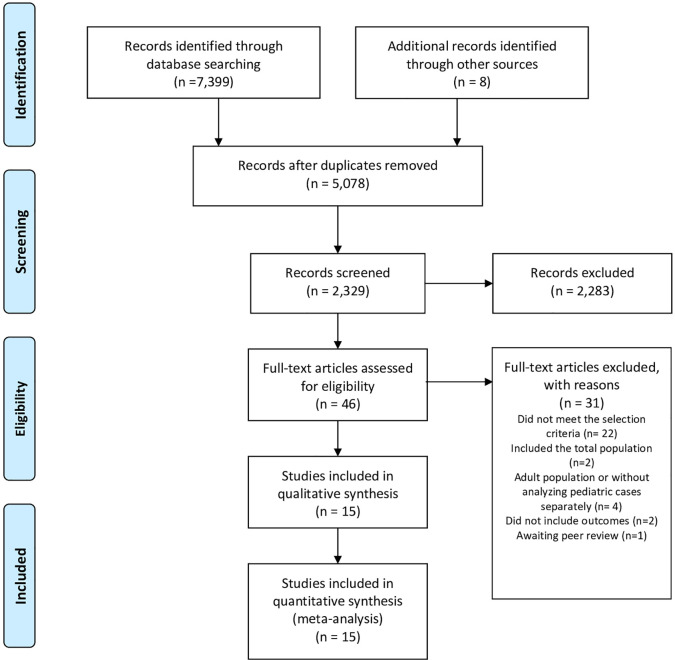
A systematic search was performed using MEDLINE, TRIP Database, International Clinical Trials Registry Platform (WHO), The Cochrane Library, Wiley, LILACS, and Google Scholar. Additionally, a search using the snowball method was performed in , , , , , , , and . Searches were conducted until July 18, 2020. A total of 191 cancer patients with coronavirus disease 2019 (COVID-19) were integrated from 15 eligible studies. In a sub-analysis, patients were stratified into two groups: hematological cancer and solid tumors. Outcome measures were overall survival, risk of hospitalized or needing intensive care, and need for ventilatory support in any modality. The random effects statistical analysis was performed with Cochran's chi square test. The odds ratio (OR) and heterogeneity were calculated using the I test.
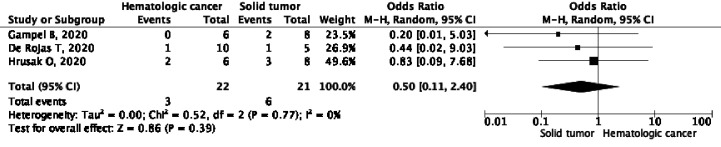
The overall survival was 99.4%. There were no statistically significant differences in the risk of hospitalization between hematological malignancies and solid tumors (95% confidence interval [CI] 0.48-18.3; OR = 2.94). The risk of being admitted to the intensive care unit was also not different between hematological malignancies and other tumors (95% CI 0.35-5.81; OR = 1.42). No differences were found for the need of ventilatory support (95% CI 0.14-3.35; OR = 0.68). Although all the studies were cross-sectional, the mortality of these patients was 0.6% at the time of analysis.
In the analyzed literature, survival in the studied group of patients with COVID-19 was very high. Suffering from hematological neoplasia or other solid tumors and COVID-19 was not a risk factor in children with cancer for the analyzed outcomes.
新型严重急性呼吸综合征冠状病毒2(SARS-CoV-2)引发的大流行已影响到所有年龄组,包括儿科人群,在所有病例中占3%-5%。我们进行了一项荟萃分析,以了解儿科癌症患者的生存情况及相关并发症,以及他们的住院、重症监护和通气护理(补充氧气/气管插管)需求。
使用MEDLINE、TRIP数据库、国际临床试验注册平台(世界卫生组织)、考克兰图书馆、威利、拉丁美洲和加勒比地区卫生科学数据库以及谷歌学术进行系统检索。此外,还使用滚雪球法在[具体未提及的地方]进行了检索。检索持续到2020年7月18日。从15项符合条件的研究中纳入了总共191例患有2019冠状病毒病(COVID-19)的癌症患者。在亚分析中,患者被分为两组:血液系统癌症和实体瘤。结局指标为总生存、住院或需要重症监护的风险以及任何方式的通气支持需求。采用Cochran卡方检验进行随机效应统计分析。使用I检验计算比值比(OR)和异质性。
总生存率为99.4%。血液系统恶性肿瘤和实体瘤之间的住院风险无统计学显著差异(95%置信区间[CI]0.48-18.3;OR = 2.94)。血液系统恶性肿瘤和其他肿瘤之间进入重症监护病房的风险也无差异(95% CI 0.35-5.81;OR = 1.42)。通气支持需求方面未发现差异(95% CI 0.14-3.35;OR = 0.68)。尽管所有研究均为横断面研究,但在分析时这些患者的死亡率为0.6%。
在所分析的文献中,研究的COVID-19患者组的生存率非常高。患有血液系统肿瘤或其他实体瘤以及COVID-19并非所分析结局中癌症儿童的危险因素。