Xu Ze-Yue, Guo Hong-Li, Li Ling, Zhang Min, Jing Xia, Xu Ze-Jun, Qiu Jin-Chun, Lu Xiao-Peng, Ding Xuan-Sheng, Chen Feng, Xu Jing
Department of Pharmacy, Children's Hospital of Nanjing Medical University, Nanjing, China.
School of Basic Medicine and Clinical Pharmacy, China Pharmaceutical University, Nanjing, China.
Front Pediatr. 2021 Jan 20;8:599044. doi: 10.3389/fped.2020.599044. eCollection 2020.
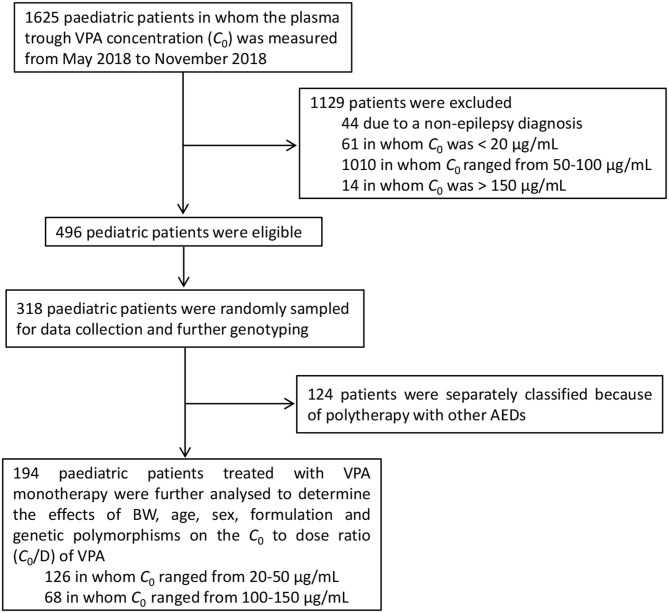
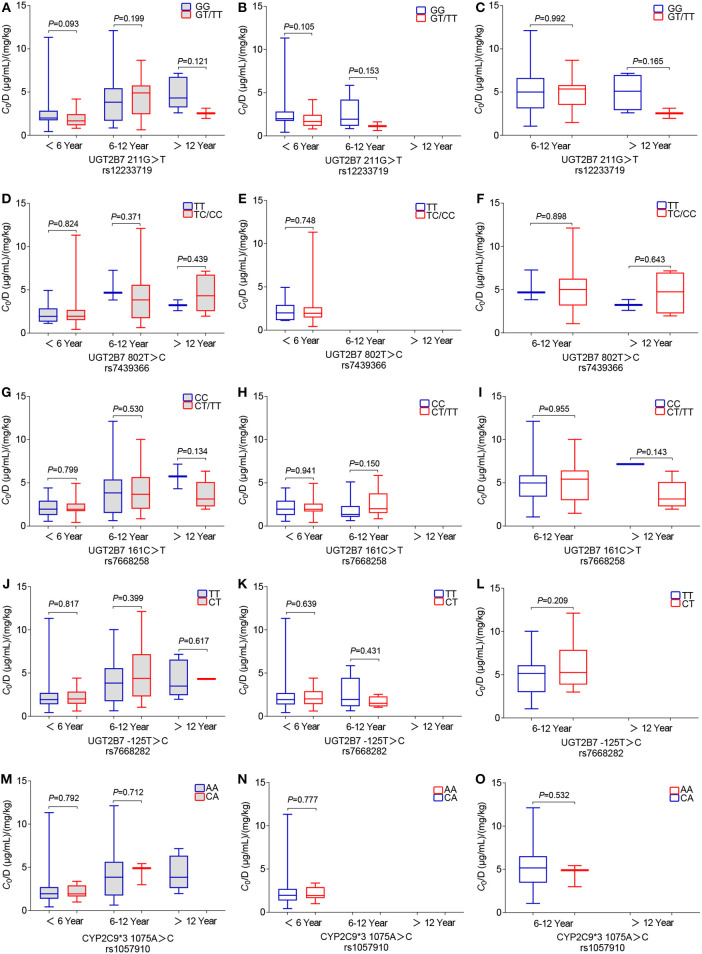
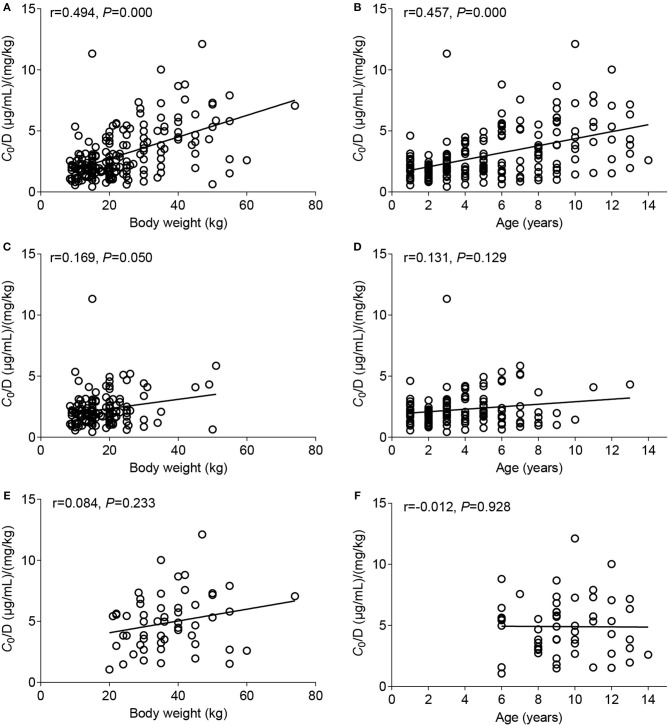
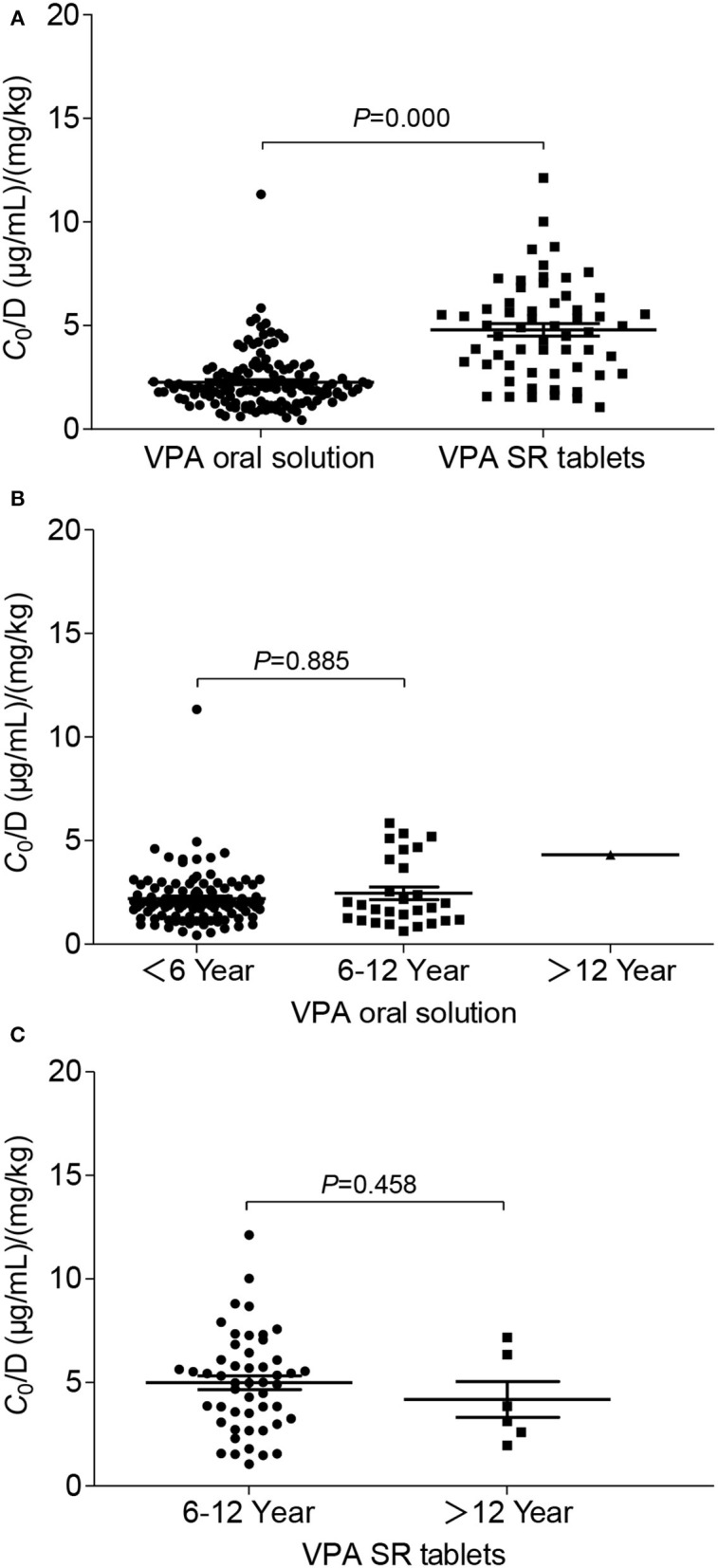
This study was conducted to evaluate the potential genetic and non-genetic factors contributing to plasma trough concentration-to-dose ( /) ratio of valproic acid (VPA) in pediatric patients with epilepsy. A single-center, retrospective cohort study was performed by collecting data from 194 children aged 1-14 years between May 2018 and November 2018. The oral solution ( = 135) group and the sustained-release (SR) tablet group ( = 59) were defined, and the plasma VPA was measured. Twenty-six single-nucleotide polymorphisms (SNPs) were chosen for genotyping with the MassARRAY system. A multiple logistic regression model was used for data analysis. Body weight (BW) and age were positively correlated with the / ratio in 194 patients, but the positive correlation disappeared after the patients were divided into oral solution and SR tablet subgroups. The average / ratio was significantly increased by 2.11-fold ( = 0.000) in children who took VPA SR tablets compared with children who were administered VPA oral solutions. No significant association between genetic variants and the / ratio was found, even for the five well-studied SNPs, namely G211T, C802T, C161T, T125C, and A1075C. However, a significant association between the / ratio and Del>A (rs144486213) was observed in the VPA oral solution group, but not in the VPA SR tablet group. The dosage forms of sodium valproate, rather than BW, age, or genetic polymorphisms, significantly affected the VPA / ratios in pediatric patients with epilepsy. Based on our findings, switching the dosage form between solution and SR tablet should be performed cautiously. Total daily dose adjustment should be considered, and the plasma concentration, seizure-control effect, and adverse drug reaction should also be monitored very closely.
本研究旨在评估导致癫痫患儿丙戊酸(VPA)血药谷浓度与剂量(/)比值的潜在遗传和非遗传因素。通过收集2018年5月至2018年11月期间194名1 - 14岁儿童的数据进行了一项单中心回顾性队列研究。定义了口服溶液组(= 135)和缓释(SR)片剂组(= 59),并测量了血浆VPA。选择26个单核苷酸多态性(SNP)用MassARRAY系统进行基因分型。采用多元逻辑回归模型进行数据分析。194例患者的体重(BW)和年龄与/比值呈正相关,但将患者分为口服溶液组和SR片剂亚组后,这种正相关消失。与服用VPA口服溶液的儿童相比,服用VPA SR片剂的儿童平均/比值显著增加了2.11倍(= 0.000)。即使对于五个研究充分的SNP,即G211T、C802T、C161T、T125C和A1075C,也未发现基因变异与/比值之间存在显著关联。然而,在VPA口服溶液组中观察到/比值与Del>A(rs144486213)之间存在显著关联,但在VPA SR片剂组中未观察到。丙戊酸钠的剂型而非BW、年龄或基因多态性显著影响癫痫患儿的VPA /比值。基于我们的研究结果,溶液剂和SR片剂之间的剂型转换应谨慎进行。应考虑调整每日总剂量,并且还应密切监测血浆浓度、癫痫控制效果和药物不良反应。