Chen Guang-Lei, Xiao Liang, Xia Qiu-Lin, Wang Yu, Yuan Jia-Hui, Chen Hao, Wang Shen-Qiang, Zhu Yi-Yong
Jiangsu Collaborative Innovation Center for Solid Organic Waste Resource Utilization, College of Resources and Environmental Science, Nanjing Agricultural University, Nanjing 210095, China.
State Key Laboratory of Soil and Sustainable Agriculture, Changshu National Agro-Ecosystem Observation and Research Station, Institute of Soil Science, Chinese Academy of Sciences, Nanjing 210008, China.
ACS Omega. 2021 Jan 18;6(4):3259-3266. doi: 10.1021/acsomega.0c05748. eCollection 2021 Feb 2.
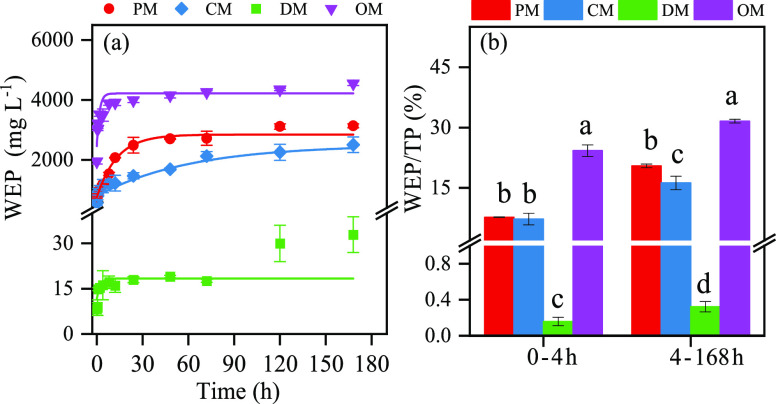
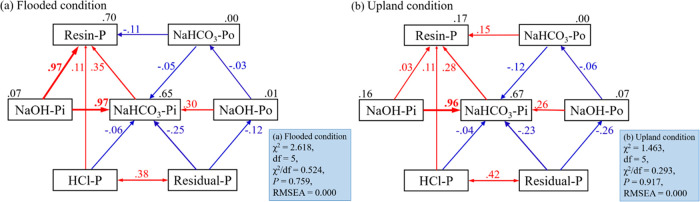
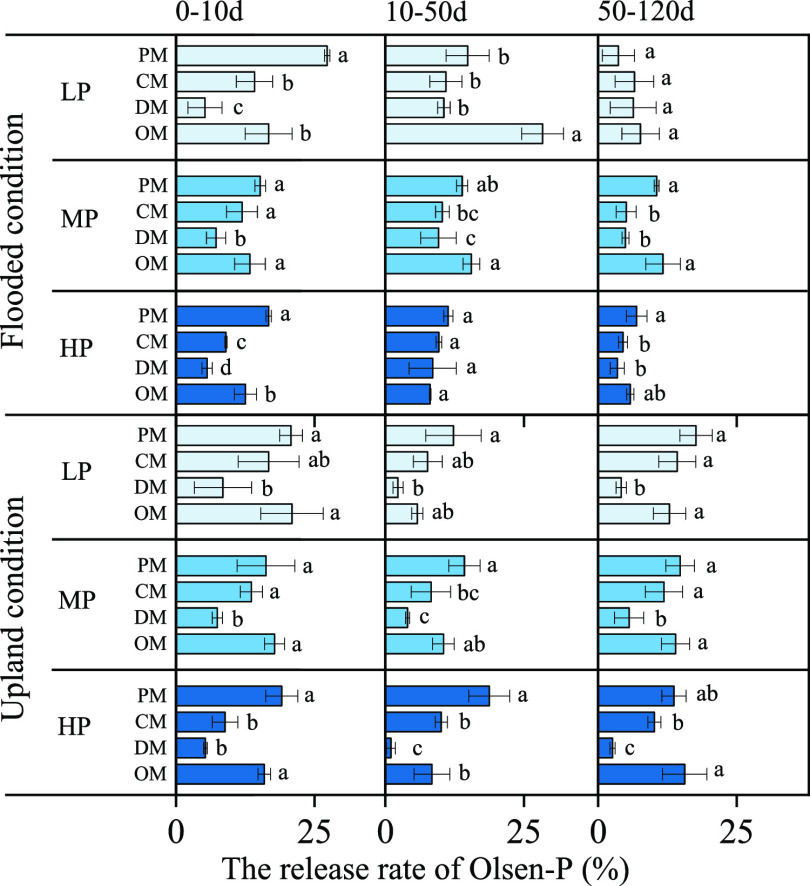
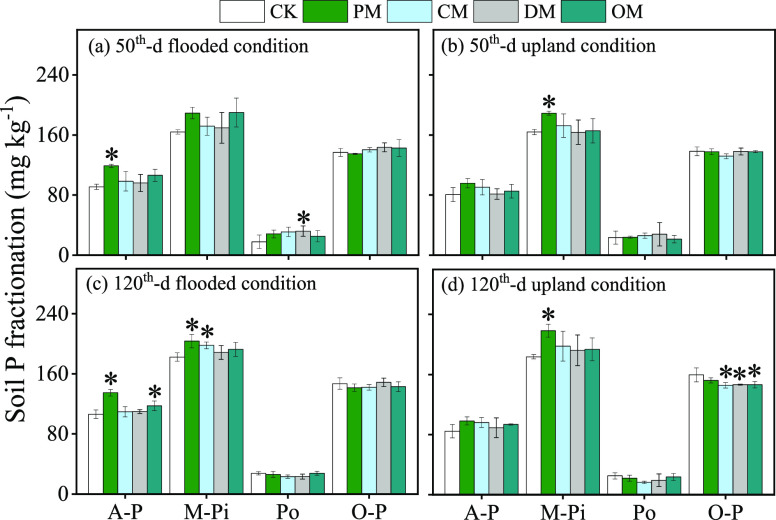
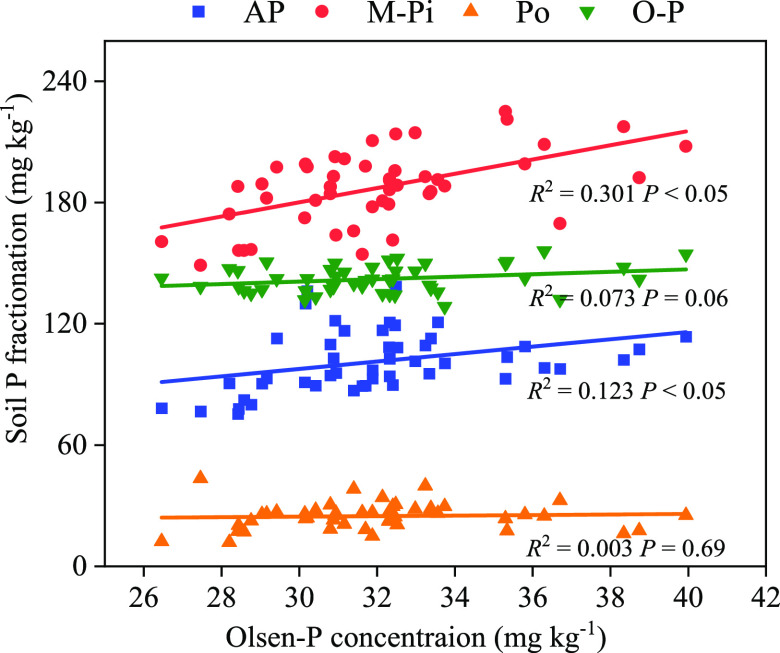
Phosphorus (P) is an essential nutrient for crop production, and animal manures are rich in P. When using animal manures as alternatives to synthetic fertilizers, it is important to know the kinetics of P release from different animal manures and the forms, amounts, and dynamics of P in manure-treated soils. We chose four types of manure, viz., pig manure (PM), chicken manure (CM), dairy manure (DM), and commercial organic compost (OM), and evaluated the P release rate and availability in water solution and flooded/upland paddy soils. The WEP/total P (TP) and the water-extractable P (WEP) concentrations are highest for OM with the order: OM > PM > CM > DM. An increase in soil Olsen-P concentration was observed for the addition of manure with a varying application rate of P from low to moderate to high. The release capacity of Olsen-P in flooded conditions was higher than that in upland conditions. Under the flooded soil, PM and OM have faster release rates than CM and OM in the upland soil. Moreover, PM significantly increased available P by 29% in the flooded paddy soil while moderately inorganic P increased by 17% in the upland paddy soil. Olsen-P has a significant linear relationship with available P (Resin-P + NaHCO-Pi; = 0.104; < 0.01) and moderately inorganic P (NaOH-Pi + HCl-P; = 0.286; < 0.01). The structural equation model showed that the organic input was beneficial to the conversion of moderately inorganic P to available P. Our results indicate that PM amendment promotes the release of available P in paddy soil.
磷(P)是作物生产必需的养分,动物粪便中富含磷。在使用动物粪便替代合成肥料时,了解不同动物粪便中磷的释放动力学以及粪便处理土壤中磷的形态、含量和动态变化非常重要。我们选择了四种粪便,即猪粪(PM)、鸡粪(CM)、奶牛粪(DM)和商业有机堆肥(OM),并评估了它们在水溶液以及淹水/旱作稻田土壤中的磷释放速率和有效性。OM的水溶性有效磷/总磷(TP)和水溶性磷(WEP)浓度最高,顺序为:OM>PM>CM>DM。随着磷施用量从低到中再到高变化,添加粪便后土壤 Olsen-P 浓度增加。淹水条件下 Olsen-P 的释放能力高于旱作条件。在淹水土壤中,PM 和 OM 的释放速率比旱作土壤中的 CM 和 OM 快。此外,PM 使淹水水稻土中的有效磷显著增加了 29%,而使旱作水稻土中的中度无机磷增加了 17%。Olsen-P 与有效磷(树脂磷 + 碳酸氢钠磷;r = 0.104;P < 0.01)和中度无机磷(氢氧化钠磷 + 盐酸磷;r = 0.286;P < 0.01)具有显著的线性关系。结构方程模型表明,有机投入有利于中度无机磷向有效磷的转化。我们的结果表明,添加猪粪促进了稻田土壤中有效磷的释放。