Khan Aziz
Stanford Cancer Institute, School of Medicine, Stanford University, Stanford, United States.
Elife. 2021 Feb 8;10:e65604. doi: 10.7554/eLife.65604.
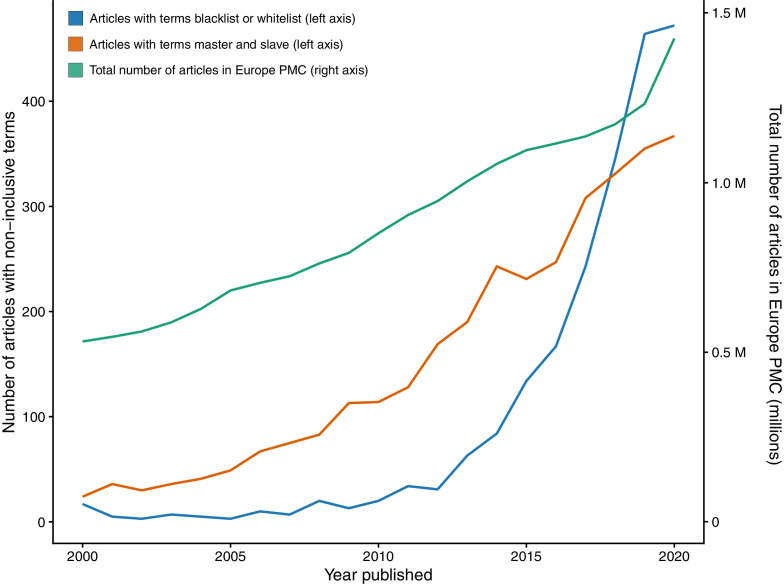
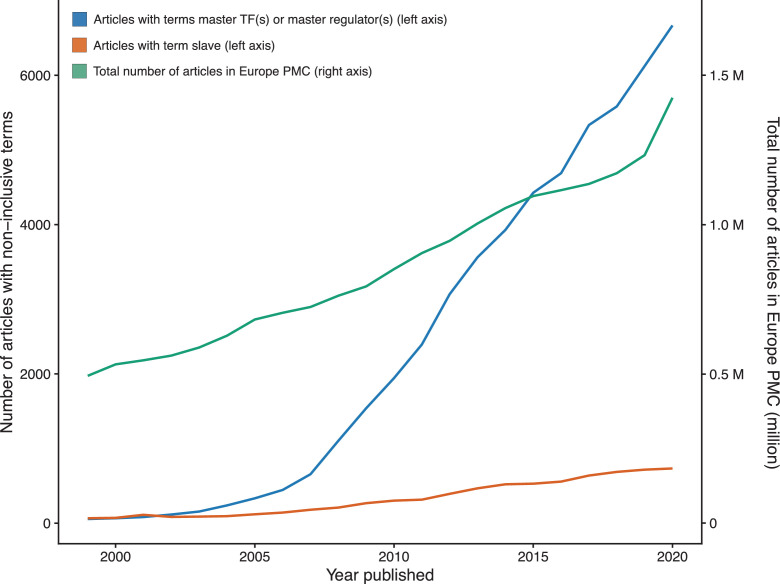
Since the Black Lives Matter movement rose to mainstream prominence, the academic enterprise has started recognizing the systematic racism present in science. However, there have been relatively few efforts to make sure that the language used to communicate science is inclusive. Here, I quantify the number of research articles published between 2000 and 2020 that contained non-inclusive terms with racial connotations, such as "blacklist" and "whitelist", or "master" and "slave". This reveals that non-inclusive language is being increasingly used in the life sciences literature, and I urge the global academic community to expunge these archaic terms to make science inclusive for everyone.
自“黑人的命也是命”运动成为主流关注焦点以来,学术领域已开始认识到科学中存在的系统性种族主义。然而,在确保用于交流科学的语言具有包容性方面,相关努力相对较少。在此,我对2000年至2020年间发表的研究文章中包含具有种族内涵的非包容性词汇(如“黑名单”“白名单”,或“主人”“奴隶”)的数量进行了量化。这表明非包容性语言在生命科学文献中使用得越来越多,我敦促全球学术界摒弃这些陈旧词汇,以使科学对每个人都具有包容性。