Pavone Vito, de Cristo Claudia, Vescio Andrea, Lucenti Ludovico, Sapienza Marco, Sessa Giuseppe, Pavone Piero, Testa Gianluca
Department of General Surgery and Medical Surgical Specialties, Section of Orthopaedics and Traumatology, University Hospital Policlinico-Vittorio Emanuele, University of Catania, 95123 Catania, Italy.
Department of Clinical and Experimental Medicine, Section of Pediatrics and Child Neuropsychiatry, University of Catania, 95123 Catania, Italy.
Children (Basel). 2021 Feb 4;8(2):104. doi: 10.3390/children8020104.
Developmental dysplasia of the hip (DDH) is one of the most common pediatric conditions. The current gold-standard treatment for children under six months of age with a reducible hip is bracing, but the orthopedic literature features several splint options, and each one has many advantages and disadvantages. The aim of this review is to analyze the available literature to document the up-to-date evidence on DDH conservative treatment.
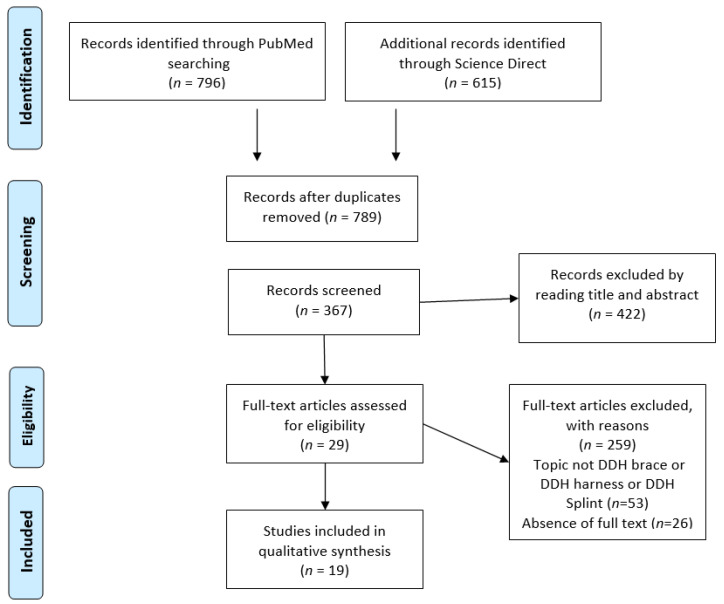
A systematic review of PubMed and Science Direct databases was performed by two independent authors (C.d.C. and A.V.) using the keywords "developmental dysplasia hip", "brace", "harness", "splint", "abduction brace" to evaluate studies of any level of evidence that reported clinical or preclinical results and dealt with conservative DDH treatment. The result of every stage was reviewed and approved by the senior investigators (V.P. and G.T.).
A total of 1411 articles were found. After the exclusion of duplicates, 367 articles were selected. At the end of the first screening, following the previously described selection criteria, we selected 29 articles eligible for full text reading. The included articles mainly focus on the Pavlik harness, Frejka, and Tubingen among the dynamic splint applications as well as the rhino-style brace, Ilfeld and generic abduction brace among the static splint applications. The main findings of the included articles were summarized.
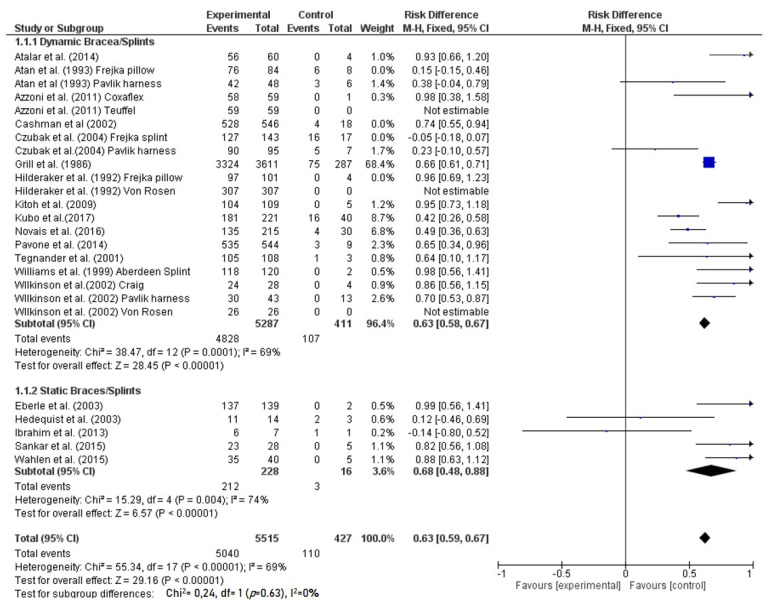
Dynamic splinting for DDH represents a valid therapeutic option in cases of instability and dislocation, especially if applied within 4-5 months of life. Dynamic splinting has a low contraindication. Static bracing is an effective option too, but only for stable hips or residual acetabular dysplasia.
发育性髋关节发育不良(DDH)是最常见的儿科疾病之一。目前,对于6个月以下可复位髋关节患儿的金标准治疗方法是使用支具,但骨科文献中有多种夹板可供选择,且每种都有诸多优缺点。本综述的目的是分析现有文献,以记录关于DDH保守治疗的最新证据。
两位独立作者(C.d.C.和A.V.)使用关键词“发育性髋关节发育不良”“支具”“吊带”“夹板”“外展支具”对PubMed和ScienceDirect数据库进行系统综述,以评估任何证据水平的研究,这些研究报告了临床或临床前结果并涉及DDH保守治疗。每个阶段的结果均由资深研究者(V.P.和G.T.)审核并批准。
共检索到1411篇文章。排除重复项后,筛选出367篇文章。在首次筛选结束时,根据前述选择标准,我们选出29篇符合全文阅读要求的文章。纳入的文章主要聚焦于动态夹板应用中的 Pavlik 吊带、Frejka 夹板和图宾根夹板,以及静态夹板应用中的犀牛式支具、伊尔费尔德支具和通用外展支具。对纳入文章的主要研究结果进行了总结。
对于DDH,动态夹板在髋关节不稳定和脱位的情况下是一种有效的治疗选择,尤其是在出生后4 - 5个月内应用。动态夹板的禁忌证较少。静态支具也是一种有效的选择,但仅适用于稳定的髋关节或残余髋臼发育不良。