Department of Neurosurgery, Kobe University Graduate School of Medicine, Kobe, Japan.
Department of Neurosurgery, Kobe City Nishi-Kobe Medical Center, 5-7-1, Kojidai, Nishi-ku, Kobe, Hyogo, 651-2273, Japan.
BMC Neurosci. 2021 Feb 8;22(1):9. doi: 10.1186/s12868-021-00614-7.
We previously reported that heat shock protein 27 (HSP27) phosphorylation plays an important role in the activation of glucose-6-phosphate dehydrogenase (G6PD), resulting in the upregulation of the pentose phosphate pathway and antioxidant effects against cerebral ischemia-reperfusion injury. The present study investigated the effect of geranylgeranylacetone, an inducer of HSP27, on ischemia-reperfusion injury in male rats as a preliminary study to see if further research of the effects of geranylgeranylacetone on the ischemic stroke was warranted.
In all experiments, male Wistar rats were used. First, we conducted pathway activity profiling based on a gas chromatography-mass spectrometry to identify ischemia-reperfusion-related metabolic pathways. Next, we investigated the effects of geranylgeranylacetone on the pentose phosphate pathway and ischemia-reperfusion injury by real-time polymerase chain reaction (RT-PCR), immunoblotting, and G6PD activity, protein carbonylation and infarct volume analysis. Geranylgeranylacetone or vehicle was injected intracerebroventricularly 3 h prior to middle cerebral artery occlusion or sham operation.
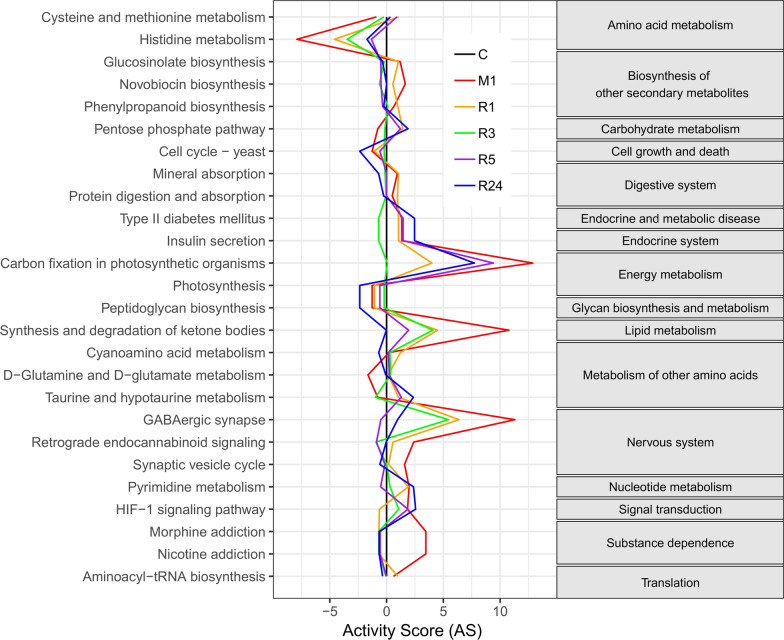
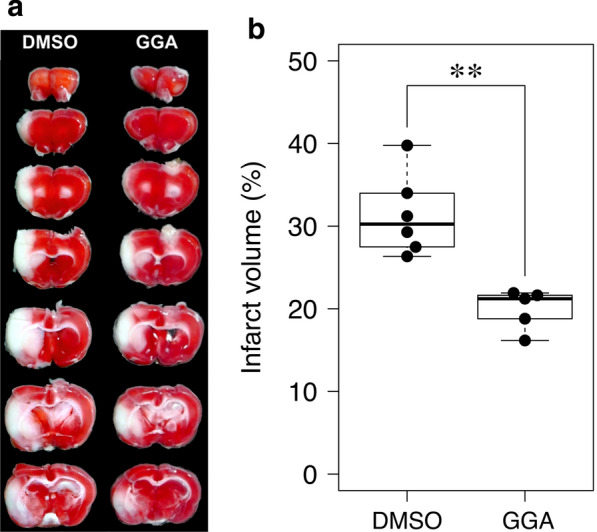
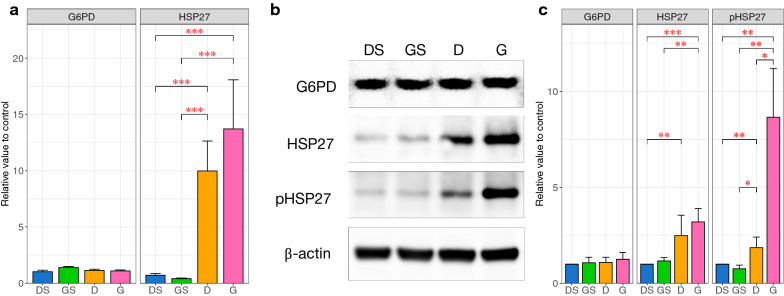
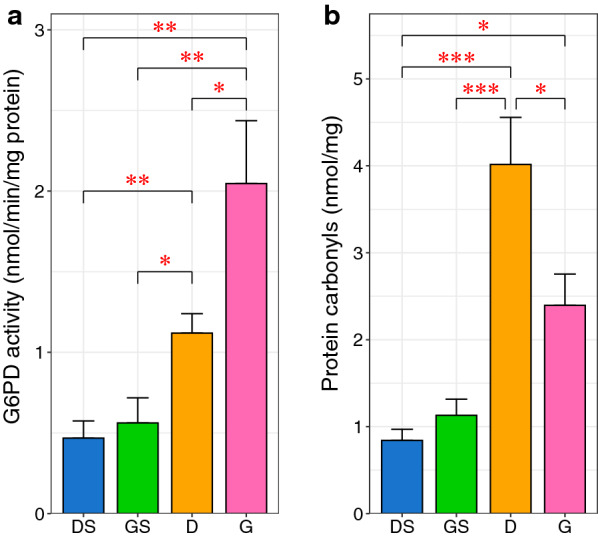
Pathway activity profiling demonstrated that changes in the metabolic state depended on reperfusion time and that the pentose phosphate pathway and taurine-hypotaurine metabolism pathway were the most strongly related to reperfusion among 137 metabolic pathways. RT-PCR demonstrated that geranylgeranylacetone did not significantly affect the increase in HSP27 transcript levels after ischemia-reperfusion. Immunoblotting showed that geranylgeranylacetone did not significantly affect the elevation of HSP27 protein levels. However, geranylgeranylacetone significantly increase the elevation of phosphorylation of HSP27 after ischemia-reperfusion. In addition, geranylgeranylacetone significantly affected the increase in G6PD activity, and reduced the increase in protein carbonylation after ischemia-reperfusion. Accordingly, geranylgeranylacetone significantly reduced the infarct size (median 31.3% vs 19.9%, p = 0.0013).
As a preliminary study, these findings suggest that geranylgeranylacetone may be a promising agent for the treatment of ischemic stroke and would be worthy of further study. Further studies are required to clearly delineate the mechanism of geranylgeranylacetone-induced HSP27 phosphorylation in antioxidant effects, which may guide the development of new approaches for minimizing the impact of cerebral ischemia-reperfusion injury.
我们之前的研究报道称,热休克蛋白 27(HSP27)的磷酸化在葡萄糖-6-磷酸脱氢酶(G6PD)的激活中起着重要作用,导致戊糖磷酸途径的上调和对脑缺血再灌注损伤的抗氧化作用。本研究旨在探讨香叶基丙酮(一种 HSP27 诱导剂)对雄性大鼠缺血再灌注损伤的影响,作为进一步研究香叶基丙酮对缺血性脑卒中影响的初步研究。
所有实验均使用雄性 Wistar 大鼠。首先,我们进行了基于气相色谱-质谱联用的途径活性谱分析,以确定与缺血再灌注相关的代谢途径。接下来,我们通过实时聚合酶链反应(RT-PCR)、免疫印迹和 G6PD 活性、蛋白质羰基化和梗死体积分析,研究了香叶基丙酮对戊糖磷酸途径和缺血再灌注损伤的影响。在大脑中动脉闭塞或假手术前 3 小时,将香叶基丙酮或载体经侧脑室注射。
途径活性谱分析表明,代谢状态的变化取决于再灌注时间,在 137 种代谢途径中,戊糖磷酸途径和牛磺酸-次牛磺酸代谢途径与再灌注的相关性最强。RT-PCR 结果表明,香叶基丙酮对缺血再灌注后 HSP27 转录水平的升高没有显著影响。免疫印迹结果表明,香叶基丙酮对 HSP27 蛋白水平的升高没有显著影响。然而,香叶基丙酮显著增加了缺血再灌注后 HSP27 的磷酸化水平。此外,香叶基丙酮显著影响了 G6PD 活性的升高,并降低了缺血再灌注后蛋白质羰基化的升高。因此,香叶基丙酮显著降低了梗死体积(中位数 31.3%比 19.9%,p=0.0013)。
作为一项初步研究,这些发现表明香叶基丙酮可能是治疗缺血性脑卒中的一种有前途的药物,值得进一步研究。需要进一步的研究来明确香叶基丙酮诱导 HSP27 磷酸化的抗氧化作用机制,这可能有助于指导开发新的方法来最大限度地减少脑缺血再灌注损伤的影响。