Istituto di Genetica Molecolare, CNR - Consiglio Nazionale delle Ricerche, Pavia 27100, Italy.
IFOM Foundation - The FIRC Institute of Molecular Oncology Foundation, Milan 20139, Italy.
J Cell Sci. 2021 Mar 22;134(6):jcs249706. doi: 10.1242/jcs.249706.
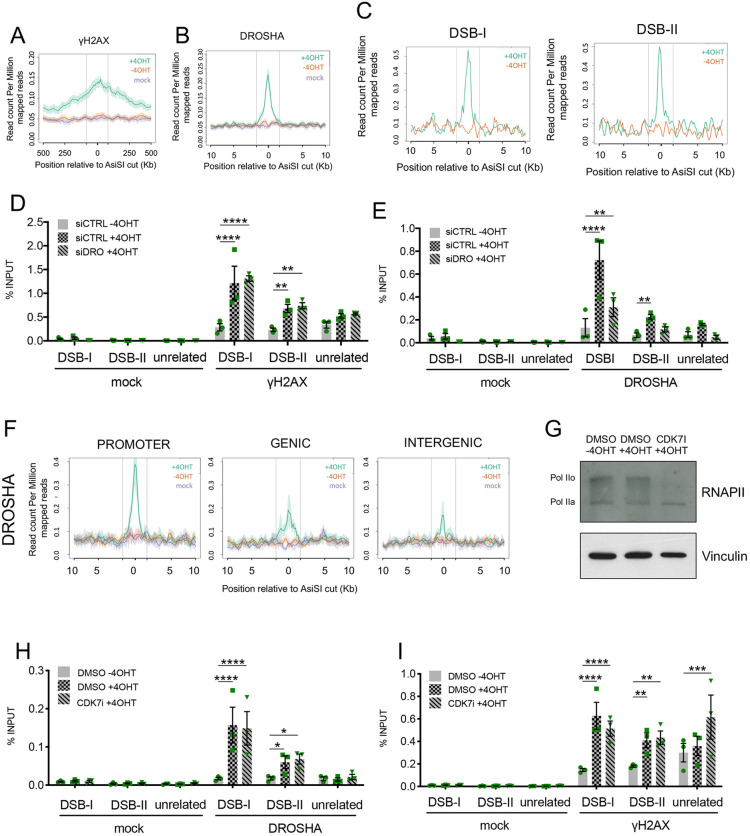
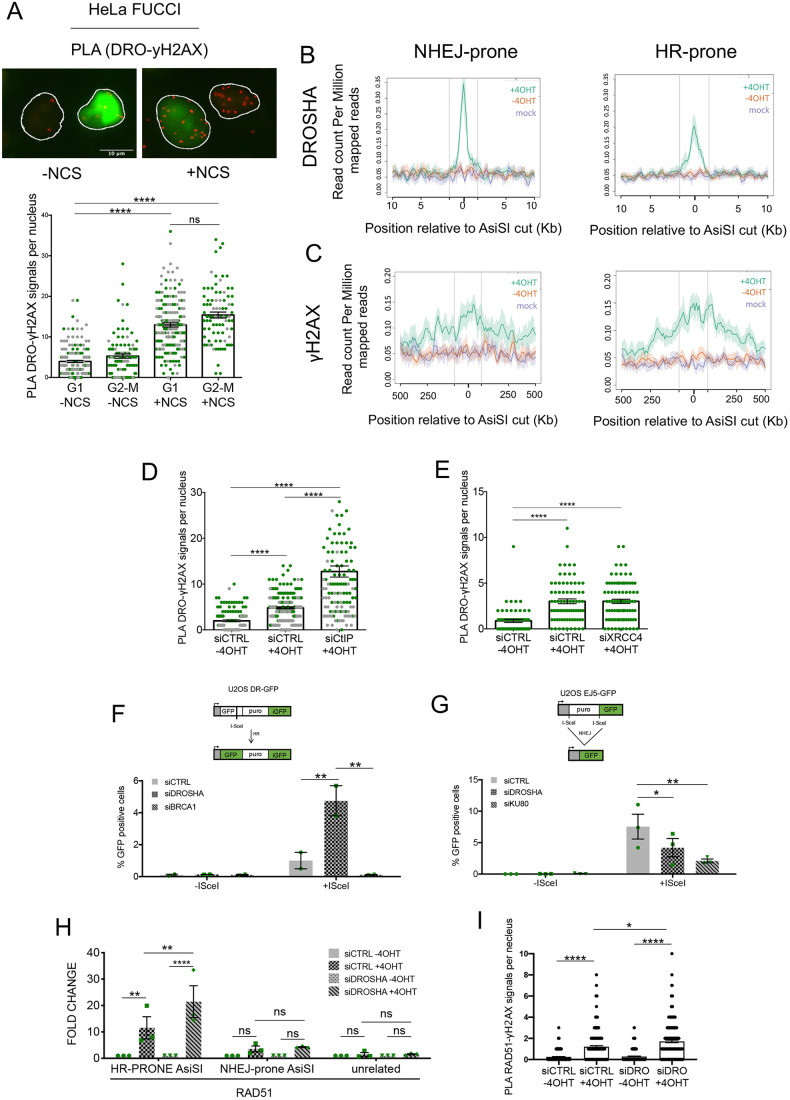
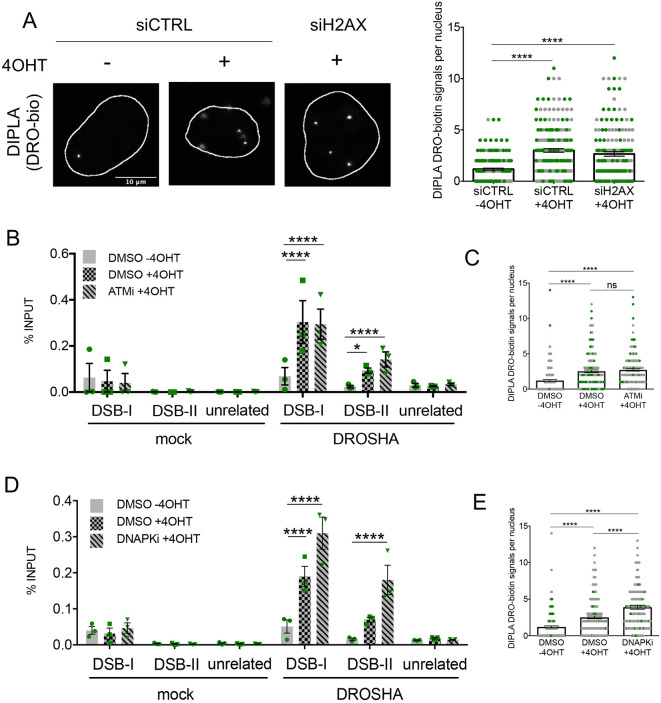
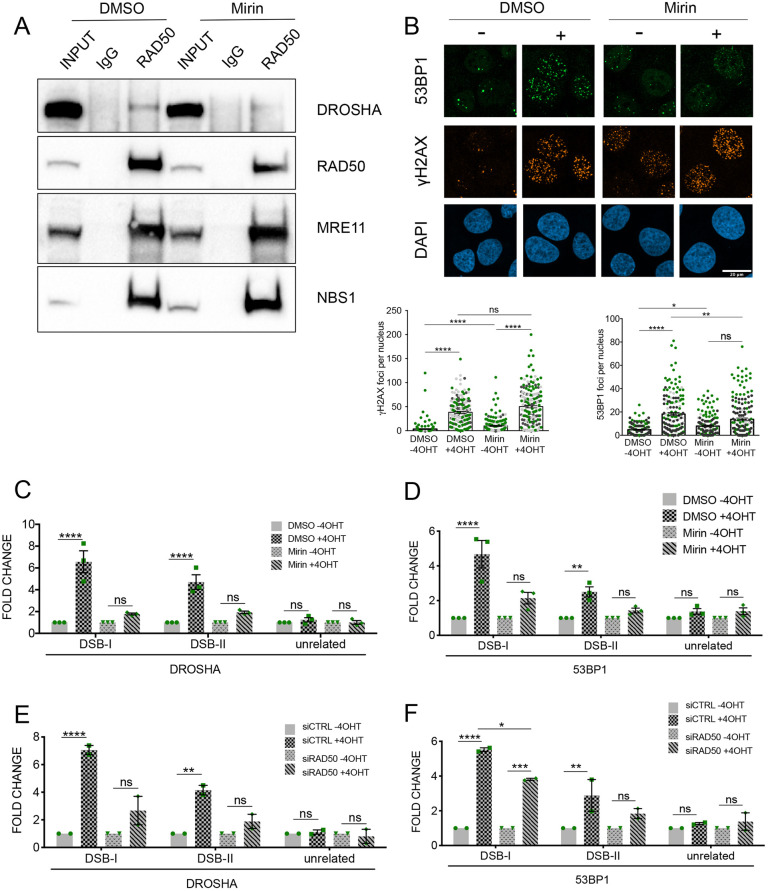
The DNA damage response (DDR) is the signaling cascade that recognizes DNA double-strand breaks (DSBs) and promotes their resolution via the DNA repair pathways of non-homologous end joining (NHEJ) or homologous recombination (HR). We and others have shown that DDR activation requires DROSHA; however, whether DROSHA exerts its functions by associating with damage sites, what controls its recruitment, and how DROSHA influences DNA repair remains poorly understood. Here, we show that DROSHA associates with DSBs independently of transcription. Neither H2AX, nor ATM or DNA-PK kinase activities are required for recruitment of DROSHA to break sites. Rather, DROSHA interacts with RAD50, and inhibition of the MRN complex by mirin treatment abolishes this interaction. MRN complex inactivation by RAD50 knockdown or mirin treatment prevents DROSHA recruitment to DSBs and, as a consequence, also prevents 53BP1 (also known as TP53BP1) recruitment. During DNA repair, DROSHA inactivation reduces NHEJ and boosts HR frequency. Indeed, DROSHA knockdown also increases the association of downstream HR factors such as RAD51 to DNA ends. Overall, our results demonstrate that DROSHA is recruited at DSBs by the MRN complex and directs DNA repair towards NHEJ.
DNA 损伤反应 (DDR) 是一种信号级联反应,可识别 DNA 双链断裂 (DSBs),并通过非同源末端连接 (NHEJ) 或同源重组 (HR) 的 DNA 修复途径促进其解决。我们和其他人已经表明,DDR 的激活需要 DROSHA;然而,DROSHA 是否通过与损伤部位结合来发挥其功能,其募集的控制因素是什么,以及 DROSHA 如何影响 DNA 修复仍知之甚少。在这里,我们表明 DROSHA 独立于转录与 DSBs 相关联。H2AX、ATM 或 DNA-PK 激酶活性都不是招募 DROSHA 到断裂部位所必需的。相反,DROSHA 与 RAD50 相互作用,而 mirin 处理抑制 MRN 复合物会破坏这种相互作用。RAD50 敲低或 mirin 处理对 MRN 复合物的失活可防止 DROSHA 募集到 DSB 上,因此也可防止 53BP1(也称为 TP53BP1)募集。在 DNA 修复过程中,DROSHA 的失活会降低 NHEJ 并增加 HR 频率。事实上,DROSHA 的敲低也会增加下游 HR 因子(如 RAD51)与 DNA 末端的结合。总的来说,我们的结果表明,MRN 复合物可将 DROSHA 募集到 DSB 上,并将 DNA 修复导向 NHEJ。