Department of Linguistic and Cultural Evolution, Max Planck Institute for the Science of Human History, Kahlaische Strasse 10, 07745, Jena, Germany.
Department for Department for General Psychology and Cognitive Neuroscience, Friedrich Schiller University of Jena, Am Steiger 3, 07743, Jena, Germany.
Sci Rep. 2021 Feb 8;11(1):3291. doi: 10.1038/s41598-021-82952-4.
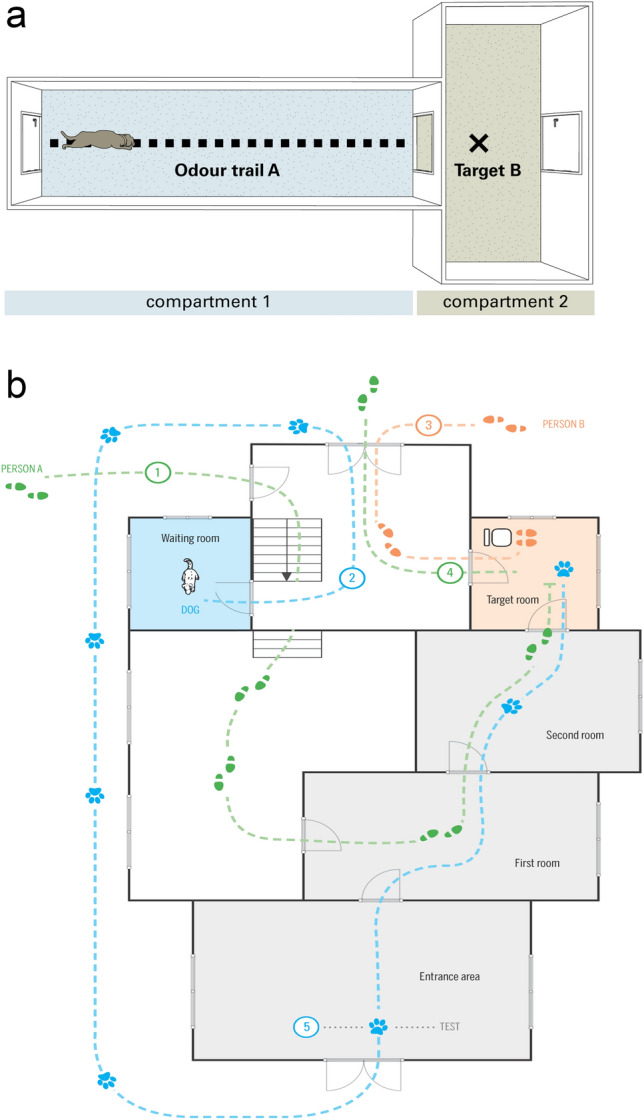
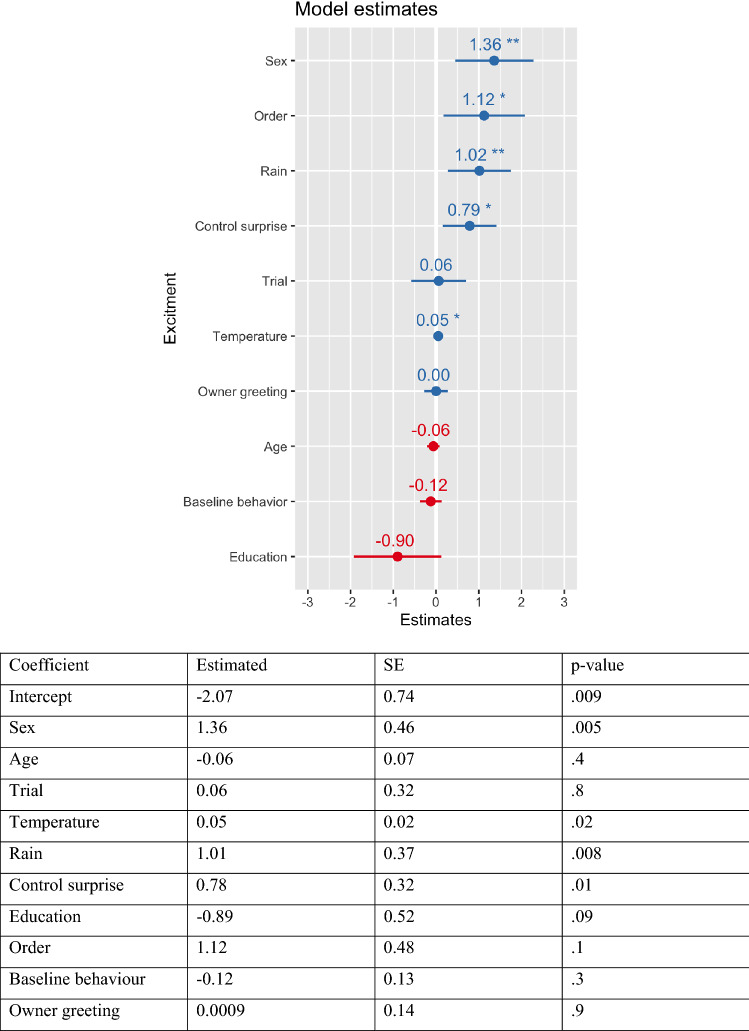
Most current knowledge about dogs' understanding of, and reacting to, their environment is limited to the visual or auditory modality, but it remains unclear how olfaction and cognition are linked together. Here we investigate how domestic dogs search for their owners using their excellent olfactory sense. We raise the question whether dogs have a representation of someone when they smell their track. The question is what they expect when they follow a trail or whether they perceive an odour as a relevant or non-relevant stimulus. We adopted a classical violation-of-expectation paradigm-and as targets we used two persons that were both important to the dog, usually the owners. In the critical condition subjects could track the odour trail of one target, but at the end of the trail they find another target. Dogs showed an increased activity when the person did not correspond with the trail compared to a control condition. Moreover, we found huge individual differences in searching behaviour supporting the assumption that dogs are only able to smell when they really sniff, and that the temperature has an influence on dogs performance. Results are discussed in the light of how cognitive abilities, motivation and odour perception influence each other.
目前关于狗对环境的理解和反应的大部分知识仅限于视觉或听觉模式,但嗅觉和认知是如何联系在一起的仍不清楚。在这里,我们研究了家犬如何利用它们出色的嗅觉来寻找它们的主人。我们提出了一个问题,即当狗闻到它们的踪迹时,它们是否对某人有一个代表。问题是它们在跟随一条踪迹时期望什么,或者它们是否将气味视为相关或不相关的刺激。我们采用了经典的违反预期范式——作为目标,我们使用了两个对狗来说都很重要的人,通常是主人。在关键条件下,与控制条件相比,当气味轨迹与目标不匹配时,狗会表现出更高的活动水平。此外,我们发现搜索行为存在巨大的个体差异,这支持了狗只有在真正嗅探时才能闻到气味的假设,并且温度会影响狗的表现。结果将根据认知能力、动机和气味感知如何相互影响进行讨论。