Haematopathology Laboratory, ACTREC, Tata Memorial Centre, Navi Mumbai, India.
Homi Bhabha National Institute (HBNI), Mumbai, India.
Leukemia. 2021 May;35(5):1392-1404. doi: 10.1038/s41375-021-01131-6. Epub 2021 Feb 8.
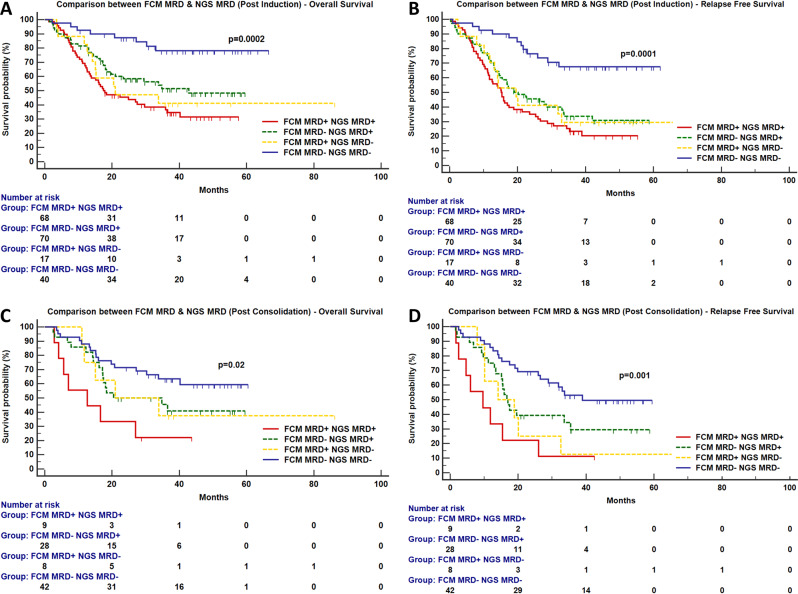
We accrued 201 patients of adult AML treated with conventional therapy, in morphological remission, and evaluated MRD using sensitive error-corrected next generation sequencing (NGS-MRD) and multiparameter flow cytometry (FCM-MRD) at the end of induction (PI) and consolidation (PC). Nearly 71% of patients were PI NGS-MRD and 40.9% PC NGS-MRD (median VAF 0.76%). NGS-MRD patients had a significantly higher cumulative incidence of relapse (p = 0.003), inferior overall survival (p = 0.001) and relapse free survival (p < 0.001) as compared to NGS-MRD patients. NGS-MRD was predictive of inferior outcome in intermediate cytogenetic risk and demonstrated potential in favorable cytogenetic risk AML. PI NGS-MRD patients had a significantly improved survival as compared to patients who became NGS-MRD subsequently indicating that kinetics of NGS-MRD clearance was of paramount importance. NGS-MRD identified over 80% of cases identified by flow cytometry at PI time point whereas FCM identified 49.3% identified by NGS. Only a fraction of cases were NGS-MRD but FCM-MRD. NGS-MRD provided additional information of the risk of relapse when compared to FCM-MRD. We demonstrate a widely applicable, scalable NGS-MRD approach that is clinically informative and synergistic to FCM-MRD in AML treated with conventional therapies. Maximum clinical utility may be leveraged by combining FCM and NGS-MRD modalities.
我们对 201 名接受常规治疗、处于形态缓解期的成人 AML 患者进行了研究,在诱导结束时(PI)和巩固时(PC)使用敏感的纠错下一代测序(NGS-MRD)和多参数流式细胞术(FCM-MRD)评估了微小残留病(MRD)。近 71%的患者在 PI 时 NGS-MRD 和 40.9%在 PC 时 NGS-MRD(中位数 VAF 为 0.76%)。与 NGS-MRD 患者相比,NGS-MRD 患者的累积复发率显著更高(p=0.003),总生存率(p=0.001)和无复发生存率(p<0.001)更差。NGS-MRD 在中危细胞遗传学风险中预测预后不良,并在有利细胞遗传学风险 AML 中具有潜力。与随后成为 NGS-MRD 的患者相比,PI NGS-MRD 患者的生存显著改善,这表明 NGS-MRD 清除的动力学至关重要。与 PI 时间点的流式细胞术相比,NGS-MRD 可识别超过 80%的病例,而 FCM 可识别 49.3%的 NGS 病例。只有一部分病例为 NGS-MRD 但 FCM-MRD。与 FCM-MRD 相比,NGS-MRD 提供了有关复发风险的额外信息。我们展示了一种广泛适用、可扩展的 NGS-MRD 方法,该方法在接受常规治疗的 AML 中与 FCM-MRD 相比具有临床意义和协同作用。通过结合 FCM 和 NGS-MRD 模式,可能会获得最大的临床应用。