Temerty Faculty of Medicine, University of Toronto, Toronto, Ontario, Canada.
Faculty of Science, University of Saskatchewan, Saskatoon, Saskatchewan, Canada.
Sports Health. 2021 Sep-Oct;13(5):446-453. doi: 10.1177/1941738121991782. Epub 2021 Feb 10.
The prevalence of symptomatic lumbar disc herniation (LDH) in athletes can be as high as 75%. For elite athletes diagnosed with LDH, return to play (RTP) is a major concern, and thus comparing surgical with nonoperative care is essential to guide practitioners and athletes, not just in terms of recovery rates but also speed of recovery.
The purpose of this systematic review is to provide an update on RTP outcomes for elite athletes after lumbar discectomy versus nonoperative treatment of LDHs.
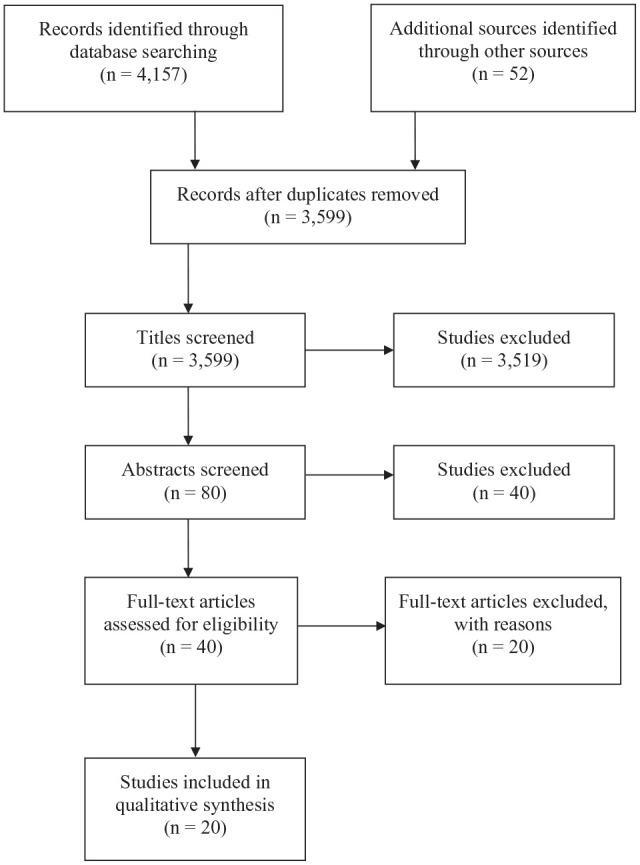
A search of the literature was conducted using 3 online databases (MEDLINE, EMBASE, and PubMed) to identify pertinent studies.
Yielded studies were screened according to the inclusion criteria.
Systematic review with meta-analysis.
Level 4.
Relevant data were extracted. A meta-analysis was performed comparing RTP rate for all comparative studies.
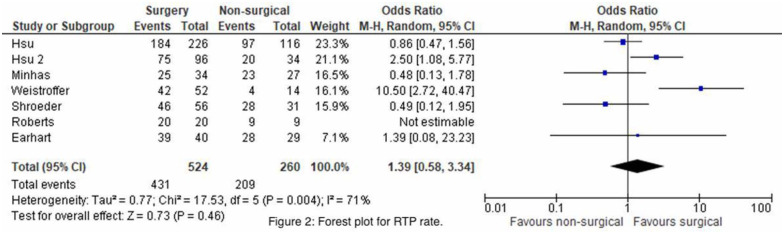
Twenty studies met the inclusion criteria and were included in this review. Overall, 663 out of 799 patients (83.0%) returned to play in the surgical group and 251 out of 308 patients (81.5%) returned to play in the nonoperative group. No statistically significant difference for RTP rate was found (odds ratio, 1.39; 95% CI, 0.58-3.34; = 0.46; 2, 71%). The mean time to RTP for patients undergoing lumbar discectomy was 5.19 months (range 1.00-8.70 months), and 4.11 months (range 3.60-5.70 months) for those treated conservatively.
There was no significant difference in RTP rate between athletes treated with operative or nonoperative management of LDHs, nor did operative management have a faster time to RTP. Athletes should consider the lack of difference in RTP rate in addition to the potential risks associated with spinal surgery when choosing a treatment option. Future randomized controlled trials are needed on this topic to allow for high-powered conclusions.
运动员中症状性腰椎间盘突出症(LDH)的患病率可高达 75%。对于被诊断为 LDH 的精英运动员,重返赛场(RTP)是一个主要关注点,因此比较手术和非手术治疗对于指导医生和运动员至关重要,不仅要考虑恢复率,还要考虑恢复速度。
本系统回顾的目的是提供关于腰椎间盘切除术与非手术治疗 LDH 后精英运动员 RTP 结果的最新信息。
使用 3 个在线数据库(MEDLINE、EMBASE 和 PubMed)进行文献检索,以确定相关研究。
根据纳入标准筛选出研究成果。
系统回顾和荟萃分析。
4 级。
提取相关数据。对所有比较研究的 RTP 率进行荟萃分析。
20 项研究符合纳入标准,并纳入本综述。总体而言,手术组有 663 名(83.0%)患者重返赛场,非手术组有 251 名(81.5%)患者重返赛场。RTP 率无统计学差异(优势比,1.39;95%CI,0.58-3.34; = 0.46;2,71%)。接受腰椎间盘切除术的患者的平均 RTP 时间为 5.19 个月(范围 1.00-8.70 个月),而接受保守治疗的患者为 4.11 个月(范围 3.60-5.70 个月)。
接受手术或非手术治疗的 LDH 运动员的 RTP 率没有显著差异,手术治疗也没有更快的 RTP 时间。当选择治疗方案时,运动员应考虑到 RTP 率差异不大,以及与脊柱手术相关的潜在风险。需要在这个主题上进行未来的随机对照试验,以得出强有力的结论。