Guangzhou Eighth People's Hospital, Guangzhou Medical University, Guangzhou, China.
State Key Laboratories of Respiratory Diseases, Guangdong Provincial Key Laboratory of Computational Biomedicine, Guangzhou Institutes of Biomedicine and Health, Chinese Academy of Sciences, Guangzhou, China.
mBio. 2021 Feb 9;12(1):e03179-20. doi: 10.1128/mBio.03179-20.
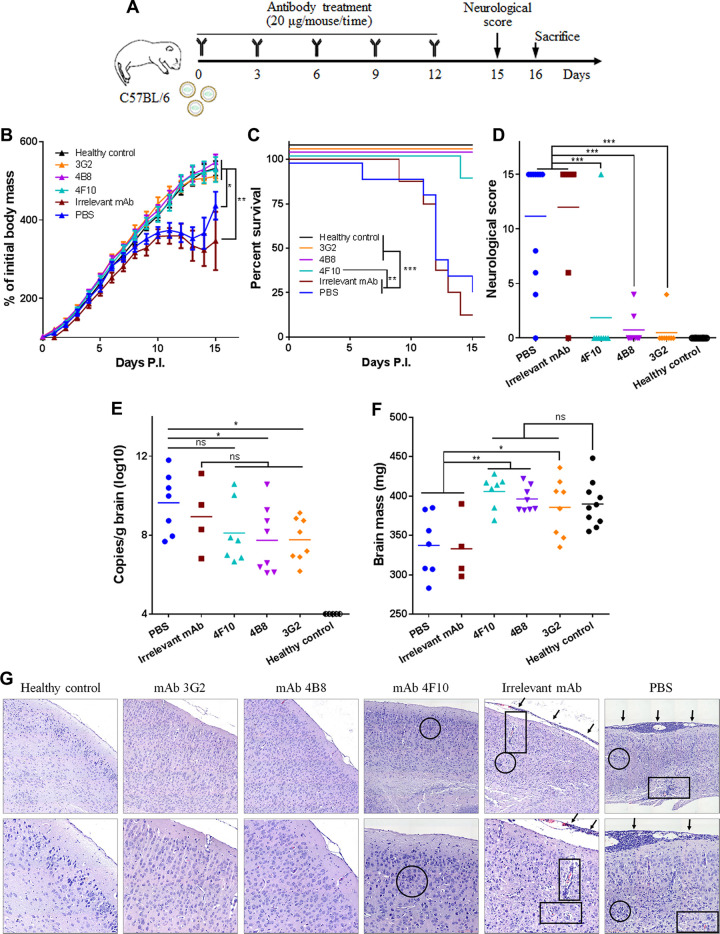
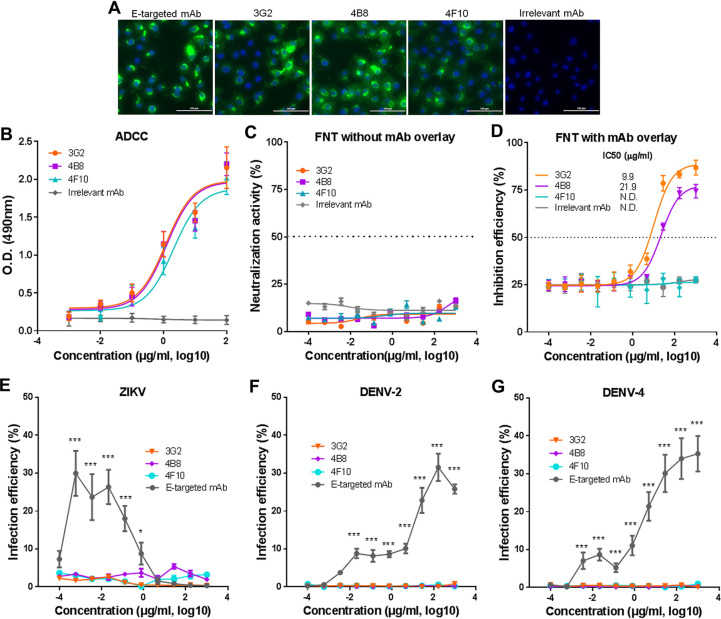
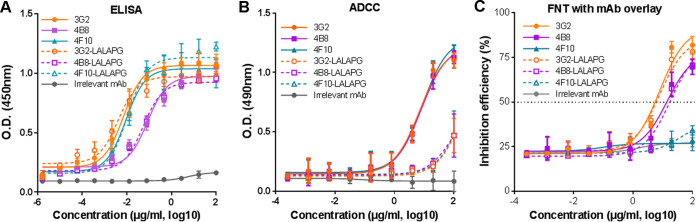
Zika virus (ZIKV) infection during pregnancy causes congenital defects such as fetal microcephaly. Monoclonal antibodies (MAbs) against the nonstructural protein 1 (NS1) have the potential to suppress ZIKV pathogenicity without enhancement of disease, but the pathways through which they confer protection remain obscure. Here, we report two types of NS1-targeted human MAbs that inhibit ZIKV infection through distinct mechanisms. MAbs 3G2 and 4B8 show a better efficacy than MAb 4F10 in suppressing ZIKV infection in C57BL/6 neonatal mice. Unlike MAb 4F10 that mainly triggers antibody-dependent cell-mediated cytotoxicity (ADCC), MAbs 3G2 and 4B8 not only trigger ADCC but inhibit ZIKV infection without Fcγ receptor-bearing effector cells, possibly at postentry stages. Destroying the Fc-mediated effector function of MAbs 3G2 and 4B8 reduces but does not abolish their protective effects, whereas destroying the effector function of MAb 4F10 eliminates the protective effects, suggesting that MAbs 3G2 and 4B8 engage both Fcγ receptor-dependent and -independent pathways. Further analysis reveals that MAbs 3G2 and 4B8 target the N-terminal region of NS1 protein, whereas MAb 4F10 targets the C-terminal region, implying that the protective efficacy of an NS1-targeted MAb may be associated with its epitope recognition. Our results illustrate that NS1-targeted MAbs have multifaceted protective effects and provide insights for the development of NS1-based vaccines and therapeutics. Zika virus (ZIKV) is a mosquito-borne flavivirus that has been linked to congenital microcephaly during recent epidemics. No licensed antiviral drug or vaccine is available. Monoclonal antibodies (MAbs) against the nonstructural protein 1 (NS1) inhibit ZIKV pathogenicity but do not enhance the disease as envelope protein-targeted MAbs do. However, the protection mechanisms are not fully understood. Here, we show that in the presence or absence of Fcγ receptor-bearing effector cells, NS1-targeted human MAbs 3G2 and 4B8 inhibit ZIKV infection. Compared to MAb 4F10 that has no inhibitory effects without effector cells, 3G2 and 4B8 confer better protection in ZIKV-infected neonatal mice. Destroying the Fc-mediated effector function reduces but does not abolish the protection of 3G2 and 4B8, suggesting that they engage both Fcγ receptor-dependent and -independent pathways. The protective efficacy of NS1-targeted MAbs may be associated with their epitope recognition. Our findings will help to develop NS1-based vaccines and therapeutics.
寨卡病毒(ZIKV)感染可导致胎儿小头畸形等先天性缺陷。针对非结构蛋白 1(NS1)的单克隆抗体(MAbs)具有抑制 ZIKV 致病作用而不加重疾病的潜力,但它们发挥保护作用的途径仍不清楚。在这里,我们报告了两种针对 NS1 的人源 MAbs,它们通过不同的机制抑制 ZIKV 感染。MAb 3G2 和 4B8 在抑制 C57BL/6 新生小鼠的 ZIKV 感染方面比 MAb 4F10 更有效。与主要触发抗体依赖的细胞介导的细胞毒性(ADCC)的 MAb 4F10 不同,MAb 3G2 和 4B8 不仅触发 ADCC,而且在没有 Fcγ 受体携带效应细胞的情况下抑制 ZIKV 感染,可能在进入后阶段。破坏 MAb 3G2 和 4B8 的 Fc 介导的效应功能会降低但不会消除其保护作用,而破坏 MAb 4F10 的效应功能则消除了保护作用,表明 MAb 3G2 和 4B8 既参与 Fcγ 受体依赖和非依赖途径。进一步分析表明,MAb 3G2 和 4B8 靶向 NS1 蛋白的 N 端区域,而 MAb 4F10 靶向 C 端区域,这表明靶向 NS1 的 MAb 的保护效果可能与其表位识别有关。我们的结果表明,靶向 NS1 的 MAbs 具有多方面的保护作用,并为基于 NS1 的疫苗和治疗药物的开发提供了见解。寨卡病毒(ZIKV)是一种蚊媒黄病毒,在最近的流行中与先天性小头畸形有关。目前尚无许可的抗病毒药物或疫苗。针对非结构蛋白 1(NS1)的单克隆抗体(MAbs)可抑制 ZIKV 的致病性,但不像包膜蛋白靶向的 MAb 那样加重疾病。然而,保护机制尚不完全清楚。在这里,我们表明,在存在或不存在 Fcγ 受体携带的效应细胞的情况下,靶向 NS1 的人源 MAbs 3G2 和 4B8 可抑制 ZIKV 感染。与没有效应细胞时没有抑制作用的 MAb 4F10 相比,3G2 和 4B8 在感染 ZIKV 的新生小鼠中提供更好的保护。破坏 Fc 介导的效应功能会降低但不会消除 3G2 和 4B8 的保护作用,表明它们既参与 Fcγ 受体依赖和非依赖途径。靶向 NS1 的 MAbs 的保护效果可能与其表位识别有关。我们的发现将有助于开发基于 NS1 的疫苗和治疗药物。