Zhang Yuyuan, Han Mengguo, Sun Xiaoxue, Gao Guojun, Yu Guoying, Huang Liong, Chen Ying
College of Life Sciences, Henan Normal University, Xinxiang, China.
Department of Neurosurgery, The First Affiliated Hospital of Xinxiang Medical University, Weihui, Henan 453100, China.
Evid Based Complement Alternat Med. 2021 Jan 25;2021:8810414. doi: 10.1155/2021/8810414. eCollection 2021.
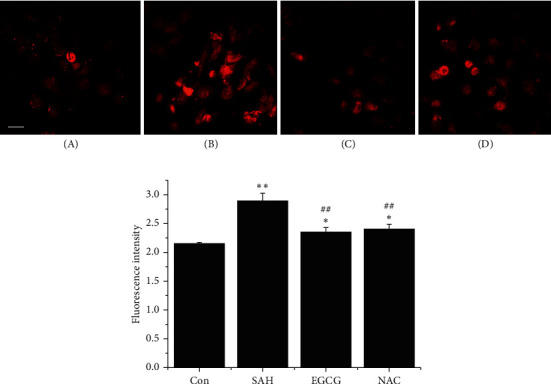
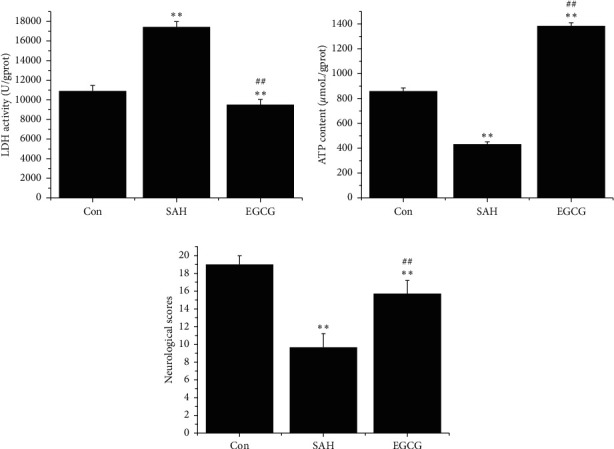
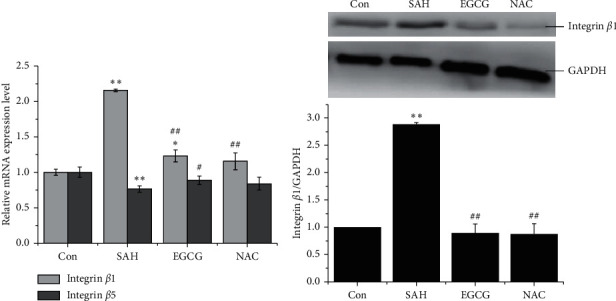
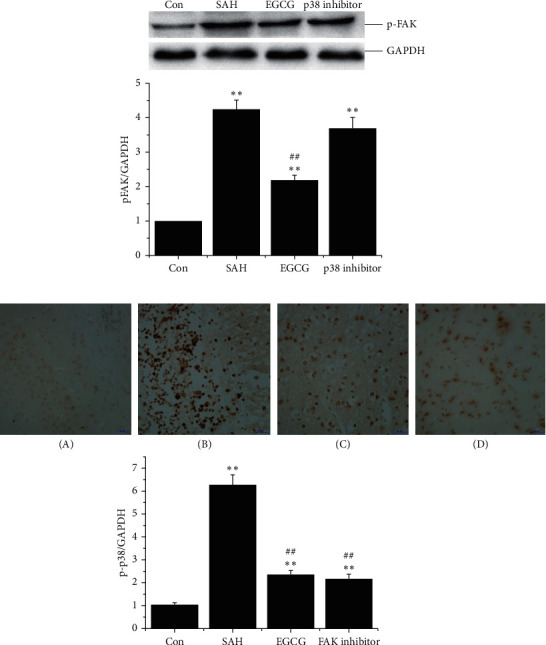
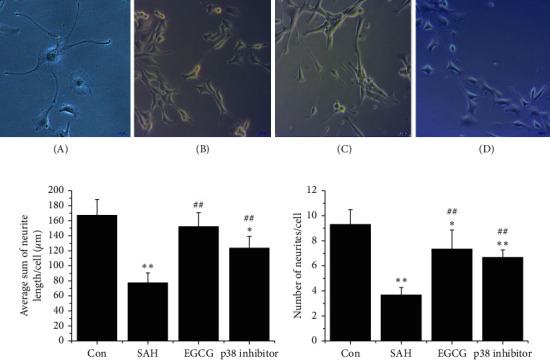
The abnormal neurites have long been regarded as the main player contributing to the poor outcome of patients with subarachnoid hemorrhage (SAH). (-)-Eigallocatechin-3-gallate (EGCG), the major biological component of tea catechin, exhibited strong neuroprotective effects against central nervous system diseases; however, the role of EGCG-mediated neurite outgrowth after SAH has not been delineated. Here, the effect of reactive oxygen species (ROS)/integrin 1/FAK/p38 pathway on neurite outgrowth was investigated. As expected, oxyhemoglobin- (OxyHb-) induced excessive ROS level was significantly reduced by EGCG as well as antioxidant N-acetyl-l-cysteine (NAC). Consequently, the expression of integrin 1 was significantly inhibited by EGCG and NAC. Meanwhile, EGCG significantly inhibited the overexpression of phosphorylated FAK and p38 to basal level after SAH. As a result, the abnormal neurites and cell injury were rescued by EGCG, which eventually increased energy generation and neurological score after SAH. These results suggested that EGCG promoted neurite outgrowth after SAH by inhibition of ROS/integrin 1/FAK/p38 signaling pathway. Therefore, EGCG might be a new pharmacological agent that targets neurite outgrowth in SAH therapy.
长期以来,异常神经突一直被视为导致蛛网膜下腔出血(SAH)患者预后不良的主要因素。(-)-表没食子儿茶素-3-没食子酸酯(EGCG)是茶儿茶素的主要生物成分,对中枢神经系统疾病具有强大的神经保护作用;然而,SAH后EGCG介导的神经突生长的作用尚未明确。在此,研究了活性氧(ROS)/整合素β1/黏着斑激酶(FAK)/p38通路对神经突生长的影响。正如预期的那样,EGCG以及抗氧化剂N-乙酰半胱氨酸(NAC)显著降低了氧合血红蛋白(OxyHb)诱导的过量ROS水平。因此,EGCG和NAC显著抑制了整合素β1的表达。同时,EGCG显著抑制了SAH后磷酸化FAK和p38的过表达,使其恢复到基础水平。结果,EGCG挽救了异常神经突和细胞损伤,最终增加了SAH后的能量生成和神经功能评分。这些结果表明,EGCG通过抑制ROS/整合素β1/FAK/p38信号通路促进SAH后的神经突生长。因此,EGCG可能是SAH治疗中一种针对神经突生长的新型药物。