Department of Medicine, Cumming School of Medicine, University of Calgary, Foothills Medical Centre - North Tower, Calgary, AB, Canada.
Department of Community Health Sciences, Cumming School of Medicine, University of Calgary, Calgary, AB, Canada.
J Gen Intern Med. 2021 May;36(5):1310-1318. doi: 10.1007/s11606-020-06543-1. Epub 2021 Feb 9.
The evolving COVID-19 pandemic has and continues to present a threat to health system capacity. Rapidly expanding an existing acute care physician workforce is critical to pandemic response planning in large urban academic health systems.
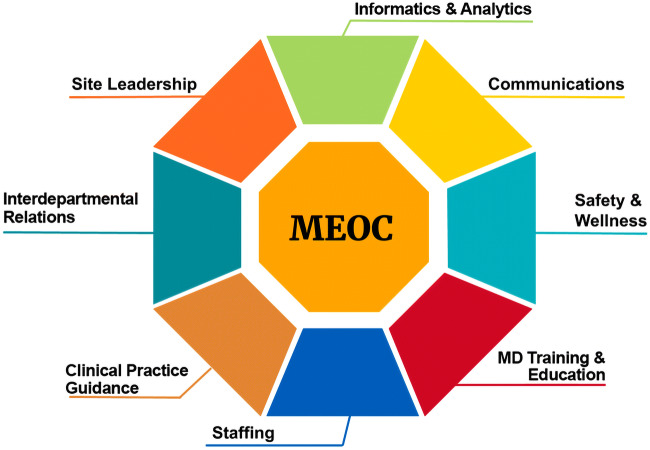
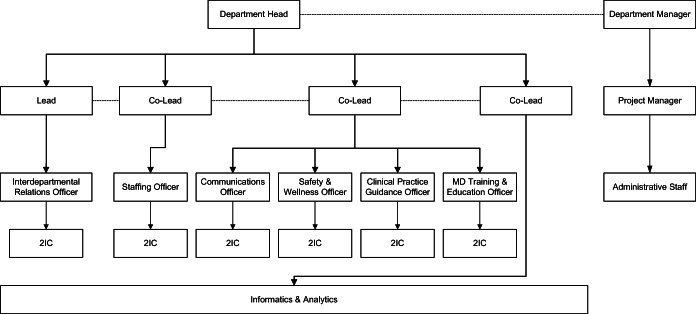
The Medical Emergency-Pandemic Operations Command (MEOC)-a multi-specialty team of physicians, operational leaders, and support staff within an academic Department of Medicine in Calgary, Canada-partnered with its provincial health system to rapidly develop a comprehensive, scalable pandemic physician workforce plan for non-ventilated inpatients with COVID-19 across multiple hospitals. The MEOC Pandemic Plan comprised seven components, each with unique structure and processes.
In this manuscript, we describe MEOC's Pandemic Plan that was designed and implemented from March to May 2020 and re-escalated in October 2020. We report on the plan's structure and process, early implementation outcomes, and unforeseen challenges. Data sources included MEOC documents, health system, public health, and physician engagement implementation data.
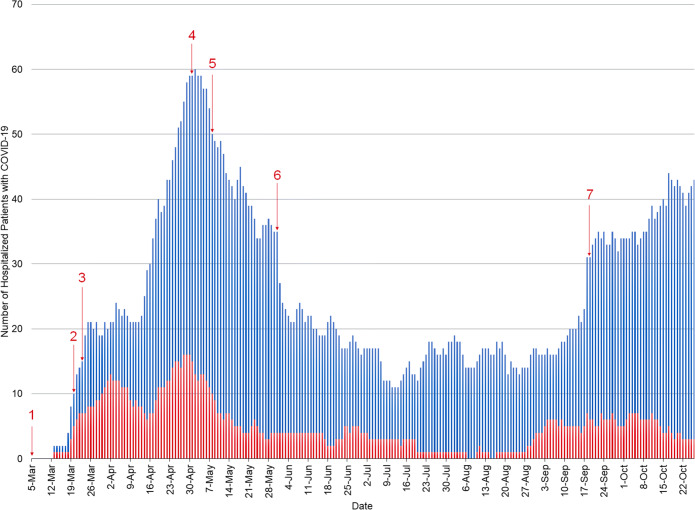
From March 5 to October 26, 2020, 427 patients were admitted to COVID-19 units in Calgary hospitals. In the initial implementation period (March-May 2020), MEOC communications reached over 2500 physicians, leading to 1446 physicians volunteering to provide care on COVID-19 units. Of these, 234 physicians signed up for hospital shifts, and 227 physicians received in-person personal protective equipment simulation training. Ninety-three physicians were deployed on COVID-19 units at four large acute care hospitals. The resurgence of cases in September 2020 has prompted re-escalation including re-activation of COVID-19 units.
MEOC leveraged an academic health system partnership to rapidly design, implement, and refine a comprehensive, scalable COVID-19 acute care physician workforce plan whose components are readily applicable across jurisdictions or healthcare crises. This description may guide other institutions responding to COVID-19 and future health emergencies.
不断演变的 COVID-19 大流行对卫生系统能力构成了威胁。在大型城市学术卫生系统中,迅速扩大现有的急症医生劳动力对于大流行应对规划至关重要。
医学紧急情况-大流行运营指挥中心(MEOC)-一个由医生、运营领导人和支持人员组成的多专业团队,隶属于加拿大卡尔加里的医学系-与省级卫生系统合作,迅速制定了一项针对多个医院 COVID-19 非呼吸机住院患者的全面、可扩展的大流行医生劳动力计划。MEOC 大流行计划包括七个部分,每个部分都有独特的结构和流程。
在本文中,我们描述了 MEOC 的大流行计划,该计划于 2020 年 3 月至 5 月设计和实施,并于 2020 年 10 月再次升级。我们报告了该计划的结构和流程、早期实施结果和意外挑战。数据来源包括 MEOC 文件、卫生系统、公共卫生和医生参与实施数据。
从 2020 年 3 月 5 日至 10 月 26 日,卡尔加里医院有 427 名患者入住 COVID-19 病房。在最初的实施期间(2020 年 3 月至 5 月),MEOC 通讯覆盖了 2500 多名医生,导致 1446 名医生自愿在 COVID-19 病房提供护理。其中,234 名医生报名参加了医院轮班,227 名医生接受了个人防护设备模拟培训。93 名医生被部署到四家大型急症护理医院的 COVID-19 病房。2020 年 9 月病例再次增加促使重新升级,包括重新启用 COVID-19 病房。
MEOC 利用学术卫生系统合作伙伴关系,迅速设计、实施和完善了一项全面、可扩展的 COVID-19 急症医生劳动力计划,其组成部分在司法管辖区或卫生危机中易于应用。这一描述可能为应对 COVID-19 和未来卫生紧急情况的其他机构提供指导。