Division of Neonatology, Department of Pediatrics and Adolescent Medicine, Pediatric Intensive Care and Neuropediatrics, Comprehensive Center for Pediatrics, Medical University Vienna, Vienna, Austria.
Division of Neonatology, University Children's Hospital Basel (UKBB), University of Basel, Basel, Switzerland.
J Neurol. 2021 Jul;268(7):2570-2577. doi: 10.1007/s00415-021-10429-5. Epub 2021 Feb 10.
To determine whether neurofilament light chain (NfL), a promising serum and cerebrospinal fluid (CSF) biomarker of neuroaxonal damage, predicts functional outcome in preterm infants with neonatal brain injury.
Our prospective observational study used a sensitive single-molecule array assay to measure serum and CSF NfL concentrations in preterm infants with moderate to severe peri/intraventricular hemorrhage (PIVH). We determined temporal serum and CSF NfL profiles from the initial diagnosis of PIVH until term-equivalent age and their association with clinical and neurodevelopmental outcome until 2 years of age assessed by Bayley Scales of Infant Development (3rd edition). We fitted univariate and multivariate logistic regression models to determine risk factors for poor motor and cognitive development.
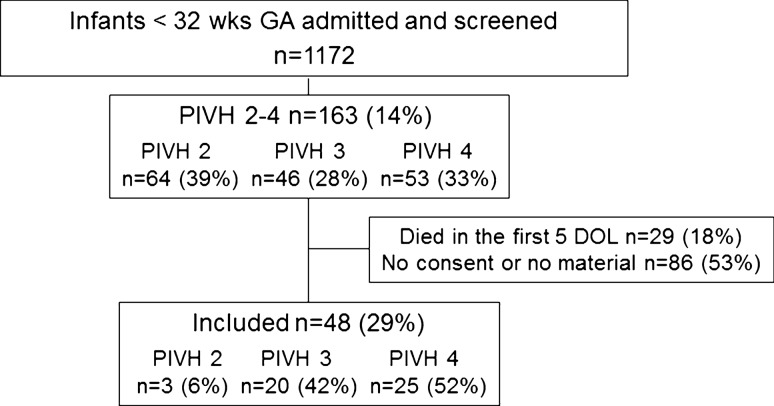
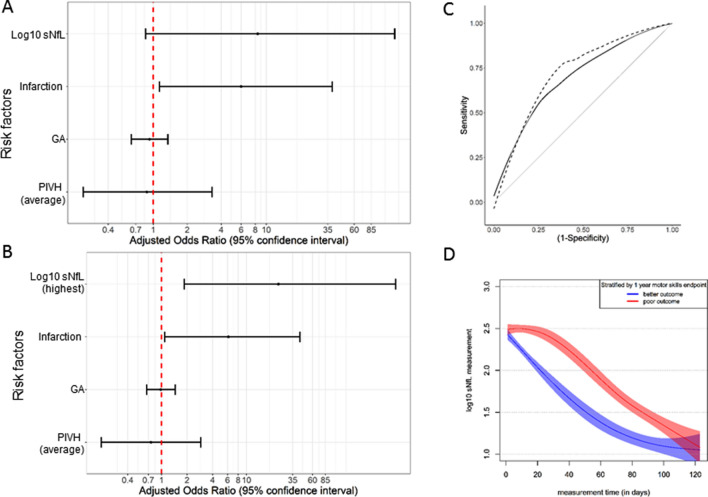
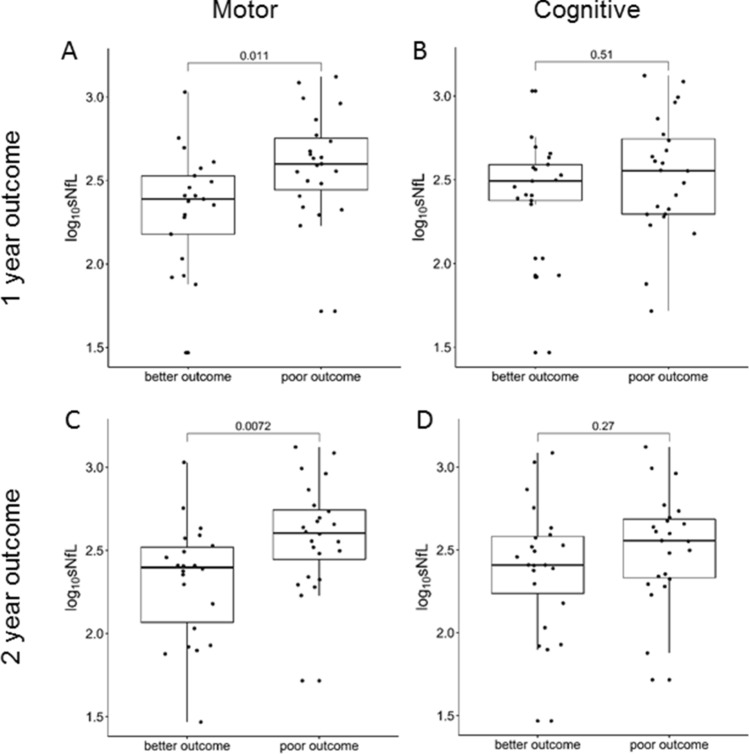
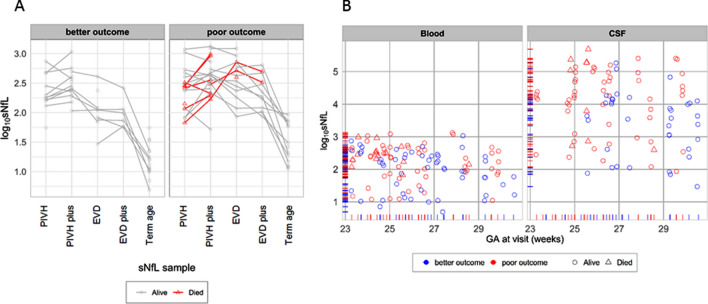
The study included 48 infants born at < 32 weeks of gestation. Median serum NfL (sNfL) at PIVH diagnosis was 251 pg/mL [interquartile range (IQR) 139-379], decreasing markedly until term-equivalent age to 15.7 pg/mL (IQR 11.1-33.5). CSF NfL was on average 113-fold higher (IQR 40-211) than corresponding sNfL values. Additional cerebral infarction (n = 25)-but not post-hemorrhagic hydrocephalus requiring external ventricular drainage (n = 29) nor any other impairment-was independently associated with sNfL. Multivariate logistic regression models identified sNfL as an independent predictor of poor motor outcome or death at 1 and 2 years.
Serum neurofilament light chain dynamics in the first weeks of life predict motor outcome in preterm infants with PIVH.
为了确定神经丝轻链(NfL),一种有前途的血清和脑脊液(CSF)神经轴突损伤生物标志物,是否可以预测伴有新生儿脑损伤的早产儿的功能结局。
我们的前瞻性观察研究使用敏感的单分子阵列测定法测量了患有中重度围/室管膜下出血(PIVH)的早产儿的血清和 CSF NfL 浓度。我们确定了从 PIVH 初始诊断到胎龄相等年龄的血清和 CSF NfL 时间曲线,并将其与 2 岁时的临床和神经发育结局(通过贝利婴幼儿发育量表第三版评估)相关联。我们拟合了单变量和多变量逻辑回归模型,以确定运动和认知发育不良的危险因素。
该研究纳入了 48 名胎龄小于 32 周的婴儿。PIVH 诊断时的血清 NfL(sNfL)中位数为 251pg/mL[四分位距(IQR)139-379],直到胎龄相等年龄时急剧下降至 15.7pg/mL(IQR 11.1-33.5)。CSF NfL 平均比相应的 sNfL 值高 113 倍(IQR 40-211)。额外的脑梗死(n=25)-而不是需要外部脑室引流的出血后脑积水(n=29)或任何其他损伤-与 sNfL 独立相关。多变量逻辑回归模型确定 sNfL 是 PIVH 早产儿运动结局不良或 1 年和 2 年死亡的独立预测因子。
生命最初几周的血清神经丝轻链动力学可预测伴有 PIVH 的早产儿的运动结局。