Song Inhak, Lee Hwangho, Jeon Se Won, Ibrahim Ismail A M, Kim Joonwoo, Byun Youngchul, Koh Dong Jun, Han Jeong Woo, Kim Do Heui
School of Chemical and Biological Engineering, Institute of Chemical Processes, Seoul National University, Seoul, Republic of Korea.
Department of Chemical Engineering, Pohang University of Science and Technology (POSTECH), Pohang, Gyeongbuk, Republic of Korea.
Nat Commun. 2021 Feb 10;12(1):901. doi: 10.1038/s41467-021-21228-x.
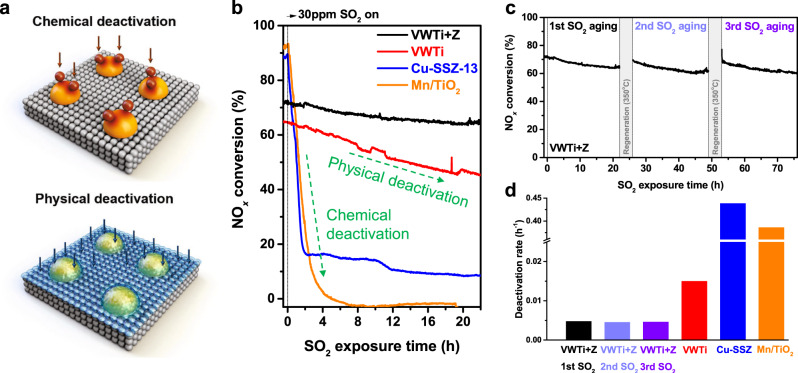
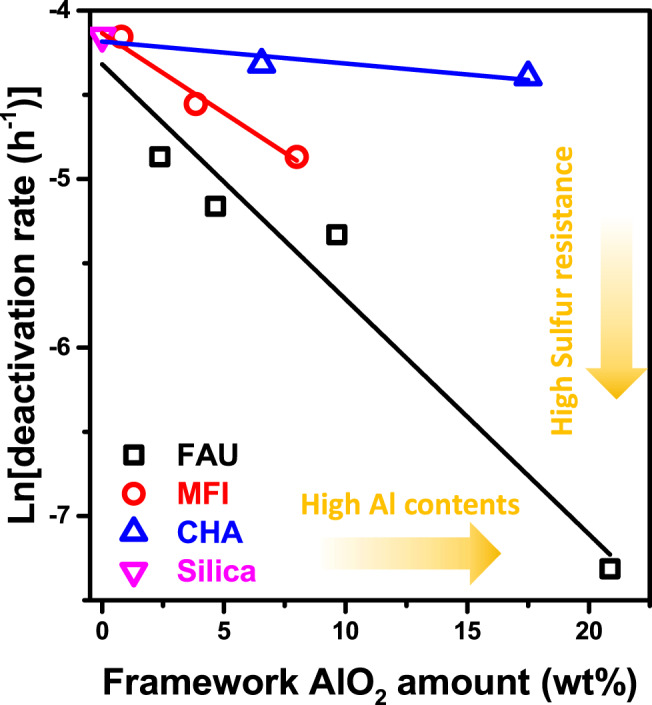
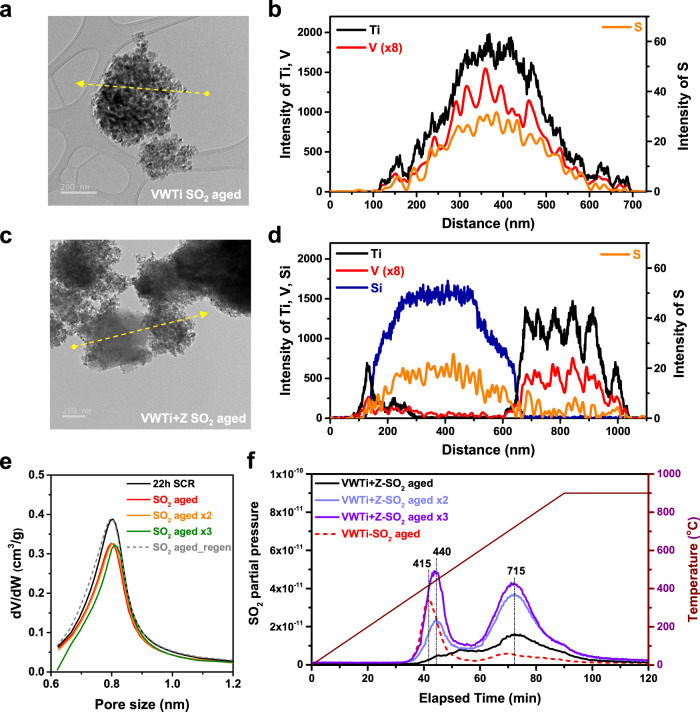
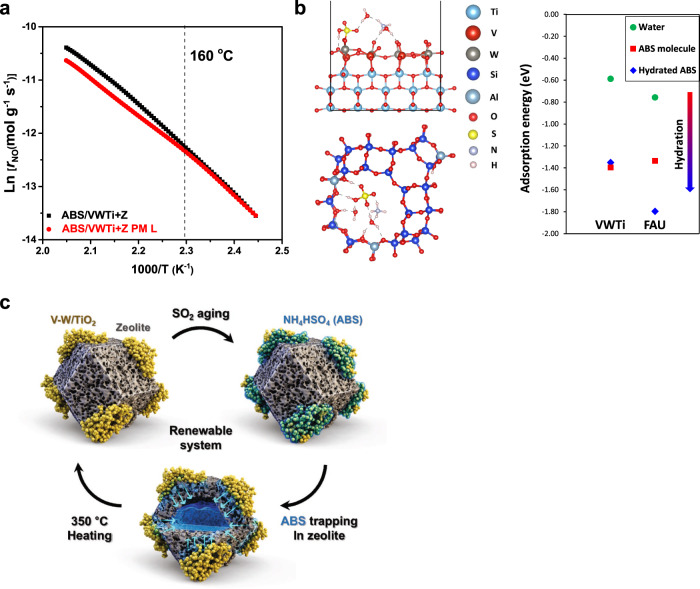
NO abatement has been an indispensable part of environmental catalysis for decades. Selective catalytic reduction with ammonia using VO/TiO is an important technology for removing NO emitted from industrial facilities. However, it has been a huge challenge for the catalyst to operate at low temperatures, because ammonium bisulfate (ABS) forms and causes deactivation by blocking the pores of the catalyst. Here, we report that physically mixed H-Y zeolite effectively protects vanadium active sites by trapping ABS in micropores. The mixed catalysts operate stably at a low temperature of 220 °C, which is below the dew point of ABS. The sulfur resistance of this system is fully maintained during repeated aging/regeneration cycles because the trapped ABS easily decomposes at 350 °C. Further investigations reveal that the pore structure and the amount of framework Al determined the trapping ability of various zeolites.
几十年来,氮氧化物减排一直是环境催化的重要组成部分。以钒/二氧化钛为催化剂、氨为还原剂的选择性催化还原技术是去除工业设施排放氮氧化物的重要技术。然而,由于硫酸氢铵(ABS)的形成并堵塞催化剂孔道导致催化剂失活,使得催化剂在低温下运行一直是一个巨大的挑战。在此,我们报道了物理混合的H-Y沸石通过在微孔中捕获ABS有效地保护了钒活性位点。混合催化剂在220°C的低温下稳定运行,该温度低于ABS的露点。在反复的老化/再生循环过程中,该体系的抗硫性得以完全保持,因为捕获的ABS在350°C时很容易分解。进一步的研究表明,孔结构和骨架铝的含量决定了各种沸石的捕获能力。