Fu Fangqiu, Zhou Yaodong, Zhang Yang, Chen Haiquan
Department of Thoracic Surgery and State Key Laboratory of Genetic Engineering, Fudan University Shanghai Cancer Center, Shanghai, China.
Institute of Thoracic Oncology, Fudan University, Shanghai, China.
Transl Lung Cancer Res. 2021 Jan;10(1):452-461. doi: 10.21037/tlcr-20-943.
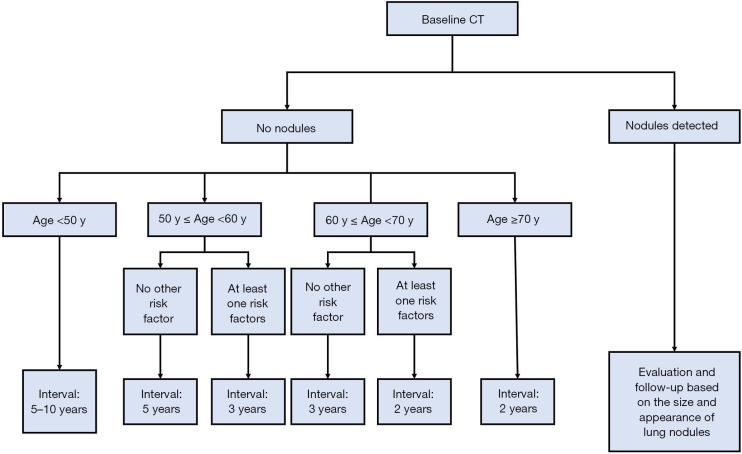
Lung cancer is the deadliest malignancy worldwide, accounting for almost 20% of all cancer deaths. Clinical trials, such as NLST and NELSON, have proved the survival benefit of lung cancer screening using low-dose computed tomography (LDCT), and most of the lung cancer screening guidelines recommended annual lung cancer screening by LDCT for high-risk individuals. However, a relatively high proportion of lung cancer patients do not have risk factors, and it is questionable whether non-high-risk individuals should receive LDCT screening. In this review, we reviewed risk factors of lung cancer and summarized the benefits and potential harms of LDCT screening. After clarifying the differences between China and western countries in lung cancer screening, we recommended that non-high-risk individuals should receive LDCT screening with an interval of five to ten years. To better balance benefits and harms from LDCT screening, we also proposed a flexible screening strategy using LDCT based on lung cancer risk. Hopefully, it may help reduce unnecessary radiation exposure from CT scans while decreasing mortality of lung cancer.
肺癌是全球最致命的恶性肿瘤,占所有癌症死亡人数的近20%。诸如国家肺癌筛查试验(NLST)和荷兰-比利时肺癌筛查试验(NELSON)等临床试验已证明,使用低剂量计算机断层扫描(LDCT)进行肺癌筛查可带来生存获益,并且大多数肺癌筛查指南建议对高危个体每年进行LDCT肺癌筛查。然而,相当一部分肺癌患者并无危险因素,非高危个体是否应接受LDCT筛查仍存疑问。在本综述中,我们回顾了肺癌的危险因素,并总结了LDCT筛查的益处和潜在危害。在明确中国和西方国家在肺癌筛查方面的差异后,我们建议非高危个体应每隔五至十年接受一次LDCT筛查。为了更好地平衡LDCT筛查的利弊,我们还基于肺癌风险提出了一种灵活的LDCT筛查策略。希望这可能有助于减少CT扫描带来的不必要辐射暴露,同时降低肺癌死亡率。