Pradhan Monika, Chocry Mathieu, Gibbons Don L, Sepesi Boris, Cascone Tina
Department of Thoracic/Head and Neck Medical Oncology, The University of Texas MD Anderson Cancer Center, Houston, TX, USA.
Aix-Marseille Université, Institut de Neurophysiopathologie (INP), CNRS, Marseille, France.
Transl Lung Cancer Res. 2021 Jan;10(1):590-606. doi: 10.21037/tlcr-20-573.
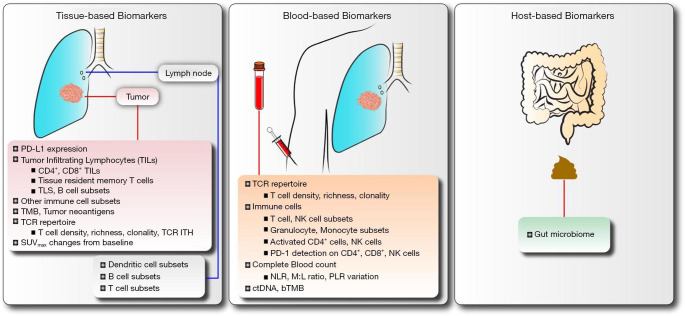
The advent of immune checkpoint inhibitors (ICIs) has dramatically changed the treatment of patients with locally advanced unresectable and metastatic non-small cell lung cancer (NSCLC). Now, ICIs are undergoing evaluation as neoadjuvant therapy in patients with early-stage, resectable NSCLC using candidate surrogate endpoints of clinical efficacy, i.e., major pathologic response (MPR, ≤10% viable tumor cells in resected tumors). The initial results from early, small-scale trials are encouraging; however, they also reveal that a substantial number of patients with operable disease may not benefit from neoadjuvant ICIs. Consequently, much investigative effort is currently directed toward identifying mechanisms of resistance to ICI therapy in resectable NSCLC. There is also an urgent need for biomarkers that could be used to guide the clinical decision-making process and maximize the clinical benefit of ICIs in patients with early-stage, resectable NSCLC. Here, we summarize the initial results from the trials of neoadjuvant ICIs in patients with early-stage and locally advanced operable NSCLC and review the findings of studies investigating emerging biomarkers associated with those trials.
免疫检查点抑制剂(ICI)的出现极大地改变了局部晚期不可切除和转移性非小细胞肺癌(NSCLC)患者的治疗方式。如今,ICI正在作为新辅助治疗在早期可切除NSCLC患者中进行评估,使用临床疗效的候选替代终点,即主要病理反应(MPR,切除肿瘤中存活肿瘤细胞≤10%)。早期小规模试验的初步结果令人鼓舞;然而,这些结果也表明,相当一部分可手术治疗的患者可能无法从新辅助ICI治疗中获益。因此,目前大量研究工作致力于确定可切除NSCLC中ICI治疗耐药的机制。对于可用于指导临床决策过程并使早期可切除NSCLC患者从ICI中获得最大临床益处的生物标志物也有迫切需求。在此,我们总结了早期和局部晚期可手术NSCLC患者新辅助ICI试验的初步结果,并回顾了研究与这些试验相关的新兴生物标志物的研究结果。