Zhang Hai-Ping, Liu Yan-Min, Li Zhao, Ma Yin-Xue, Li Li-Juan, Zhao Dan-Tong, Lou Jin-Li, Gao Zu-Hua, Yan Hui-Ping
Clinical Laboratory Center and Clinical Research Center for Autoimmune Liver Disease, Beijing Youan Hospital, Capital Medical University, Beijing, China.
Department of Liver Disease Immunology, Beijing Youan Hospital, Capital Medical University, Beijing, China.
Ann Transl Med. 2021 Jan;9(2):153. doi: 10.21037/atm-20-8036.
Anti-soluble liver antigen/liver pancreas (anti-SLA/LP) is a highly specific serological marker for the diagnosis of autoimmune hepatitis (AIH). The aim of the present study was to define the clinical characteristics and human leucocyte antigen (HLA) genotypes of Chinese patients with anti-SLA/LP positive AIH.
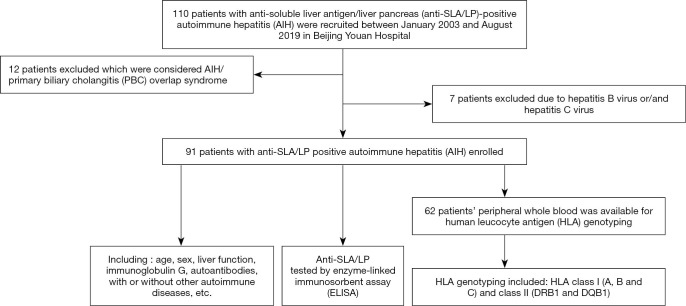
Ninety-one AIH patients who were anti-SLA/LP positive were enrolled in this case control study. Clinical information was obtained through reviewing patients' clinical notes. High-resolution genotyping of HLA-A, B, C, DRB1, and DQB1 alleles was performed by sequence-based typing polymerase chain reaction on 62 of the 91 patients. Data from 500 healthy patients were used as baseline controls.
Anti-SLA/LP-positive AIH patients were characterized as follows: adults (age 20-80 years), female (88%), and frequent anti-nuclear antibody positivity (91%). Genetically, compared with the controls, HLA-B35:01 and C08:01 were significantly more frequent in patients. The frequencies of HLA-B08:01, B40:02, DRB104:01, DRB104:05, DRB114:01, and DRB116:02 increased, and the frequency in DRB115:01 decreased in patients, but did not reach significance after Bonferroni's correction. Patients with other autoimmune diseases had a higher DRB104:05 and DQB104:01 allele carrier frequency than those without. DRB104:05 and DQB1*04:01 alleles were found at increased frequency in patients with decompensated liver disease than those with compensated liver disease.
Chinese anti-SLA/LP-positive AIH patients have some distinct clinical characteristics than other populations reported in the literature. The presence of certain specific HLA alleles could potentially increase the risk of developing anti-SLA/LP-positive AIH or other autoimmune disease and decompensated liver disease in the Chinese population.
抗可溶性肝抗原/肝胰(anti-SLA/LP)是诊断自身免疫性肝炎(AIH)的一种高度特异性血清学标志物。本研究的目的是明确抗SLA/LP阳性AIH中国患者的临床特征和人类白细胞抗原(HLA)基因型。
91例抗SLA/LP阳性的AIH患者纳入本病例对照研究。通过查阅患者临床记录获取临床信息。对91例患者中的62例进行基于序列分型聚合酶链反应的HLA-A、B、C、DRB1和DQB1等位基因高分辨率基因分型。500例健康患者的数据用作基线对照。
抗SLA/LP阳性AIH患者具有以下特征:成年人(年龄20 - 80岁),女性(88%),且抗核抗体阳性率高(91%)。在基因方面,与对照组相比,患者中HLA-B35:01和C08:01的频率显著更高。患者中HLA-B08:01、B40:02、DRB104:01、DRB104:05、DRB114:01和DRB116:02的频率增加,DRB115:01的频率降低,但经Bonferroni校正后未达到显著水平。患有其他自身免疫性疾病的患者比未患患者具有更高的DRB104:05和DQB104:01等位基因携带频率。与代偿期肝病患者相比,失代偿期肝病患者中DRB104:05和DQB1*04:01等位基因的频率增加。
中国抗SLA/LP阳性AIH患者具有一些与文献报道的其他人群不同的临床特征。某些特定HLA等位基因的存在可能会增加中国人群发生抗SLA/LP阳性AIH或其他自身免疫性疾病以及失代偿期肝病的风险。