Department of Medicine, University of Washington School of Medicine, Seattle, WA.
Division of Epidemiology and Population Science, and.
Blood Adv. 2021 Jan 12;5(1):167-175. doi: 10.1182/bloodadvances.2020003353.
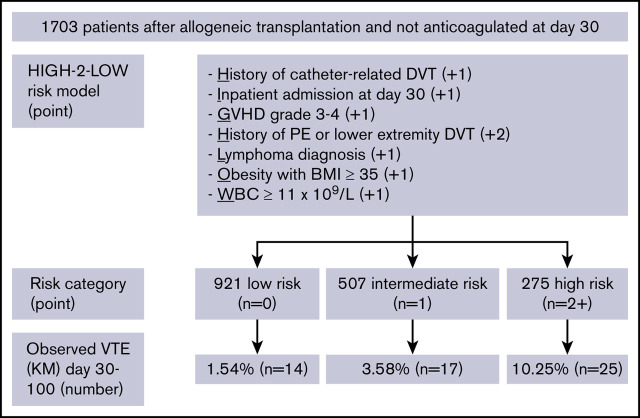
Venous thromboembolism (VTE) after allogeneic hematopoietic cell transplantation (HCT) is a significant treatment-associated complication, although optimal timing of thromboprophylaxis remains uncertain when weighing concurrent risks of bleeding. We aimed to derive and internally validate a risk assessment model (RAM) using patients who underwent first allogeneic HCT from 2006 through 2015 (n = 1703). Index date was defined as the 30th day after transplant, at which point we estimated >75% of patients would have achieved platelet engraftment >50 × 109/L. Stepwise logistic regression modeling was used for model development, and internal validation was achieved by fitting a logistic regression model with 1000 bootstrapped resamples to estimate the optimism-corrected c-statistic. The final RAM, "HIGH-2-LOW," included 7 predictors obtained at 30 days after transplant: History of catheter-related deep venous thrombosis (DVT), Inpatient at day 30, Graft-versus-host disease grade 3 to 4, History of pulmonary embolism or lower-extremity DVT, Lymphoma diagnosis, Obesity with body mass index ≥35 kg/m2, and White blood cell count ≥11 × 109/L. Approximately 16% of patients were stratified as high risk, with incident VTE rate of 10.3% at 100 days compared with 1.5% for those at low risk. VTE odds ratios at 100 days were 5.87 (95% confidence interval [CI], 2.98-11.57) and 2.71 (95% CI, 1.38-5.35) in the high- and intermediate-risk vs low-risk groups, respectively. HIGH-2-LOW model serves as a novel and potentially clinically meaningful tool to identify high-risk allogeneic HCT patients who may benefit from early thromboprophylaxis after platelet engraftment.
异基因造血细胞移植(HCT)后静脉血栓栓塞症(VTE)是一种重要的治疗相关并发症,尽管在权衡出血的并发风险时,最佳的血栓预防时机仍不确定。我们旨在使用 2006 年至 2015 年间接受首次异基因 HCT 的患者来推导和内部验证风险评估模型(RAM)(n=1703)。索引日期定义为移植后第 30 天,此时我们估计>75%的患者血小板植入>50×109/L。逐步逻辑回归模型用于模型开发,通过拟合 1000 个 bootstrap 重采样的逻辑回归模型来估计优化校正的 c 统计量,实现内部验证。最终的 RAM“高 2-低”包括移植后 30 天获得的 7 个预测因子:导管相关深静脉血栓形成(DVT)病史、第 30 天住院、移植物抗宿主病 3 至 4 级、肺栓塞或下肢 DVT 病史、淋巴瘤诊断、肥胖症(体重指数≥35 kg/m2)和白细胞计数≥11×109/L。约 16%的患者被分层为高危,100 天内 VTE 发生率为 10.3%,而低危患者为 1.5%。高危组和中危组在 100 天时的 VTE 比值分别为 5.87(95%置信区间[CI],2.98-11.57)和 2.71(95%CI,1.38-5.35)。HIGH-2-LOW 模型是一种新颖的、潜在具有临床意义的工具,可以识别出在血小板植入后可能受益于早期血栓预防的高危异基因 HCT 患者。