Krah D L, Choppin P W
Rockefeller University, New York, New York 10021.
J Virol. 1988 May;62(5):1565-72. doi: 10.1128/JVI.62.5.1565-1572.1988.
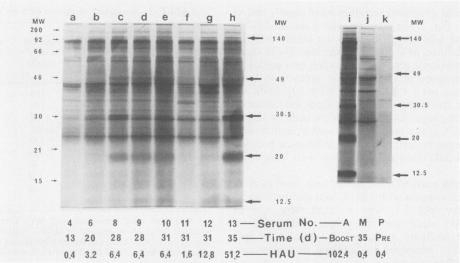
Mice were immunized with measles virus to determine whether an auto-anti-idiotypic antireceptor response could be generated as a probe for measles virus receptors. Mice initially responded to viral antigens (days 11 to 18) and subsequently developed antibodies to a putative measles virus receptor (peak at day 30 to 35) by three criteria: the sera (1) agglutinated erythrocytes which virus agglutinates, (2) reacted with Vero cells, and (3) inhibited virus attachment to Vero cells. Additionally, select sera inhibited virus infection of Vero cells. The cell-reactive activity was identified as immunoglobulin G antibody and was neutralized by sera reacting with virus (idiotype). The application of this anti-idiotypic antibody to identify measles virus-binding sites on Vero cells was revealed by the ability of sera to immunoprecipitate 20- and 30.5-kilodalton proteins from metabolically labeled ([35S]methionine) Vero cells.
用麻疹病毒免疫小鼠,以确定是否能产生自身抗独特型抗受体反应,作为检测麻疹病毒受体的一种手段。小鼠最初对病毒抗原产生反应(第11至18天),随后通过三个标准产生了针对假定的麻疹病毒受体的抗体(第30至35天达到峰值):血清(1)能凝集病毒所凝集的红细胞,(2)与Vero细胞发生反应,(3)抑制病毒附着于Vero细胞。此外,部分血清还能抑制Vero细胞的病毒感染。细胞反应活性被鉴定为免疫球蛋白G抗体,并被与病毒反应的血清(独特型)中和。血清能够从经代谢标记([35S]甲硫氨酸)的Vero细胞中免疫沉淀出20和30.5千道尔顿的蛋白质,这表明了这种抗独特型抗体在鉴定Vero细胞上麻疹病毒结合位点方面的应用。