Morishita Asahiro, Oura Kyoko, Tadokoro Tomoko, Fujita Koji, Tani Joji, Masaki Tsutomu
Department of Gastroenterology and Neurology, Faculty of Medicine, Kagawa University, Kagawa 761-0793, Japan.
Cancers (Basel). 2021 Jan 29;13(3):514. doi: 10.3390/cancers13030514.
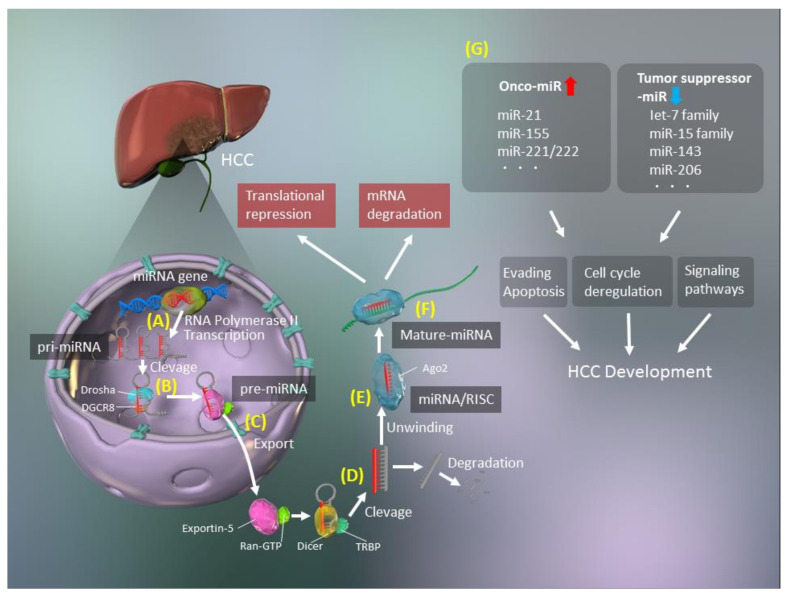
Hepatocellular carcinoma (HCC) is the seventh most frequent cancer and the fourth leading cause of cancer mortality worldwide. Despite substantial advances in therapeutic strategies, the prognosis of late-stage HCC remains dismal because of the high recurrence rate. A better understanding of the etiology of HCC is therefore necessary to improve outcomes. MicroRNAs (miRNAs) are small, endogenous, noncoding, single-stranded RNAs that modulate the expression of their target genes at the posttranscriptional and translational levels. Aberrant expression of miRNAs has frequently been detected in cancer-associated genomic regions or fragile sites in various human cancers and has been observed in both HCC cells and tissues. The precise patterns of aberrant miRNA expression differ depending on disease etiology, including various causes of hepatocarcinogenesis, such as viral hepatitis, alcoholic liver disease, or nonalcoholic steatohepatitis. However, little is known about the underlying mechanisms and the association of miRNAs with the pathogenesis of HCC of various etiologies. In the present review, we summarize the key mechanisms of miRNAs in the pathogenesis of HCC and emphasize their potential utility as valuable diagnostic and prognostic biomarkers, as well as innovative therapeutic targets, in HCC diagnosis and treatment.
肝细胞癌(HCC)是全球第七大常见癌症,也是癌症死亡的第四大主要原因。尽管治疗策略取得了重大进展,但由于复发率高,晚期HCC的预后仍然很差。因此,更好地了解HCC的病因对于改善治疗结果很有必要。微小RNA(miRNA)是小的、内源性的、非编码的单链RNA,它们在转录后和翻译水平上调节其靶基因的表达。在各种人类癌症的癌症相关基因组区域或脆弱位点经常检测到miRNA的异常表达,并且在HCC细胞和组织中也观察到这种情况。miRNA异常表达的精确模式因疾病病因而异,包括肝癌发生的各种原因,如病毒性肝炎、酒精性肝病或非酒精性脂肪性肝炎。然而,关于miRNA的潜在机制以及miRNA与各种病因的HCC发病机制之间的关联,我们知之甚少。在本综述中,我们总结了miRNA在HCC发病机制中的关键机制,并强调它们作为有价值的诊断和预后生物标志物以及创新治疗靶点在HCC诊断和治疗中的潜在用途。