Graduate School of Health and Sports Science, Doshisha University, Kyoto 610-0394, Japan.
Division of Bioengineering, Graduate School of Engineering Science, Osaka University, Osaka 560-8531, Japan.
Nutrients. 2021 Jan 30;13(2):459. doi: 10.3390/nu13020459.
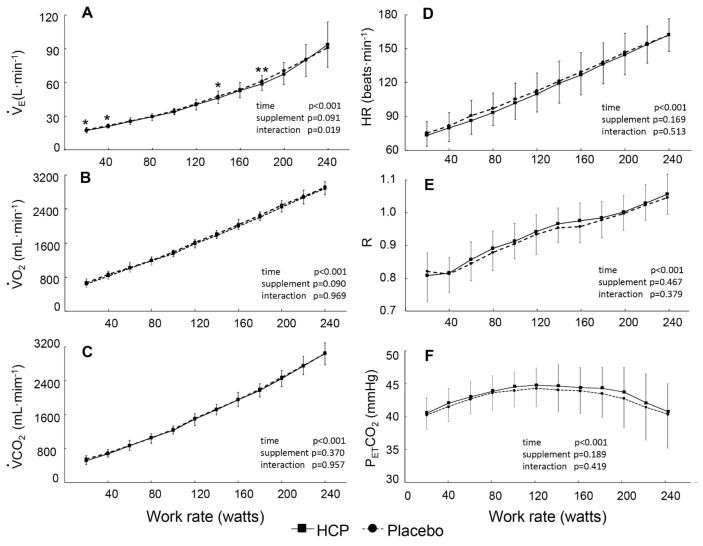
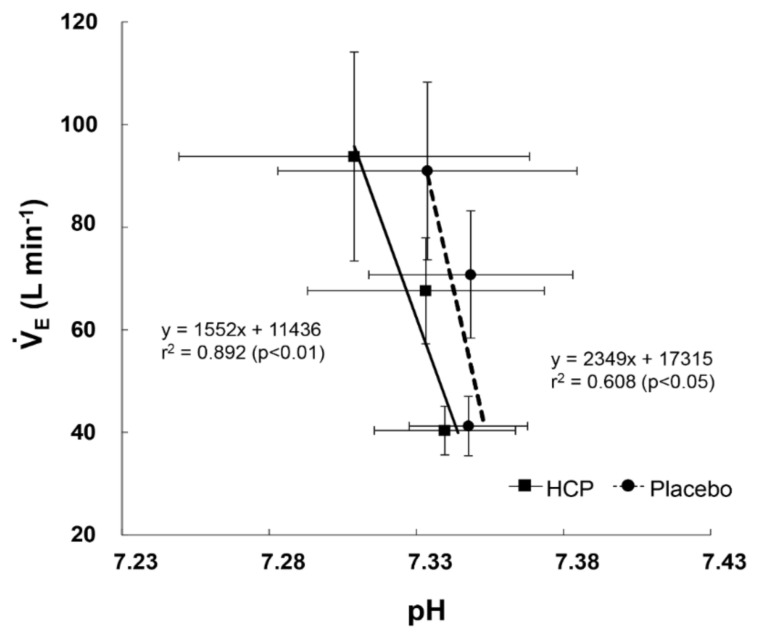
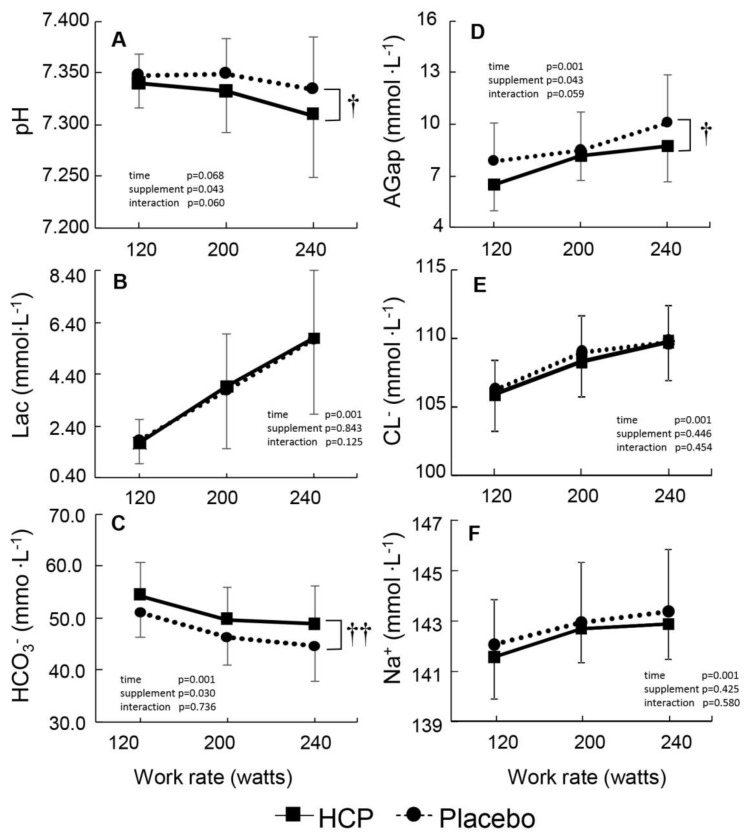
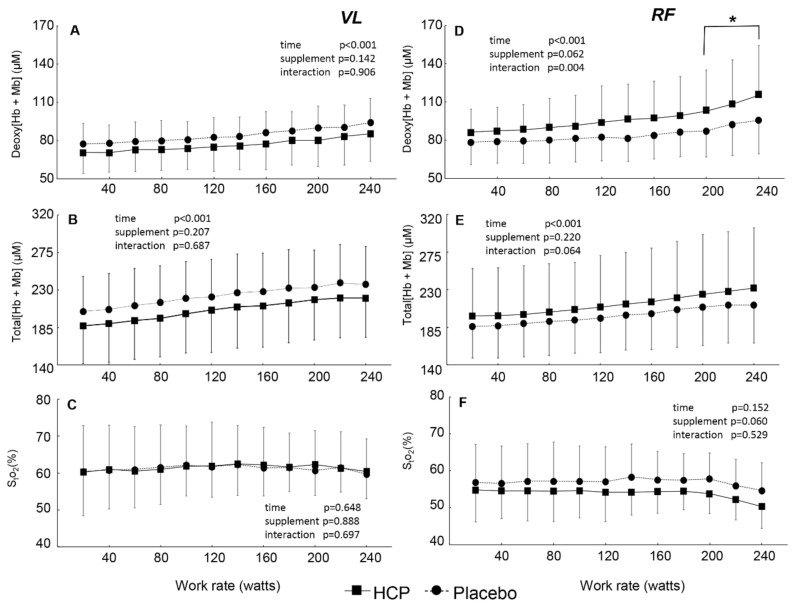
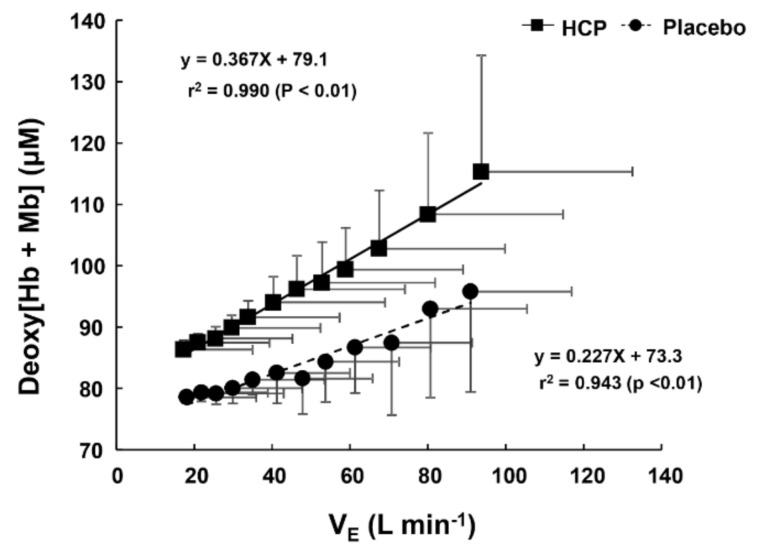
We investigated effects of molecular hydrogen (H) supplementation on acid-base status, pulmonary gas exchange responses, and local muscle oxygenation during incremental exercise. Eighteen healthy, trained subjects in a randomized, double-blind, crossover design received H-rich calcium powder (HCP) (1500 mg/day, containing 2.544 µg/day of H) or H-depleted placebo (1500 mg/day) for three consecutive days. They performed cycling incremental exercise starting at 20-watt work rate, increasing by 20 watts/2 min until exhaustion. Breath-by-breath pulmonary ventilation (V˙) and CO output (V˙CO) were measured and muscle deoxygenation (deoxy[Hb + Mb]) was determined via time-resolved near-infrared spectroscopy in the (VL) and (RF). Blood gases' pH, lactate, and bicarbonate (HCO) concentrations were measured at rest and 120-, 200-, and 240-watt work rates. At rest, the HCP group had significantly lower V˙, V˙CO, and higher HCO, partial pressures of CO (PCO) versus placebo. During exercise, a significant pH decrease and greater HCO continued until 240-watt workload in HCP. The V˙ was significantly lower in HCP versus placebo, but HCP did not affect the gas exchange status of V˙CO or oxygen uptake (V˙O). HCP increased absolute values of deoxy[Hb + Mb] at the RF but not VL. Thus, HCP-induced hypoventilation would lead to lower pH and secondarily impaired balance between O delivery and utilization in the local RF during exercise, suggesting that HCP supplementation, which increases the at-rest antioxidant potential, affects the lower ventilation and pH status during incremental exercise. HPC induced a significantly lower O delivery/utilization ratio in the RF but not the VL, which may be because these regions possess inherently different vascular/metabolic control properties, perhaps related to fiber-type composition.
我们研究了分子氢(H)补充对递增运动期间酸碱状态、肺气体交换反应和局部肌肉氧合的影响。18 名健康、训练有素的受试者以随机、双盲、交叉设计接受 H 丰富的碳酸钙(HCP)(1500 毫克/天,含有 2.544 微克/天的 H)或 H 耗尽的安慰剂(1500 毫克/天)连续三天。他们以 20 瓦的工作率开始进行自行车递增运动,每 2 分钟增加 20 瓦,直到力竭。通过呼吸到呼吸肺通气(V˙)和 CO 输出(V˙CO)进行测量,并通过时间分辨近红外光谱在(VL)和(RF)中确定肌肉去氧(去氧[Hb + Mb])。在休息时和 120、200 和 240 瓦工作率时测量血液气体的 pH、乳酸和碳酸氢盐(HCO)浓度。在休息时,与安慰剂相比,HCP 组的 V˙、V˙CO 显著降低,HCO 分压(PCO)更高。在运动过程中,HCP 中的 pH 显著降低,HCO 持续增加,直到 240 瓦的工作量。与安慰剂相比,HCP 中的 V˙ 明显较低,但 HCP 不影响 V˙CO 或氧摄取(V˙O)的气体交换状态。HCP 增加了 RF 中绝对的 deoxy[Hb + Mb]值,但 VL 没有。因此,HCP 诱导的通气不足会导致运动期间局部 RF 中的 pH 值降低和 O 输送与利用之间的平衡受损,表明增加静息抗氧化能力的 HCP 补充会影响递增运动期间的通气和 pH 状态。HPC 在 RF 中引起显著较低的 O 输送/利用率,但在 VL 中没有,这可能是因为这些区域具有固有的不同血管/代谢控制特性,可能与纤维类型组成有关。