Cervicodynia/Omalgia/Lumbago/Sciatica Department 2, Sichuan Provincial Orthopedics Hospital, No. 132 West First Section First Ring Road, Wuhou District, Chengdu, Sichuan Province, China.
Experiment Teaching Center for Preclinical Medicine, Chengdu Medical College, No. 783, Xindu Avenue, Xindu District, Chengdu, Sichuan Province, China.
J Orthop Surg Res. 2021 Feb 11;16(1):130. doi: 10.1186/s13018-021-02280-1.
Although integrated traditional Chinese medicine (TCM) has long been indicated to be effective in the treatment of sciatica and is widely used in the management of this condition, the mechanism by which integrated TCM alleviates sciatica has not yet been fully defined, and the effect of integrated TCM on gene expression in the peripheral blood of patients with sciatica is still unknown. We performed this study to investigate the effect of integrated TCM on peripheral blood gene expression in patients with sciatica and to explore new clues for studying the mechanism of integrated TCM in alleviating sciatica.
We used a microarray to identify differentially expressed genes (DEGs) in the peripheral blood of patients with sciatica and healthy controls (DEGs-baseline), bioinformatic analysis to reveal the characteristics of DEGs-baseline, and the key genes that contribute to the gene dysregulation. A microarray was also used to identify DEGs in the peripheral blood of patients with sciatica after integrated TCM treatment compared with those at baseline, and the expression levels of DEGs were validated by qRT-PCR.
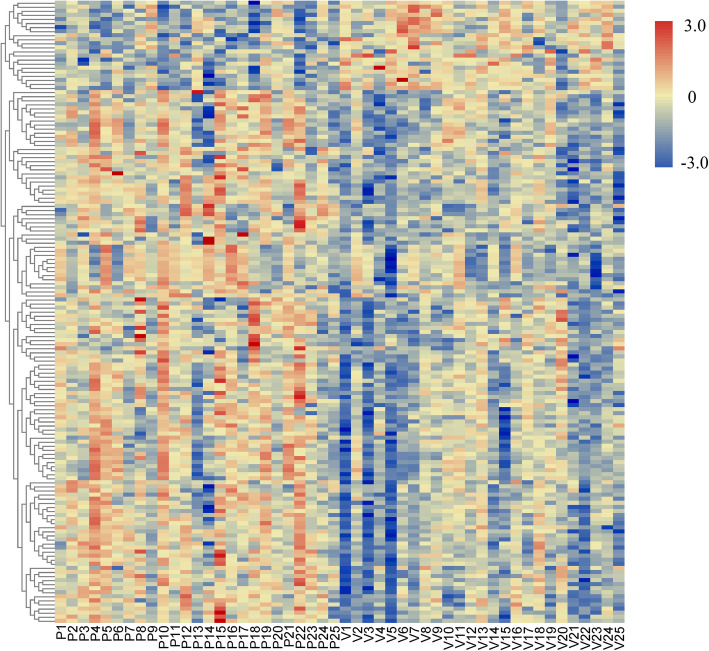
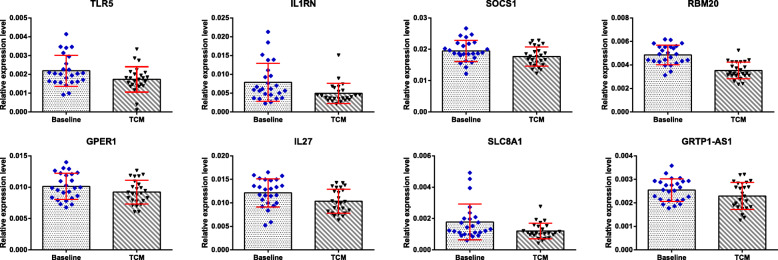
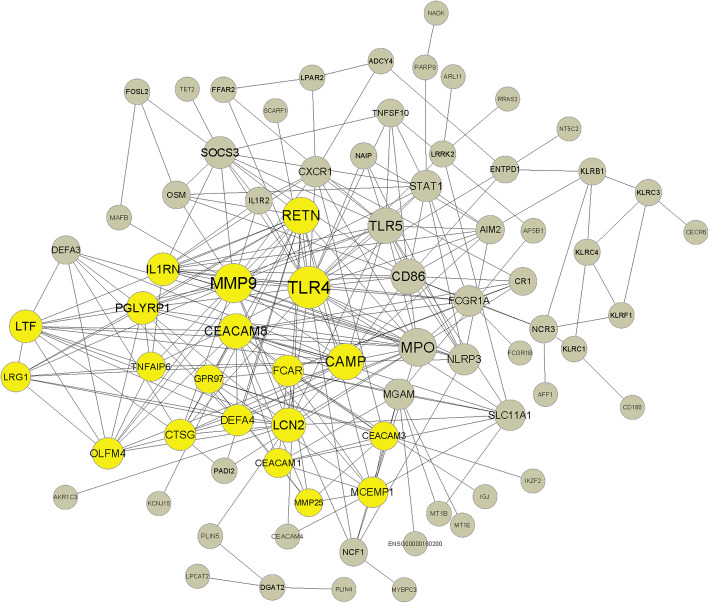
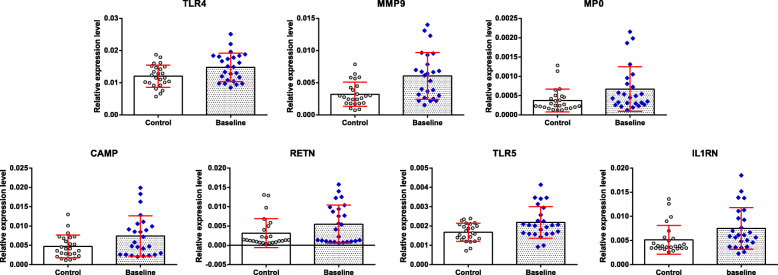
We identified 153 DEGs-baseline, which included 131 upregulated genes and 22 downregulated genes. Bioinformatic analysis revealed that most of the DEGs-baseline were related to immunity and the inflammatory response and that TLR4, MMP9, MPO, CAMP, RETN, TLR5, and IL1RN were key genes involved in the dysregulation of genes in the peripheral blood of patients with sciatica. The expression levels of TLR5, IL1RN, SLC8A1, RBM20, GPER1, IL27, SOCS1, and GRTP1-AS1 were decreased in the peripheral blood of patients after integrated TCM treatment compared with that at baseline, which was accompanied by relief of pain.
Integrated TCM treatment relieved pain while regulating the gene expression of TLR5, IL1RN, SLC8A1, RBM20, GPER1, IL27, SOCS1, and GRTP1-AS1 in the peripheral blood of patients with sciatica. Our study provides new clues for studying the mechanism of TCM in treating sciatica.
虽然综合中医药(TCM)长期以来被证明对坐骨神经痛的治疗有效,并且广泛应用于该疾病的管理,但综合 TCM 缓解坐骨神经痛的机制尚未完全确定,综合 TCM 对坐骨神经痛患者外周血基因表达的影响也尚不清楚。我们进行这项研究旨在探讨综合 TCM 对坐骨神经痛患者外周血基因表达的影响,并探索研究综合 TCM 缓解坐骨神经痛机制的新线索。
我们使用微阵列技术鉴定坐骨神经痛患者和健康对照组(基线)外周血中的差异表达基因(DEGs),进行生物信息学分析以揭示 DEGs-baseline 的特征,并确定导致基因失调的关键基因。我们还使用微阵列技术鉴定了综合 TCM 治疗后与基线相比坐骨神经痛患者外周血中的 DEGs,并通过 qRT-PCR 验证 DEGs 的表达水平。
我们鉴定出 153 个 DEGs-baseline,其中包括 131 个上调基因和 22 个下调基因。生物信息学分析表明,大多数 DEGs-baseline 与免疫和炎症反应有关,TLR4、MMP9、MPO、CAMP、RETN、TLR5 和 IL1RN 是涉及坐骨神经痛患者外周血基因失调的关键基因。与基线相比,综合 TCM 治疗后患者外周血中 TLR5、IL1RN、SLC8A1、RBM20、GPER1、IL27、SOCS1 和 GRTP1-AS1 的表达水平降低,同时疼痛得到缓解。
综合 TCM 治疗缓解了疼痛,同时调节了坐骨神经痛患者外周血中 TLR5、IL1RN、SLC8A1、RBM20、GPER1、IL27、SOCS1 和 GRTP1-AS1 的基因表达。我们的研究为研究 TCM 治疗坐骨神经痛的机制提供了新的线索。