Arts et Metiers ParisTech, Institut de Biomecanique Humaine Georges Charpak, Paris, France.
Physical Medicine and Pediatric Rehabilitation Department, Hôpital Armand Trousseau, APHP, Sorbonne Université, 26 avenue du Docteur Arnold Netter, 75012, Paris, France.
Sci Rep. 2021 Feb 11;11(1):3577. doi: 10.1038/s41598-021-82005-w.
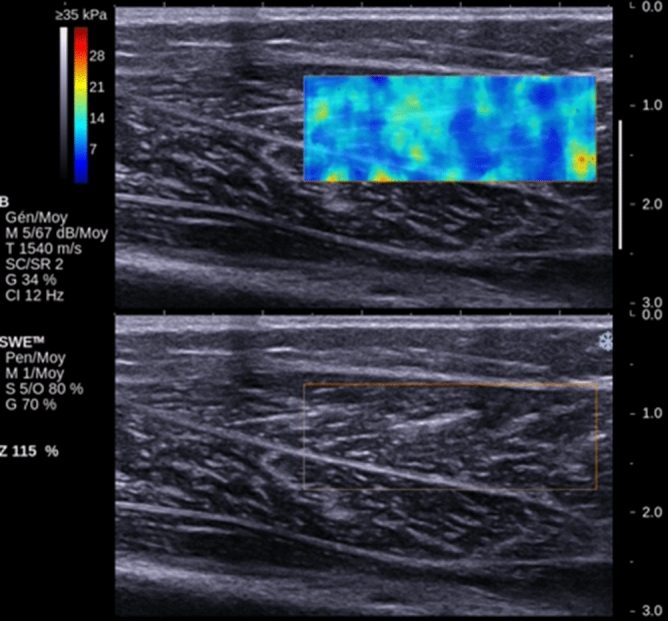
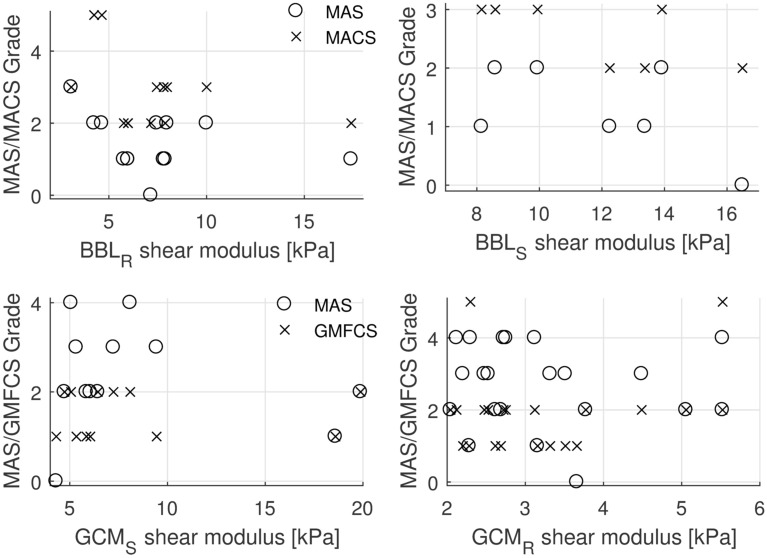
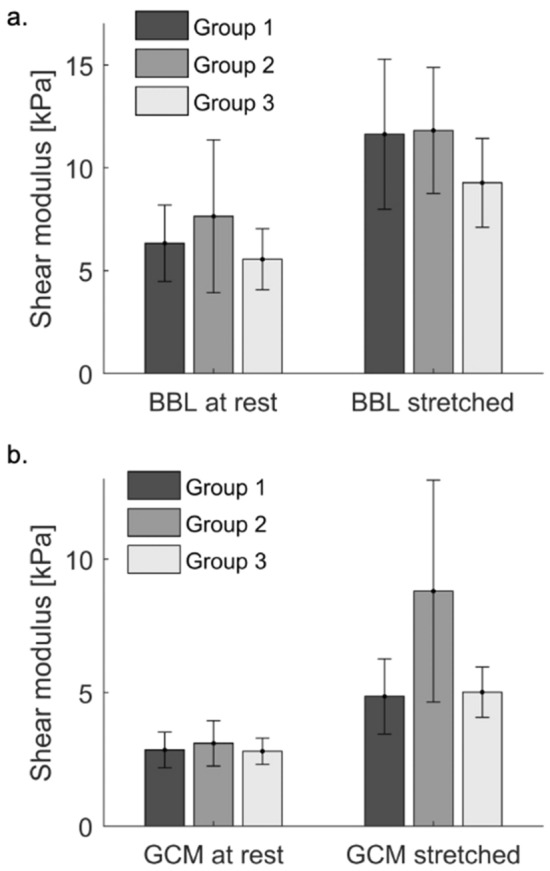
Shear wave elastography (SWE) is an ultrasound technique to obtain soft tissue mechanical properties. The aim of this study was to establish the reliability of SWE in young children, define reference data on healthy ones and compare the shear modulus of healthy and spastic muscles from cerebral palsy (CP). The reproducibility is evaluated: at rest, on 7 children without any musculoskeletal pathology by 3 different operators, on 2 muscles: biceps brachii long head and medial gastrocnemius. The comparison study was made, on the same 2 muscles, at rest and under passive stretching, with a control group (29 healthy children), a spastic group (spastic muscles of 16 children from CP) and a non-spastic group (non-spastic muscles of 14 children from CP). The intra-operator reliability and inter-operator reliability, in terms of standard deviation, were 0.6 kPa (11.2% coefficient of variation (CV)) and 0.8 kPa (14.9% CV) for the biceps, respectively, and 0.4 kPa (11.5% CV) and 0.5 kPa (13.8% CV) for the gastrocnemius. At rest, no significant difference was found. Under passive stretching, the non-spastic CP biceps were significantly stiffer than the control ones (p = 0.033). Spastic gastrocnemius had a higher shear modulus than in the control muscles (p = 0.0003) or the non-spastic CP muscles (p = 0.017). CP stretched medial gastrocnemius presented an abnormally high shear moduli for 50% of patients.
剪切波弹性成像(SWE)是一种获取软组织力学特性的超声技术。本研究旨在评估 SWE 在幼儿中的可靠性,确定健康幼儿的参考数据,并比较脑瘫(CP)患儿痉挛和非痉挛肌肉的剪切模量。评估重复性:在 7 名无任何肌肉骨骼疾病的儿童中,由 3 名不同的操作者在休息时对肱二头肌长头和内侧比目鱼肌进行 3 次测量。在休息时和被动拉伸下,对同一 2 块肌肉(肱二头肌和内侧比目鱼肌)进行比较研究,对照组为 29 名健康儿童,痉挛组为 16 名 CP 患儿的痉挛肌肉,非痉挛组为 14 名 CP 患儿的非痉挛肌肉。在肱二头肌方面,操作者内和操作者间的可靠性分别为 0.6 kPa(11.2%变异系数(CV))和 0.8 kPa(14.9% CV),在比目鱼肌方面,分别为 0.4 kPa(11.5% CV)和 0.5 kPa(13.8% CV)。在休息时,未发现显著差异。在被动拉伸下,CP 患儿的非痉挛性肱二头肌明显比对照组僵硬(p = 0.033)。痉挛性比目鱼肌的剪切模量高于对照组肌肉(p = 0.0003)或非痉挛性 CP 肌肉(p = 0.017)。50%的 CP 患儿拉伸后的内侧比目鱼肌的剪切模量异常高。