Langer Corey J, Gajra Ajeet, Gridelli Cesare, Konduri Kartik, Morgensztern Daniel, Spigel David, Talbot Denis, Thomas Michael, Weiss Jared, Pilot Richard, Bhore Rafia, Wolfsteiner Marianne, Ong Teng Jin, Socinski Mark
Abramson Cancer Center, University of Pennsylvania, Philadelphia, PA, United States.
SUNY Upstate Medical University, Department of Medicine, Syracuse, NY, United States.
Front Oncol. 2021 Jan 26;10:485587. doi: 10.3389/fonc.2020.485587. eCollection 2020.
Despite improvements in the treatment of advanced non-small cell lung cancer (NSCLC), certain patient populations remain underrepresented in clinical trials. Many patients have benefited from platinum doublets, including -paclitaxel-based regimens, but there are patients with comorbidities who particularly require careful balancing of efficacy and safety. Clinical trial data are limited for patients who are elderly or have renal impairment, diabetes, or impaired performance status.
To better understand outcomes in these patient populations, we performed a pooled analysis using data from the ABOUND clinical trial program (ABOUND.SQM, ABOUND.PS2, ABOUND.70+) and the key phase III trial of -paclitaxel/carboplatin in advanced NSCLC. The populations included in this pooled analysis consisted of elderly patients (≥ 70 years) and patients with renal impairment (eGFR < 60 ml/min/1.73 m), diabetes, or poor performance status (ECOG PS 2).
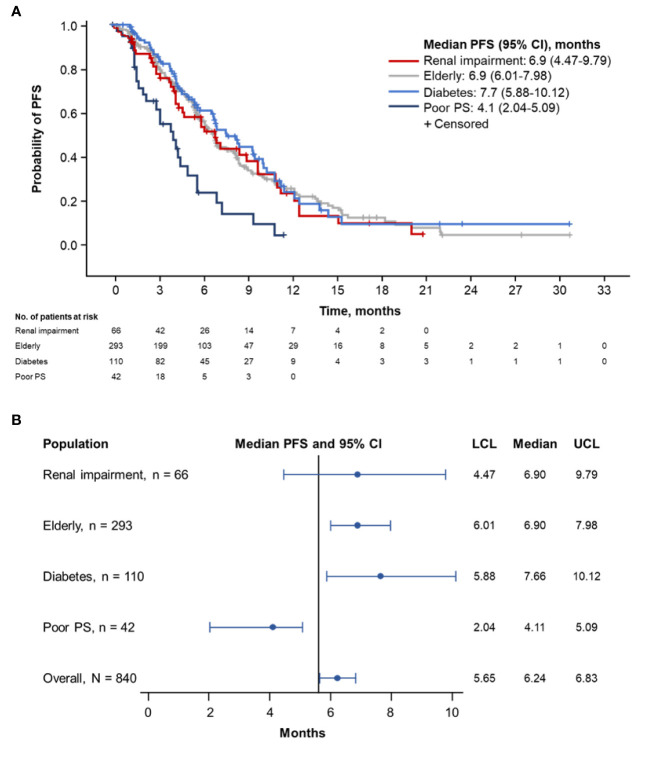
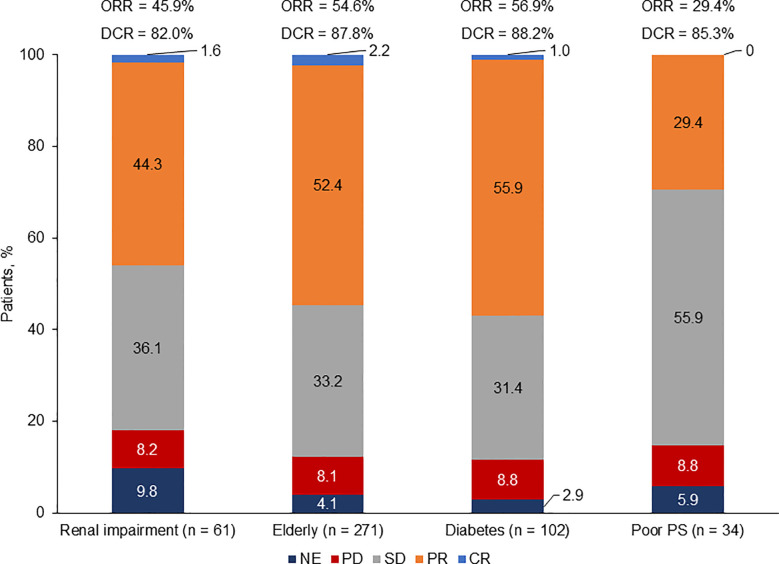
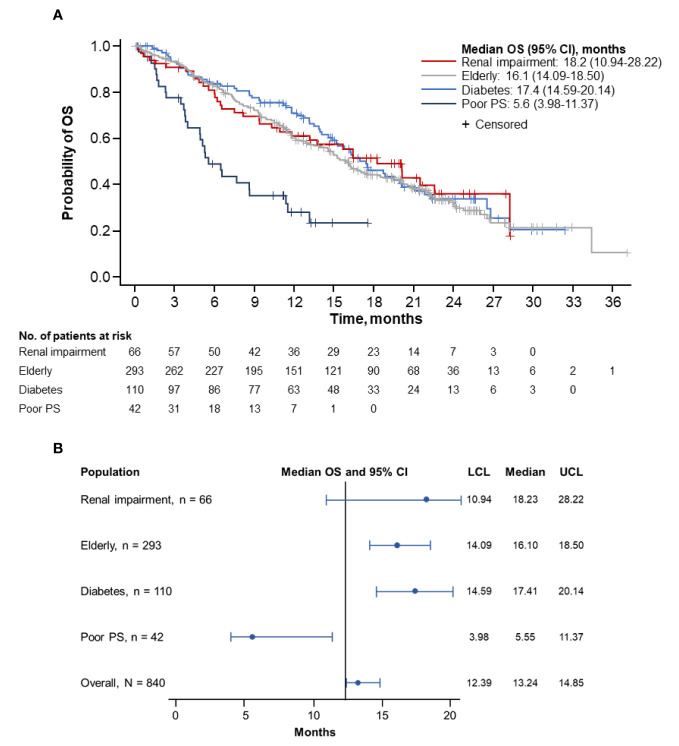
Median progression-free survival (PFS) ranged from 4.1 months in patients with ECOG PS 2 (95% CI, 2.04-5.09 months) to 7.7 months in patients with diabetes (95% CI, 5.88-10.12 months). PFS for elderly patients and patients with renal impairment was 6.9 months each (95% CI, 6.01-7.98 months and 4.47-9.79 months, respectively). Median overall survival (OS) was 18.2 months (95% CI, 10.94-28.22 months), 17.4 months (95% CI, 14.59-20.14 months), and 16.1 months (95% CI, 14.09-18.50 months) in patients with renal impairment, patients with diabetes, and elderly patients, respectively. Patients with ECOG PS 2 exhibited the shortest median OS: 5.6 months (95% CI, 3.98-11.37 months). Overall response rates were 56.9%, 54.6%, 45.9%, and 29.4% in patients with diabetes, elderly patients, patients with renal impairment, and patients with ECOG PS 2, respectively. Most treatment-related adverse events were hematologic. The most common grade 3/4 hematologic adverse events in patients with renal impairment, elderly patients, patients with diabetes, and patients with poor performance status included neutropenia, anemia, and thrombocytopenia.
Although survival data in patients with ECOG PS 2 were notably inferior to the other cohorts, our findings are consistent with those previously reported in the population-specific studies of the ABOUND trials and lend additional support for the use of -paclitaxel-based regimens in historically understudied and vulnerable populations.
尽管晚期非小细胞肺癌(NSCLC)的治疗有所改善,但某些患者群体在临床试验中的代表性仍然不足。许多患者已从铂类双联疗法中获益,包括基于紫杉醇的方案,但有合并症的患者尤其需要仔细权衡疗效和安全性。对于老年患者或有肾功能损害、糖尿病或体能状态不佳的患者,临床试验数据有限。
为了更好地了解这些患者群体的治疗结果,我们使用ABOUND临床试验项目(ABOUND.SQM、ABOUND.PS2、ABOUND.70+)以及晚期NSCLC中紫杉醇/卡铂关键III期试验的数据进行了汇总分析。该汇总分析纳入的人群包括老年患者(≥70岁)以及有肾功能损害(估算肾小球滤过率<60 ml/min/1.73 m²)、糖尿病或体能状态不佳(东部肿瘤协作组体能状态2级)的患者。
无进展生存期(PFS)中位数在东部肿瘤协作组体能状态2级患者中为4.1个月(95%置信区间,2.04 - 5.09个月),在糖尿病患者中为7.7个月(95%置信区间,5.88 - 10.12个月)。老年患者和肾功能损害患者的PFS均为6.9个月(95%置信区间分别为6.01 - 7.98个月和4.47 - 9.79个月)。总生存期(OS)中位数在肾功能损害患者中为18.2个月(95%置信区间,10.94 - 28.22个月),在糖尿病患者中为17.4个月(95%置信区间,14.59 - 20.14个月),在老年患者中为16.1个月(95%置信区间,14.09 - 18.50个月)。东部肿瘤协作组体能状态2级患者的OS中位数最短:5.6个月(95%置信区间,3.98 - 11.37个月)。糖尿病患者、老年患者、肾功能损害患者和东部肿瘤协作组体能状态2级患者的总体缓解率分别为56.9%、54.6%、45.9%和29.4%。大多数与治疗相关的不良事件为血液学不良事件。肾功能损害患者、老年患者、糖尿病患者和体能状态不佳患者中最常见的3/4级血液学不良事件包括中性粒细胞减少、贫血和血小板减少。
尽管东部肿瘤协作组体能状态2级患者的生存数据明显低于其他队列,但我们的研究结果与ABOUND试验针对特定人群的既往研究结果一致,并为在历史上研究不足且脆弱的人群中使用基于紫杉醇的方案提供了更多支持。