Unit of Clinical Pharmacology, Department of Biomedical and Clinical Sciences L. Sacco, "Luigi Sacco" University Hospital, Università di Milano, Milan, Italy.
Scientific Institute, IRCCS E. Medea, Bosisio Parini, Italy.
Int J Neuropsychopharmacol. 2021 Jul 14;24(6):477-489. doi: 10.1093/ijnp/pyab005.
Hyponatremia associated with antipsychotic drugs is a rare but potentially life-threatening adverse drug reaction; the underlying pharmacological mechanism has not yet been explained.
We investigated the relationship between pharmacological targets of antipsychotic drugs and the occurrence of hyponatremia by conducting a nested case-control study using the Food and Drug Administration Adverse Event Reporting System database. Multiple logistic regression was used to determine the associations between antipsychotics receptor occupancy and hyponatremia. We also performed a systematic review of clinical studies on this association.
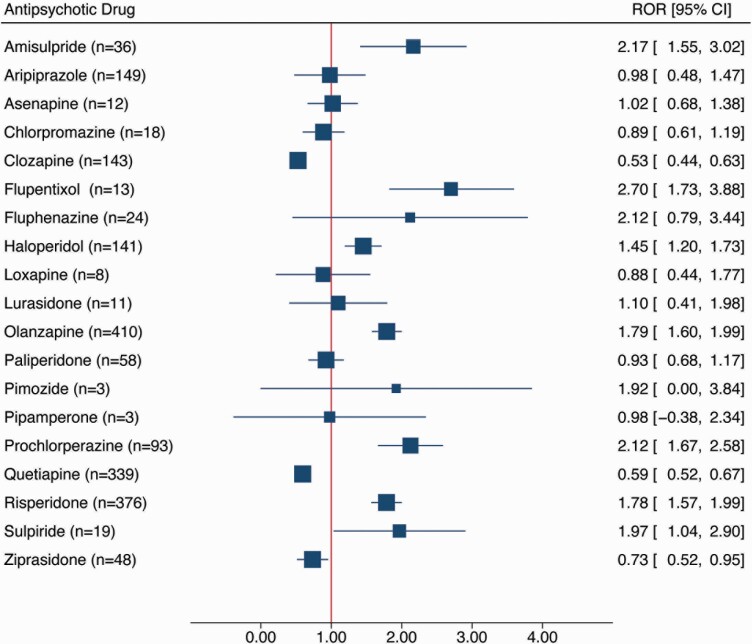
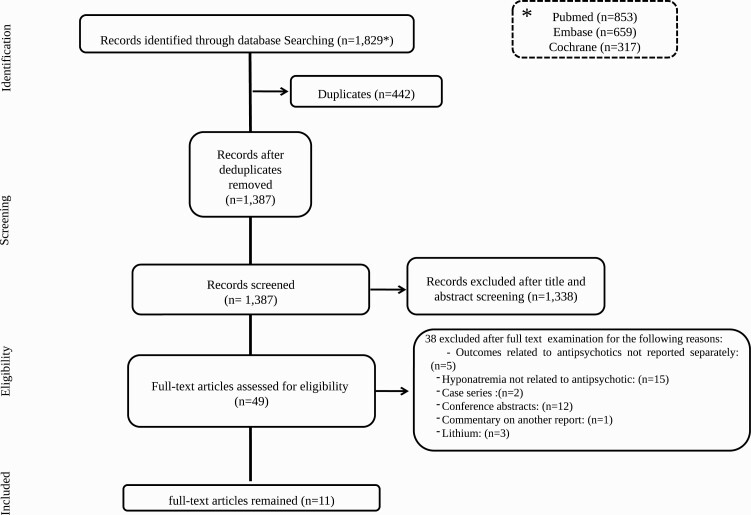
Of 139 816 reports involving at least 1 antipsychotic, 1.1% reported hyponatremia. Olanzapine was the most frequently suspected drug (27%). A significant positive association was found between dopamine D3, D4, and hyponatremia, while adrenergic α 1, serotonin 5-HT1A, and 5-HT2A receptor occupancies were negatively associated. A multivariable stepwise regression model showed that dopamine D3 (adj. odds ratio = 1.21; 95% CI = 1.09-1.34; P < .05) predicted the risk for hyponatremia (P < .05), while serotonin 5-HT2A occupancy (Adj. odds ratio = 0.78; 95% CI = 0.68-0.90; P < .01) exhibited a protective effect against hyponatremia. Among the 11 studies included in the systematic review, incidence rates of hyponatremia diverged between 0.003% and 86%, whereas the odds of developing hyponatremia from effect studies ranged between 0.83 and 3.47.
Antipsychotic drugs having a combined modest occupancy for D3 and 5-HT2A receptors and higher levels of D3 receptor occupancy correspond to different degrees of risk for hyponatremia. Based on the few, relatively large-scale available studies, atypical antipsychotics have a more attenuated risk profile for hyponatremia.
抗精神病药物相关的低钠血症是一种罕见但可能危及生命的药物不良反应,其潜在的药理学机制尚未得到解释。
我们使用食品和药物管理局不良事件报告系统数据库,进行了一项嵌套病例对照研究,以调查抗精神病药物的药理学靶点与低钠血症发生之间的关系。采用多变量逻辑回归来确定抗精神病药物受体占有率与低钠血症之间的关系。我们还对该相关性的临床研究进行了系统回顾。
在涉及至少 1 种抗精神病药物的 139816 份报告中,有 1.1%报告了低钠血症。奥氮平是最常被怀疑的药物(27%)。多巴胺 D3、D4 与低钠血症之间存在显著的正相关,而肾上腺素能α1、5-羟色胺 5-HT1A 和 5-HT2A 受体占有率则呈负相关。多变量逐步回归模型显示,多巴胺 D3(调整后的优势比=1.21;95%可信区间=1.09-1.34;P<0.05)可预测低钠血症的风险(P<0.05),而 5-羟色胺 5-HT2A 占有率(调整后的优势比=0.78;95%可信区间=0.68-0.90;P<0.01)则对低钠血症有保护作用。在系统综述中纳入的 11 项研究中,低钠血症的发生率在 0.003%至 86%之间存在差异,而从效应研究中发生低钠血症的几率在 0.83 至 3.47 之间。
抗精神病药物对 D3 和 5-HT2A 受体的联合中等占有率以及 D3 受体占有率较高,与低钠血症的风险程度不同。基于少数相对较大规模的可用研究,非典型抗精神病药物发生低钠血症的风险特征更缓和。