Department of Internal Medicine II, University Hospital Würzburg, Würzburg, Germany.
Mildred Scheel Early Career Center Würzburg, Würzburg, Germany.
Ann Hematol. 2021 Jun;100(6):1537-1546. doi: 10.1007/s00277-021-04447-6. Epub 2021 Feb 11.
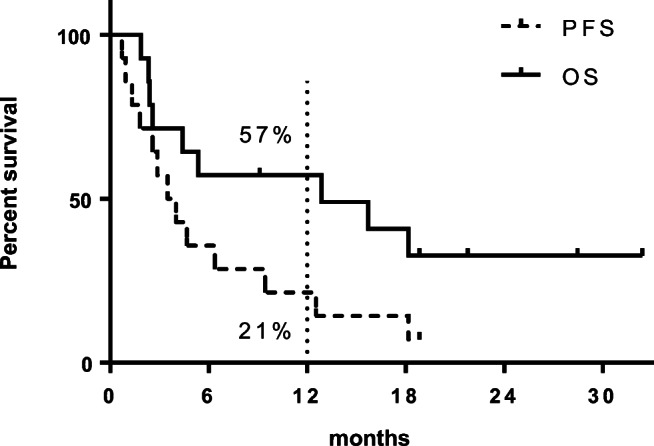
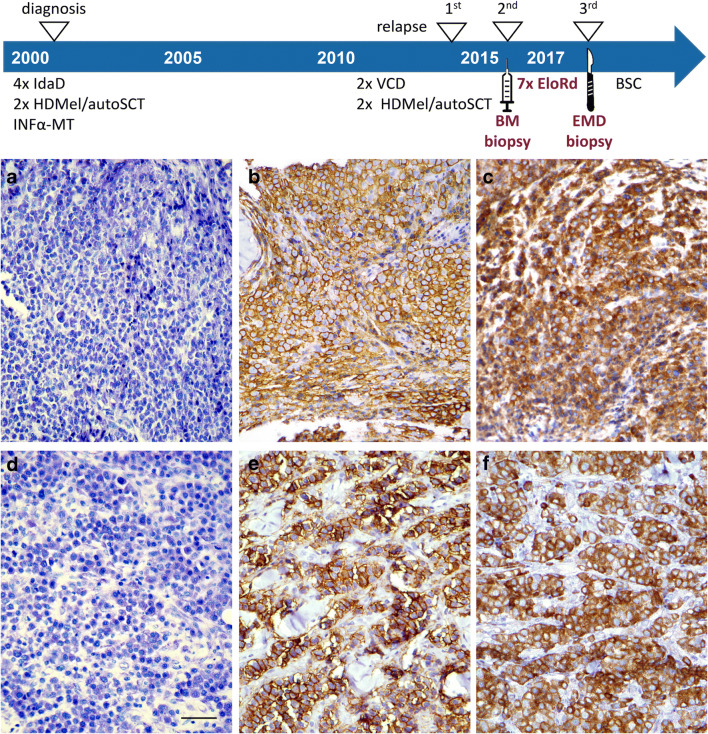
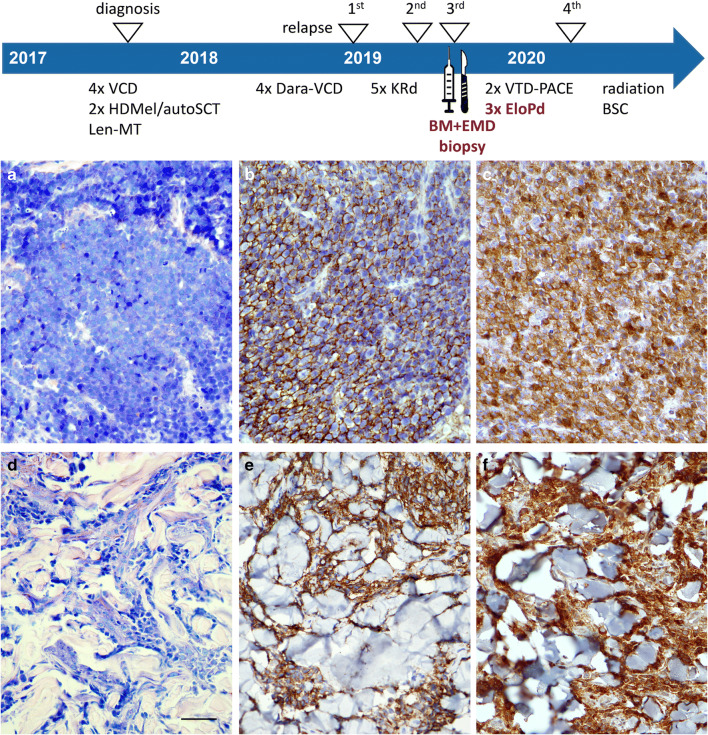
Extramedullary disease (EMD) represents a high-risk state of multiple myeloma (MM) associated with poor prognosis. While most anti-myeloma therapeutics demonstrate limited efficacy in this setting, some studies exploring the utility of chimeric antigen receptor (CAR)-modified T cells reported promising results. We have recently designed SLAMF7-directed CAR T cells for the treatment of MM. SLAMF7 is a transmembrane receptor expressed on myeloma cells that plays a role in myeloma cell homing to the bone marrow. Currently, the only approved anti-SLAMF7 therapeutic is the monoclonal antibody elotuzumab, but its efficacy in EMD has not been investigated thoroughly. Thus, we retrospectively analyzed the efficacy of elotuzumab-based combination therapy in a cohort of 15 patients with EMD. Moreover, since the presence of the target antigen is an indispensable prerequisite for effective targeted therapy, we investigated the SLAMF7 expression on extramedullary located tumor cells before and after treatment. We observed limited efficacy of elotuzumab-based combination therapies, with an overall response rate of 40% and a progression-free and overall survival of 3.8 and 12.9 months, respectively. Before treatment initiation, all available EMD tissue specimens (n = 3) demonstrated a strong and consistent SLAMF7 surface expression by immunohistochemistry. Furthermore, to investigate a potential antigen reduction under therapeutic selection pressure, we analyzed samples of de novo EMD (n = 3) outgrown during elotuzumab treatment. Again, immunohistochemistry documented strong and consistent SLAMF7 expression in all samples. In aggregate, our data point towards a retained expression of SLAMF7 in EMD and encourage the development of more potent SLAMF7-directed immunotherapies, such as CAR T cells.
髓外疾病(EMD)代表多发性骨髓瘤(MM)的一种高风险状态,与预后不良相关。虽然大多数抗骨髓瘤疗法在这种情况下疗效有限,但一些探索嵌合抗原受体(CAR)修饰 T 细胞在该领域应用的研究报告了有前景的结果。我们最近设计了针对 MM 的 SLAMF7 定向 CAR T 细胞。SLAMF7 是一种表达在骨髓瘤细胞上的跨膜受体,在骨髓瘤细胞归巢到骨髓中发挥作用。目前,唯一批准的抗 SLAMF7 治疗药物是单克隆抗体埃罗妥珠单抗,但尚未对其在 EMD 中的疗效进行全面研究。因此,我们回顾性分析了基于埃罗妥珠单抗的联合治疗在 15 名 EMD 患者中的疗效。此外,由于靶抗原的存在是有效靶向治疗的不可或缺的前提,我们在治疗前后研究了髓外肿瘤细胞上 SLAMF7 的表达。我们观察到基于埃罗妥珠单抗的联合治疗疗效有限,总体缓解率为 40%,无进展生存期和总生存期分别为 3.8 个月和 12.9 个月。在治疗开始前,所有可用的 EMD 组织标本(n=3)均通过免疫组化显示出强烈而一致的 SLAMF7 表面表达。此外,为了研究治疗选择压力下潜在的抗原减少,我们分析了在埃罗妥珠单抗治疗过程中生长的新发性 EMD(n=3)的样本。再次,免疫组化在所有样本中均记录了强烈而一致的 SLAMF7 表达。总的来说,我们的数据表明 EMD 中 SLAMF7 的表达保持不变,并鼓励开发更有效的 SLAMF7 定向免疫疗法,如 CAR T 细胞。