School of Applied Biosciences, College of Agriculture and Life Sciences, Kyungpook National University, Daegu, 41566, Republic of Korea.
School of Life Sciences, BK21 Four KNU Creative Bioresearch Group, Kyungpook National University, Daegu, 41566, Republic of Korea.
Sci Rep. 2021 Feb 12;11(1):3761. doi: 10.1038/s41598-021-82551-3.
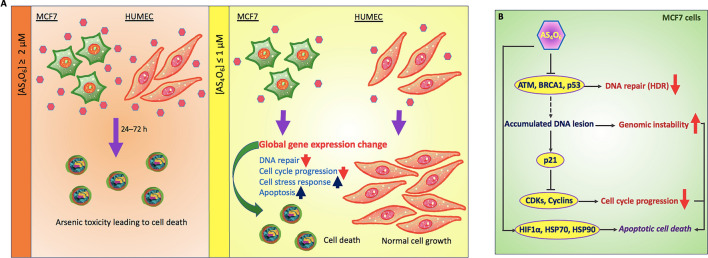
Arsenic is reportedly a biphasic inorganic compound for its toxicity and anticancer effects in humans. Recent studies have shown that certain arsenic compounds including arsenic hexoxide (ASO; hereafter, AS6) induce programmed cell death and cell cycle arrest in human cancer cells and murine cancer models. However, the mechanisms by which AS6 suppresses cancer cells are incompletely understood. In this study, we report the mechanisms of AS6 through transcriptome analyses. In particular, the cytotoxicity and global gene expression regulation by AS6 were compared in human normal and cancer breast epithelial cells. Using RNA-sequencing and bioinformatics analyses, differentially expressed genes in significantly affected biological pathways in these cell types were validated by real-time quantitative polymerase chain reaction and immunoblotting assays. Our data show markedly differential effects of AS6 on cytotoxicity and gene expression in human mammary epithelial normal cells (HUMEC) and Michigan Cancer Foundation 7 (MCF7), a human mammary epithelial cancer cell line. AS6 selectively arrests cell growth and induces cell death in MCF7 cells without affecting the growth of HUMEC in a dose-dependent manner. AS6 alters the transcription of a large number of genes in MCF7 cells, but much fewer genes in HUMEC. Importantly, we found that the cell proliferation, cell cycle, and DNA repair pathways are significantly suppressed whereas cellular stress response and apoptotic pathways increase in AS6-treated MCF7 cells. Together, we provide the first evidence of differential effects of AS6 on normal and cancerous breast epithelial cells, suggesting that AS6 at moderate concentrations induces cell cycle arrest and apoptosis through modulating genome-wide gene expression, leading to compromised DNA repair and increased genome instability selectively in human breast cancer cells.
砷被报道为一种具有两重性的无机化合物,对人类具有毒性和抗癌作用。最近的研究表明,某些砷化合物,包括砷六氧化物(ASO;以下简称 AS6),可诱导人类癌细胞和鼠类癌症模型中的程序性细胞死亡和细胞周期停滞。然而,AS6 抑制癌细胞的机制尚不完全清楚。在这项研究中,我们通过转录组分析报告了 AS6 的作用机制。特别是,比较了 AS6 在人正常和癌性乳腺上皮细胞中的细胞毒性和全基因组基因表达调控。使用 RNA 测序和生物信息学分析,通过实时定量聚合酶链反应和免疫印迹试验验证了这些细胞类型中显著受影响的生物学途径中的差异表达基因。我们的数据表明,AS6 对人乳腺上皮正常细胞(HUMEC)和密歇根癌症基金会 7 号(MCF7)的细胞毒性和基因表达具有明显不同的影响,MCF7 是人乳腺上皮癌细胞系。AS6 以剂量依赖的方式选择性地抑制 MCF7 细胞的生长并诱导其死亡,而不影响 HUMEC 的生长。AS6 改变了 MCF7 细胞中大量基因的转录,但在 HUMEC 中改变的基因要少得多。重要的是,我们发现细胞增殖、细胞周期和 DNA 修复途径明显受到抑制,而细胞应激反应和凋亡途径在 AS6 处理的 MCF7 细胞中增加。总之,我们提供了 AS6 对正常和癌变乳腺上皮细胞产生不同影响的第一个证据,表明 AS6 在中等浓度下通过调节全基因组基因表达诱导细胞周期停滞和细胞凋亡,从而选择性地导致人乳腺癌细胞中 DNA 修复受损和基因组不稳定性增加。