Chan Jason Yongsheng, Tan Grace Fangmin, Yeong Joe, Ong Chee Wee, Ng Dave Yong Xiang, Lee Elizabeth, Koh Joanna, Ng Cedric Chuan-Young, Lee Jing Yi, Liu Wei, Wong Ru Xin, Ong Chin-Ann Johnny, Farid Mohamad, Teh Bin Tean, Soo Khee Chee
Cancer Science Institute of Singapore, National University of Singapore, Singapore, Singapore.
Division of Medical Oncology, National Cancer Centre Singapore, Singapore, Singapore.
NPJ Precis Oncol. 2021 Feb 12;5(1):11. doi: 10.1038/s41698-021-00150-x.
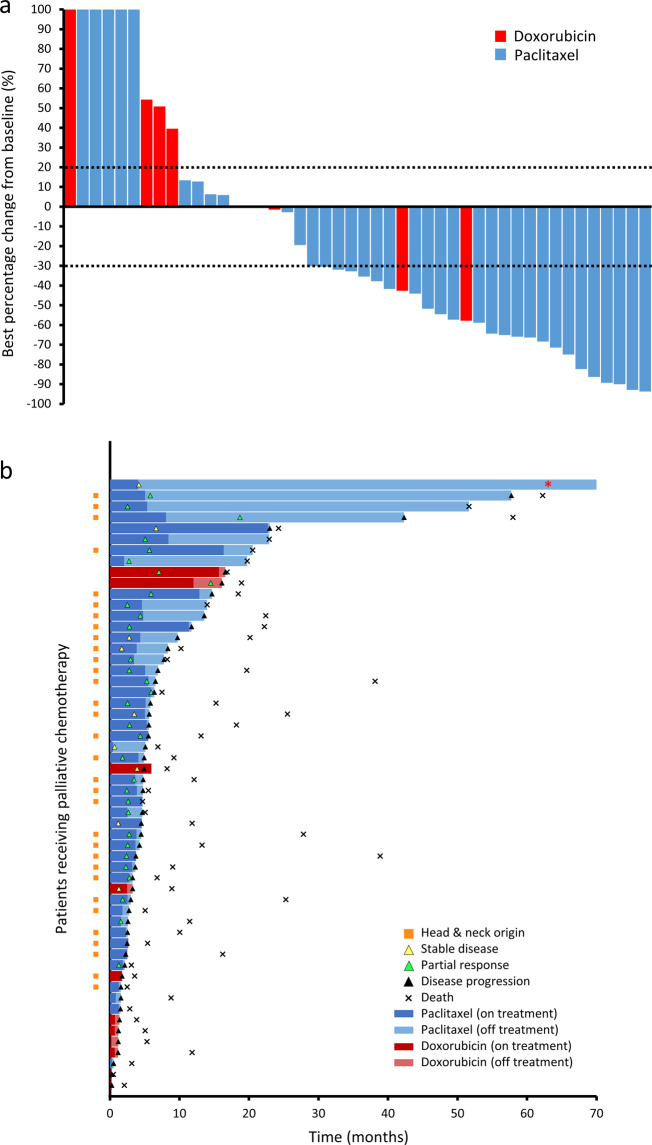
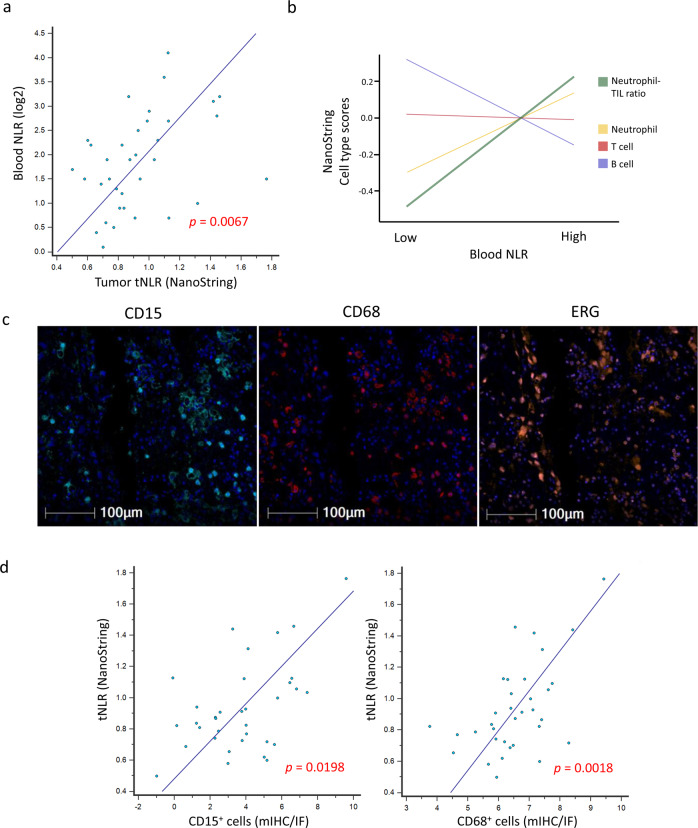
Angiosarcomas are a rare subtype of soft-tissue sarcomas which exhibit aggressive clinical phenotypes with limited treatment options and poor outcomes. In this study, we investigated the clinical relevance of the peripheral blood neutrophil-to-lymphocyte ratio (NLR) as a marker of systemic immune response, as well as its correlation with intra-tumoral immune profiles in a subgroup of cases (n = 35) using the NanoString PanCancer IO360 panel and multiplex immunohistochemistry. In the overall cohort (n = 150), angiosarcomas of the head and neck (AS-HN) comprised most cases (58.7%) and median overall survival (OS) was 1.1 year. NLR, classified as high in 78 of 112 (70%) evaluable patients, was independently correlated with worse OS (HR 1.84, 95%CI 1.18-2.87, p = 0.0073). Peripheral blood NLR was positively correlated with intra-tumoral NLR (tNLR) (Spearman's rho 0.450, p = 0.0067). Visualization of tumor-infiltrating immune cells confirmed that tNLR scores correlated directly with both neutrophil (CD15 cells, rho 0.398, p = 0.0198) and macrophage (CD68 cells, rho 0.515, p = 0.0018) cell counts. Interestingly, tNLR correlated positively with oncogenic pathway scores including angiogenesis, matrix remodeling and metastasis, and cytokine and chemokine signaling, as well as myeloid compartment scores (all p < 0.001). In patients with documented response assessment to first-line chemotherapy, these pathway scores were all significantly higher in non-responders (47%) compared to responders. In conclusion, systemic and local immune responses may inform chemotherapy response and clinical outcomes in angiosarcomas.
血管肉瘤是软组织肉瘤的一种罕见亚型,具有侵袭性临床表型,治疗选择有限且预后较差。在本研究中,我们调查了外周血中性粒细胞与淋巴细胞比值(NLR)作为全身免疫反应标志物的临床相关性,以及在一组病例(n = 35)中使用NanoString泛癌IO360面板和多重免疫组化分析其与肿瘤内免疫图谱的相关性。在整个队列(n = 150)中,头颈部血管肉瘤(AS-HN)占大多数病例(58.7%),中位总生存期(OS)为1.1年。在112例可评估患者中的78例(70%)中,NLR被分类为高,其与较差的OS独立相关(HR 1.84,95%CI 1.18 - 2.87,p = 0.0073)。外周血NLR与肿瘤内NLR(tNLR)呈正相关(Spearman秩相关系数0.450,p = 0.0067)。肿瘤浸润免疫细胞的可视化证实,tNLR评分与中性粒细胞(CD15细胞,rho 0.398,p = 0.0198)和巨噬细胞(CD68细胞,rho 0.515,p = 0.0018)计数直接相关。有趣的是,tNLR与包括血管生成、基质重塑和转移以及细胞因子和趋化因子信号传导的致癌途径评分以及髓系区室评分呈正相关(所有p < 0.001)。在有记录的一线化疗反应评估的患者中,与反应者相比,无反应者(47%)的这些途径评分均显著更高。总之,全身和局部免疫反应可能为血管肉瘤的化疗反应和临床结果提供信息。