Turku Bioscience Centre, University of Turku and Åbo Akademi University, Turku, Finland.
Department for Otorhinolaryngology, Head and Neck Surgery, University of Turku and Turku University Hospital, Kiinamyllynkatu 4-8, 20521, Turku, Finland.
Eur Arch Otorhinolaryngol. 2021 Nov;278(11):4575-4585. doi: 10.1007/s00405-021-06650-7. Epub 2021 Feb 13.
Prognostic biomarkers and novel therapeutic approaches have been slow to emerge in the treatment of head and neck squamous cell carcinoma (HNSCC). In this study, an HNSCC patient cohort is created and performance of putative prognostic biomarkers investigated in a population-validated setting. The overall goal is to develop a novel way to combine biomarker analyses with population-level clinical data on HNSCC patients and thus to improve the carryover of biomarkers into clinical practice.
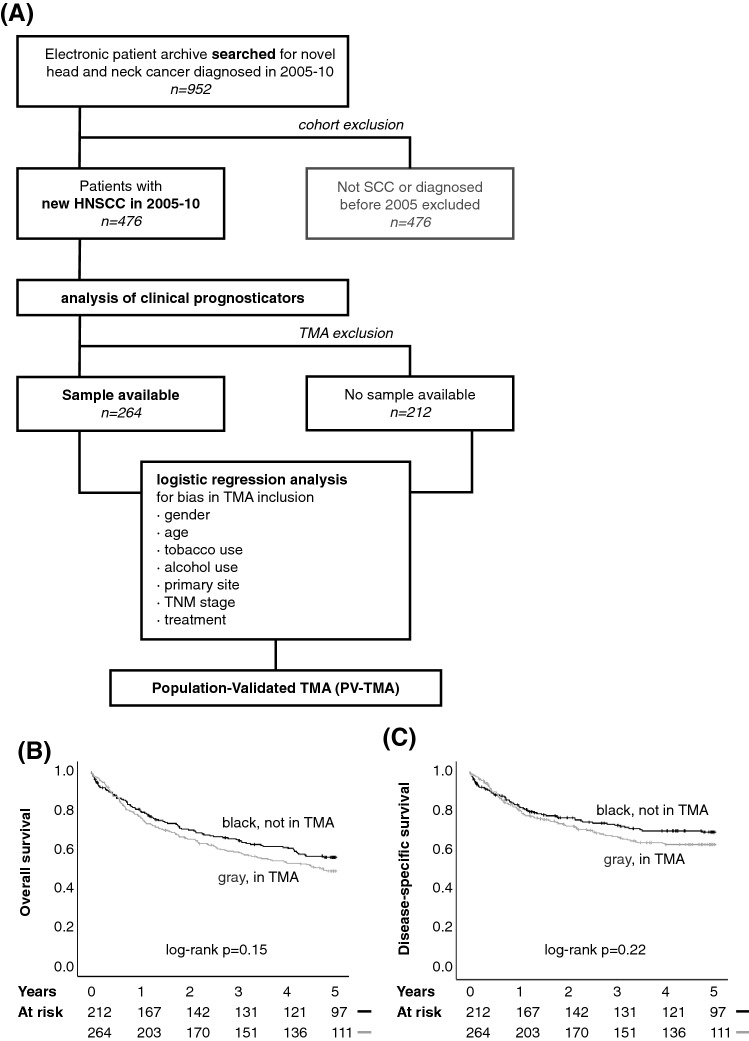
To avoid selection biases in retrospective study design, all HNSCC patients were identified and corresponding clinical data were collected from the Southwest Finland geographical area. A particular emphasis was laid on avoiding potential biases in sample selection for immunohistochemical staining analyses. Staining results were evaluated for potential prognostic resolution.
After comprehensive evaluation, the patient cohort was found to be representative of the background population in terms of clinical characteristics such as patient age and TNM stage distribution. A negligible drop-out of 1.3% (6/476) was observed during the first follow-up year. By immunohistochemical analysis, the role of previously implicated HNSCC biomarkers (p53, EGFR, p16, CIP2A, Oct4, MET, and NDFIP1) was investigated.
Our exceptionally representative patient material supports the use of population validation to improve the applicability of results to real-life situations. The failure of the putative prognostic biomarkers emphasizes the need for controlling bias in retrospective studies, especially in the heterogenous tumor environment of HNSCC. The resolution of simple prognostic examination is unlikely to be sufficient to identify biomarkers for clinical practice of HNSCC.
在头颈部鳞状细胞癌(HNSCC)的治疗中,预后生物标志物和新的治疗方法一直难以出现。在这项研究中,创建了一个 HNSCC 患者队列,并在人群验证的环境中研究了潜在的预后生物标志物的性能。总体目标是开发一种新的方法,将生物标志物分析与 HNSCC 患者的人群水平临床数据相结合,从而提高生物标志物在临床实践中的可转移性。
为了避免回顾性研究设计中的选择偏倚,从西南芬兰地理区域识别所有 HNSCC 患者并收集相应的临床数据。特别强调避免免疫组织化学染色分析中样本选择的潜在偏差。评估染色结果以确定潜在的预后分辨率。
经过全面评估,患者队列在患者年龄和 TNM 分期分布等临床特征方面与背景人群具有代表性。在第一年的随访中,仅观察到 1.3%(6/476)的微小脱落。通过免疫组织化学分析,研究了先前涉及的 HNSCC 生物标志物(p53、EGFR、p16、CIP2A、Oct4、MET 和 NDFIP1)的作用。
我们具有代表性的患者材料支持使用人群验证来提高结果在现实情况下的适用性。潜在预后生物标志物的失败强调了在回顾性研究中控制偏倚的必要性,特别是在 HNSCC 异质肿瘤环境中。简单预后检查的分辨率不太可能足以识别用于 HNSCC 临床实践的生物标志物。