Tsumagari Ryosuke, Maruo Kenta, Nakao Takaaki, Ueda Shuji, Yamanoue Minoru, Shirai Yasuhito
Department of Applied Chemistry in Bioscience, Graduate School of Agricultural Sciences, Kobe University, Kobe, Japan.
Front Aging Neurosci. 2021 Jan 28;13:573966. doi: 10.3389/fnagi.2021.573966. eCollection 2021.
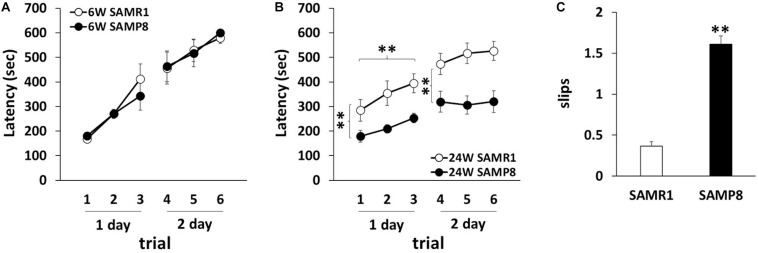
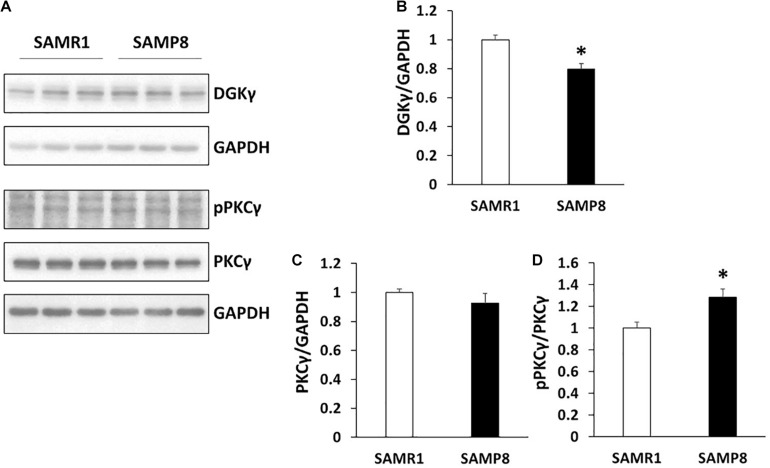
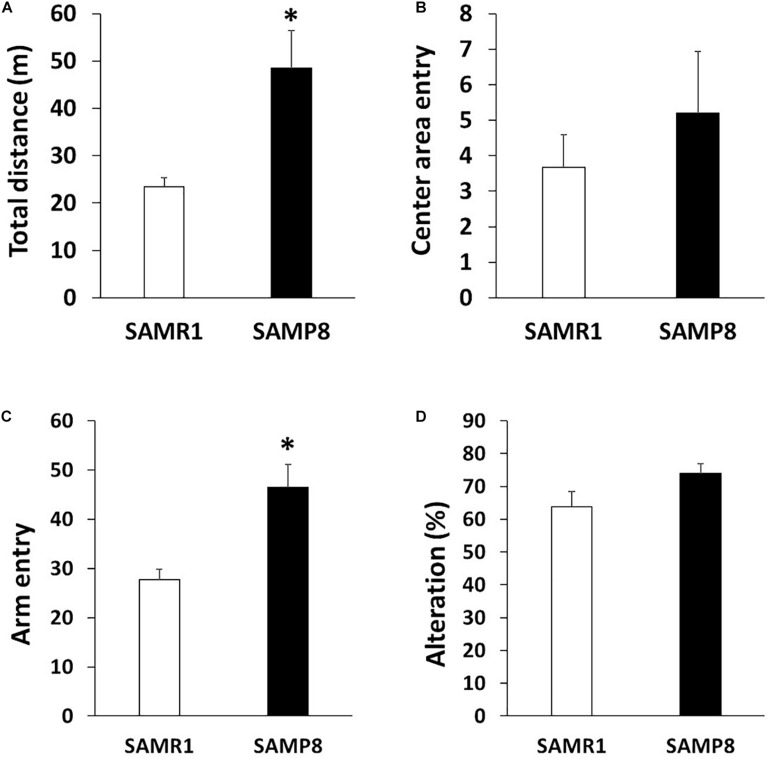
Senescence-accelerated mouse prone 8 (SAMP8) is an animal model of age-related central nervous system (CNS) disorders. Although SAMP8 shows deficits in learning, memory, and emotion, its motor coordination has not been clarified. We have recently reported that DGKγ-regulated PKCγ activity is important for cerebellar motor coordination. However, involvement of the functional correlation between the kinases in age-related motor dyscoordination still remains unknown. Therefore, we have investigated the motor coordination in SAMP8 and involvement of the functional correlation between DGKγ and PKCγ in the age-related motor dyscoordination. Although 6 weeks old SAMP8 showed equivalent motor coordination with control mice (SAMR1) in the rotarod test, 24 weeks old SAMP8 exhibited significantly less latency in the rotarod test and more frequent slips in the beam test compared to the age-matched SAMR1. Furthermore, 24 weeks old SAMP8 showed the higher locomotor activity in open field test and Y-maze test. Western blotting revealed that DGKγ expression decreased in the cerebellum of 24 weeks old SAMP8, while PKCγ was upregulated. These results suggest that SAMP8 is a useful model of age-related motor dysfunction and that the DGKγ-regulated PKCγ activity is involved in the age-related motor dyscoordination.
衰老加速小鼠8型(SAMP8)是一种与年龄相关的中枢神经系统(CNS)疾病的动物模型。尽管SAMP8在学习、记忆和情绪方面存在缺陷,但其运动协调性尚未明确。我们最近报道,二酰甘油激酶γ(DGKγ)调节的蛋白激酶Cγ(PKCγ)活性对小脑运动协调性很重要。然而,激酶之间的功能相关性在与年龄相关的运动失调中的作用仍不清楚。因此,我们研究了SAMP8的运动协调性以及DGKγ与PKCγ之间的功能相关性在与年龄相关的运动失调中的作用。尽管6周龄的SAMP8在转棒试验中表现出与对照小鼠(SAMR1)相当的运动协调性,但与年龄匹配的SAMR1相比,24周龄的SAMP8在转棒试验中的潜伏期明显缩短,在横梁试验中的滑倒频率更高。此外,24周龄的SAMP8在旷场试验和Y迷宫试验中表现出更高的运动活性。蛋白质印迹分析显示,24周龄SAMP8的小脑中DGKγ表达下降,而PKCγ上调。这些结果表明,SAMP8是一种与年龄相关的运动功能障碍的有用模型,并且DGKγ调节的PKCγ活性参与了与年龄相关的运动失调。