Saboth Md Prasant Kumar, Sarin PhD Enisha, Alwadhi Md Varun, Jaiswal Mph Avinash, Mohanty Md Jaya Swarup, Choudhary Dch Nidhi, Bisht Mbbs Nitin, Gupta Mbbs Anil, Kumar BSc Arvind, Gupta Md Sachin, Kumar Md Harish
Health, Nutrition and WASH, IPE Global, New Delhi, India.
Pediatrics, Dr Ram Manohar Lohia Hopsital and Post-Graduate Institute, New Delhi, India.
J Trop Pediatr. 2021 Jan 29;67(1). doi: 10.1093/tropej/fmab005.
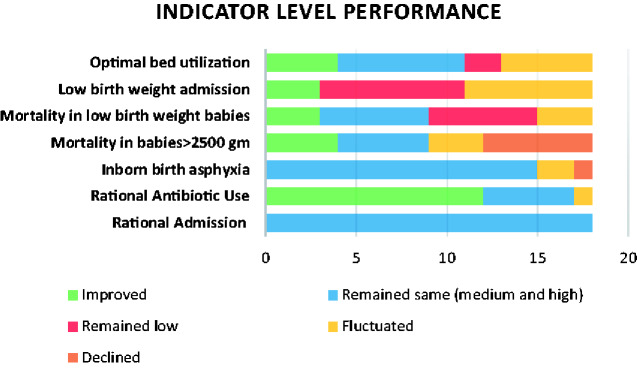
Lack of quality care is associated with newborn mortality and stillbirth. India launched the Special newborn care unit (SNCU) Quality of Care Index (SQCI) for measuring quality indicators in SNCU. The USAID Vriddhi project provided support to the use of SQCI in 19 SNCU across aspirational districts of Jharkhand, Uttarakhand, Himachal Pradesh, Punjab and Haryana. The objective was to provide holistic support to quality care processes by generating analyzed quarterly reports for action with the goal toward sustainability by capacitating SNCU personnel and program officers to use SQCI, over a 1period from April 2019 to June 2020. The composite index has seven indicators and converts them into indices, each having a range from 0.1 to 1, to measure performance of SNCU.7 of the 18 SNCU improved their composite scores from the first to the last quarter. Rational use of antibiotics showed improvement in 12 SNCU. Survival in newborns >2500 g and <2500, low birth weight admission and optimal bed utilization had the most variations between and within facilities. Based on quarterly data analysis, all facilities introduced KMC, 10 facilities improved equipment and drug supply, 9 facilities launched in-house capacity building to improve asphyxia management. The SQCI implementation helped to show a process of using SQCI data for identifying bottlenecks and addressing quality concerns. The project has transitioned to complete responsibility of SQCI usage by the district and facility teams. Use of an existing mechanism of quality monitoring without any major external support makes the SQCI usable and doable.
缺乏优质护理与新生儿死亡率和死产有关。印度推出了新生儿特殊护理单元(SNCU)护理质量指数(SQCI),用于衡量SNCU的质量指标。美国国际开发署的Vriddhi项目为贾坎德邦、北阿坎德邦、喜马偕尔邦、旁遮普邦和哈里亚纳邦等目标地区的19个SNCU使用SQCI提供了支持。其目标是通过生成季度分析报告以采取行动,为优质护理流程提供全面支持,目标是通过使SNCU人员和项目官员能够使用SQCI实现可持续性,时间跨度为2019年4月至2020年6月。综合指数有七个指标,并将它们转换为指数,每个指数的范围从0.1到1,以衡量SNCU的绩效。18个SNCU中有7个从第一季度到最后一个季度提高了综合得分。12个SNCU的抗生素合理使用情况有所改善。体重>2500克和<2500克的新生儿存活率、低体重儿入院情况和最佳床位利用率在不同设施之间和设施内部差异最大。基于季度数据分析,所有设施都引入了袋鼠式护理,10个设施改善了设备和药品供应,9个设施开展了内部能力建设以改善窒息管理。SQCI的实施有助于展示一个利用SQCI数据识别瓶颈并解决质量问题的过程。该项目已过渡为由地区和设施团队完全负责SQCI的使用。在没有任何重大外部支持的情况下使用现有的质量监测机制,使得SQCI具有实用性和可操作性。