Department for Shoulder and Elbow Surgery, Center for Musculoskeletal Surgery, Charité Universitaetsmedizin Berlin, Berlin, Germany.
Department of Trauma Surgery and Orthopaedics, Ruhr-University Hospital Bergmannsheil Bochum, Bochum, Germany.
Am J Sports Med. 2021 Mar;49(4):857-865. doi: 10.1177/0363546520987823. Epub 2021 Feb 17.
Treatment of first-time shoulder dislocation (FSD) is a topic of debate. After high rates of recurrent instability after nonoperative management were reported in the literature, primary repair of FSD significantly increased. At the same time, new concepts were proposed that had promising results for immobilization in external rotation (ER) and abduction (ABD).
The aim of this study was to evaluate the recurrence rates (primary outcome) and clinical outcomes (secondary outcome parameters) of immobilization in ER+ABD versus arthroscopic primary stabilization after FSD.
Randomized controlled trial; Level of evidence, 1.
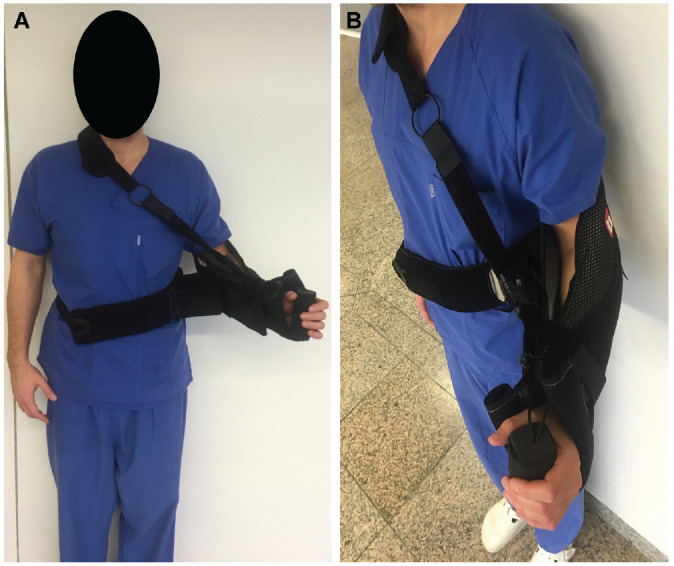
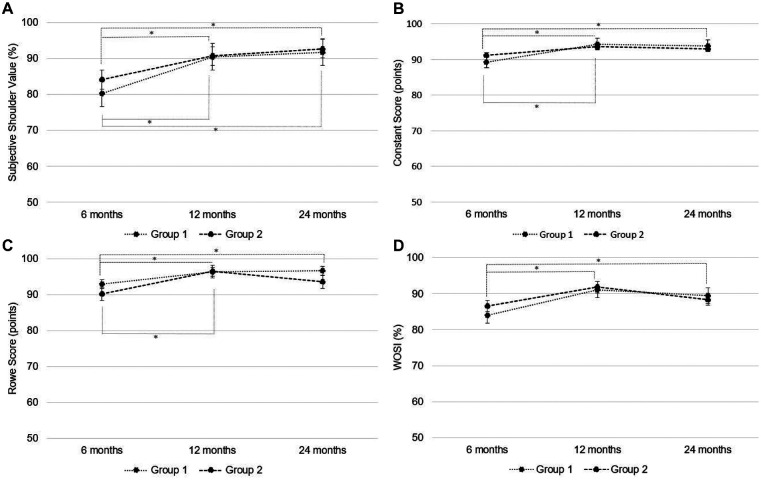
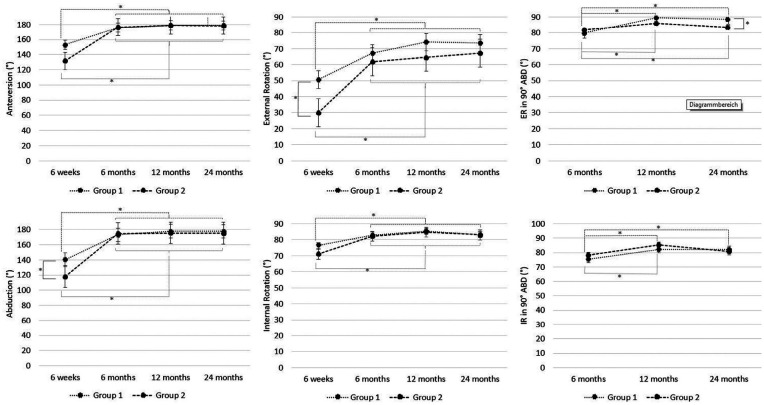
In a multicenter randomized controlled trial, patients with FSD were randomized to either treatment with immobilization in 60° of ER plus 30° of ABD (group 1) or surgical treatment with arthroscopic Bankart repair (group 2). Clinical evaluation was performed 1, 3, and 6 weeks as well as 6, 12, and 24 months postoperatively or after reduction, including range of motion, instability testing, subjective shoulder value, Constant-Murley score, Rowe score, and Western Ontario Shoulder Instability Index. Recurrent instability events were prospectively recorded.
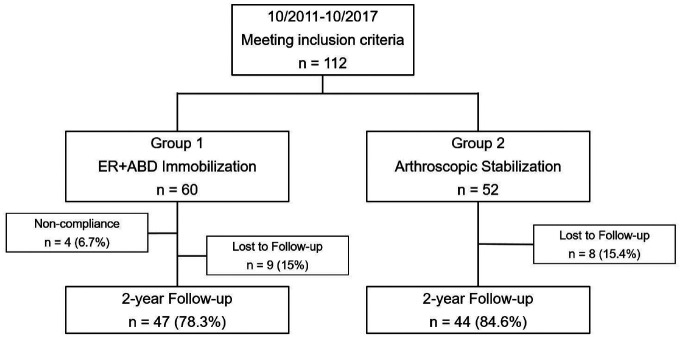
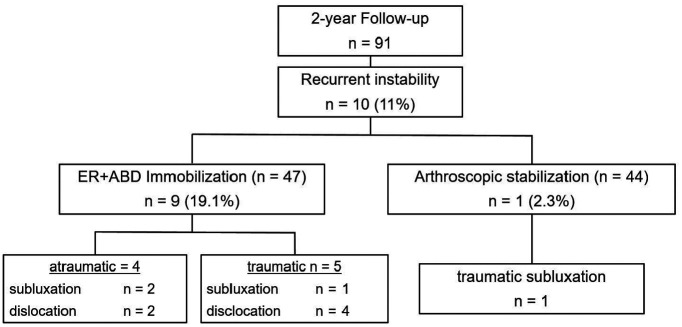
Between 2011 and 2017, a total of 112 patients were included in this study. Of these, 60 patients were allocated to group 1 and 52 to group 2. At the 24-month follow-up, 91 patients (81.3%) were available for clinical examination. The recurrence rate was 19.1% in group 1 and 2.3% in group 2 ( = .016). No significant differences were found between groups regarding clinical shoulder scores ( > .05). Due to noncompliance with the immobilization treatment protocol, 4 patients (6.7%) were excluded.
Immobilization in ER+ABD versus primary arthroscopic shoulder stabilization for the treatment of FSD showed no differences in clinical shoulder scores. However, recurrent instability was significantly higher after nonoperative treatment.
首次肩关节脱位(FSD)的治疗是一个有争议的话题。在文献中报告了非手术治疗后复发性不稳定的高发生率后,FSD 的主要修复明显增加。与此同时,提出了一些新概念,这些概念在外旋(ER)和外展(ABD)固定方面具有有前景的结果。
本研究旨在评估 FSD 后 ER+ABD 固定与关节镜下初次稳定化治疗的复发率(主要结局)和临床结局(次要结局参数)。
随机对照试验;证据水平,1 级。
在一项多中心随机对照试验中,将 FSD 患者随机分为 60°ER 加 30°ABD 固定治疗组(组 1)或关节镜下 Bankart 修复术治疗组(组 2)。临床评估在术后 1、3 和 6 周以及 6、12 和 24 个月或复位后进行,包括运动范围、不稳定测试、主观肩部值、Constant-Murley 评分、Rowe 评分和 Western Ontario 肩部不稳定指数。前瞻性记录复发性不稳定事件。
2011 年至 2017 年间,共有 112 名患者纳入本研究。其中,60 名患者分配至组 1,52 名患者分配至组 2。在 24 个月的随访中,91 名患者(81.3%)可进行临床检查。组 1 的复发率为 19.1%,组 2 的复发率为 2.3%( =.016)。两组间临床肩部评分无显著差异(>.05)。由于不符合 ER+ABD 固定治疗方案,4 名患者(6.7%)被排除。
ER+ABD 固定与 FSD 的初次关节镜下稳定化治疗相比,在临床肩部评分方面无差异。然而,非手术治疗后的复发性不稳定明显更高。