Mathematics Education, Faculty of Mathematics, University of Regensburg, Universitätsstraße 31, 93053, Regensburg, Germany.
Medizinische Klinik und Polklinik IV, Klinikum der Universität München, LMU Munich, Munich, Germany.
Adv Health Sci Educ Theory Pract. 2021 Aug;26(3):847-863. doi: 10.1007/s10459-020-10025-8. Epub 2021 Feb 12.
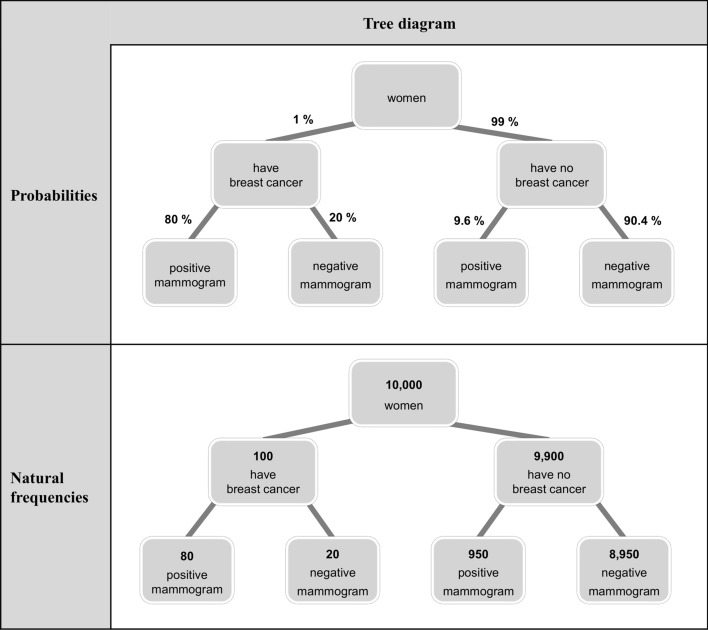
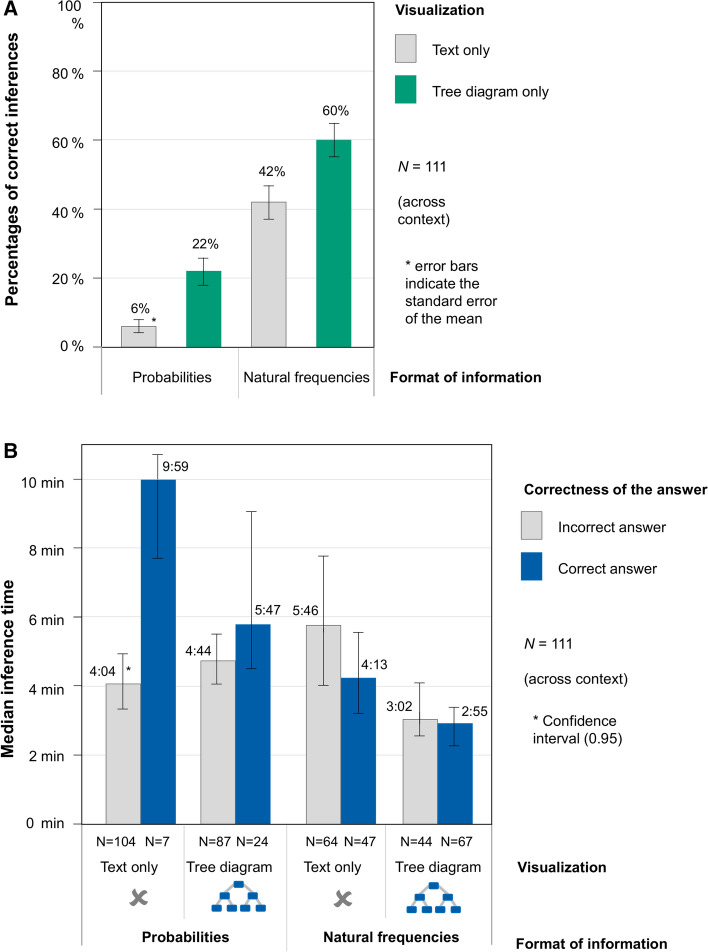
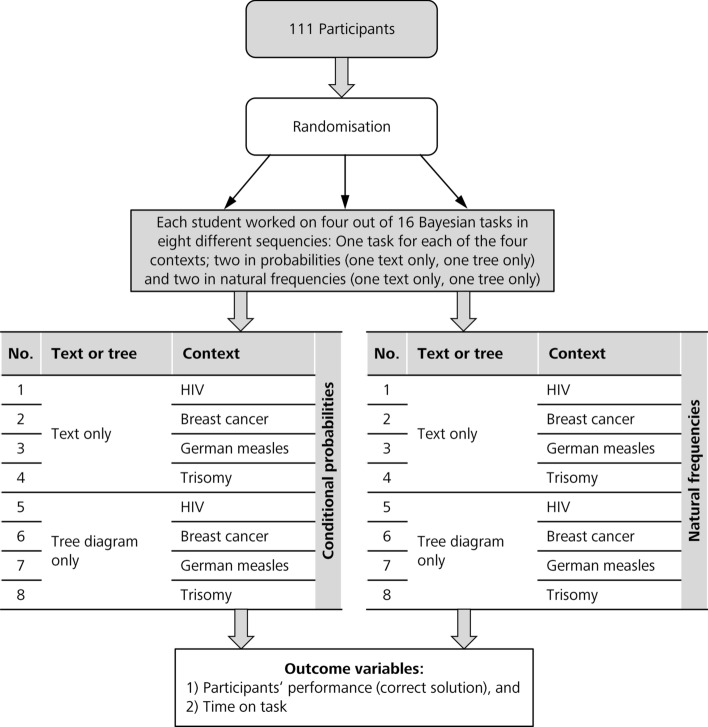
When physicians are asked to determine the positive predictive value from the a priori probability of a disease and the sensitivity and false positive rate of a medical test (Bayesian reasoning), it often comes to misjudgments with serious consequences. In daily clinical practice, however, it is not only important that doctors receive a tool with which they can correctly judge-the speed of these judgments is also a crucial factor. In this study, we analyzed accuracy and efficiency in medical Bayesian inferences. In an empirical study we varied information format (probabilities vs. natural frequencies) and visualization (text only vs. tree only) for four contexts. 111 medical students participated in this study by working on four Bayesian tasks with common medical problems. The correctness of their answers was coded and the time spent on task was recorded. The median time for a correct Bayesian inference is fastest in the version with a frequency tree (2:55 min) compared to the version with a probability tree (5:47 min) or to the text only versions based on natural frequencies (4:13 min) or probabilities (9:59 min).The score diagnostic efficiency (calculated by: median time divided by percentage of correct inferences) is best in the version with a frequency tree (4:53 min). Frequency trees allow more accurate and faster judgments. Improving correctness and efficiency in Bayesian tasks might help to decrease overdiagnosis in daily clinical practice, which on the one hand cause cost and on the other hand might endanger patients' safety.
当医生被要求根据疾病的先验概率和医学测试的灵敏度和假阳性率来确定阳性预测值(贝叶斯推理)时,往往会出现判断错误,造成严重后果。然而,在日常临床实践中,医生不仅需要一个能够正确判断的工具,判断的速度也是一个关键因素。在这项研究中,我们分析了医学贝叶斯推理的准确性和效率。在一项实证研究中,我们针对四个情境改变了信息格式(概率与自然频率)和可视化(仅文本与仅树图)。111 名医学生通过完成四个常见医学问题的贝叶斯任务参与了这项研究。我们对他们答案的正确性进行了编码,并记录了完成任务所花费的时间。正确进行贝叶斯推理的中位数时间在基于自然频率的文本仅版本(4:13 分钟)和概率仅版本(9:59 分钟),以及基于频率树的版本(2:55 分钟)中最快,而基于概率树的版本则用时最长(5:47 分钟)。基于频率树的版本得分诊断效率(通过:中位数时间除以正确推理的百分比计算)最高(4:53 分钟)。频率树可以进行更准确和快速的判断。提高贝叶斯任务的准确性和效率可能有助于减少日常临床实践中的过度诊断,这一方面会导致成本增加,另一方面可能会危及患者的安全。