Liggins Institute, University of Auckland, Auckland, New Zealand.
PLoS One. 2021 Feb 18;16(2):e0246175. doi: 10.1371/journal.pone.0246175. eCollection 2021.
To describe maternal and neonatal glycaemic control following antenatal corticosteroid administration to women with diabetes in pregnancy.
Retrospective cohort study.
A tertiary hospital in Auckland, New Zealand.
Women with diabetes in pregnancy who received antenatal corticosteroids from 2006-2016.
Corticosteroid administration, maternal and neonatal glycaemia data were retrieved from electronic patient records. Demographic data were downloaded from the hospital database. Relationships between variables were analysed using multivariate analysis.
Maternal hyperglycaemia and neonatal hypoglycaemia.
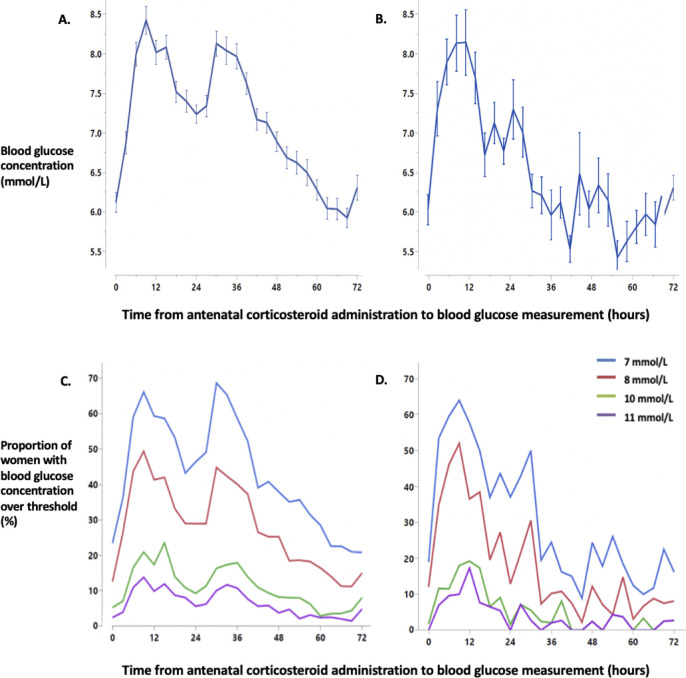
Corticosteroids were administered to 647 of 7317 of women with diabetes (8.8%) who gave birth to 715 babies. After an initial course of corticosteroids, 92% and 52% of women had blood glucose concentrations > 7 and > 10 mmol/L respectively. Median peak blood glucose concentration of approximately 10 mmol/L occurred 9 hours after corticosteroid administration and hyperglycaemia lasted approximately 72 hours. Thirty percent of women gave birth within 72 hours of the last dose of corticosteroids. Babies of women who were hyperglycaemic within 24 hours of birth were more likely to develop hypoglycaemia (< 2.6 mmol/L, OR 1.51 [95% CI 1.10-2.07], p = 0.01) and severe hypoglycaemia (≤ 2.0 mmol/L, OR 2.00 [95% CI 1.41-2.85], p < 0.0001) than babies of non-hyperglycaemic mothers. There was no association between maternal glycaemia within 7 days of the last dose of corticosteroids and neonatal hypoglycaemia.
Hyperglycaemia is common in women with diabetes in pregnancy following antenatal corticosteroid administration. Maternal hyperglycaemia in the 24 hours prior to birth is associated with increased risk of neonatal hypoglycaemia. Limitations included the retrospective study design, so that not all data were available for all women and babies and the glucose testing schedule was variable.
描述妊娠糖尿病孕妇使用产前皮质类固醇后母婴血糖控制情况。
回顾性队列研究。
新西兰奥克兰的一家三级医院。
2006-2016 年间接受产前皮质类固醇治疗的妊娠糖尿病孕妇。
从电子病历中检索皮质类固醇给药、产妇和新生儿血糖数据。从医院数据库下载人口统计学数据。使用多元分析分析变量之间的关系。
产妇高血糖和新生儿低血糖。
在 7317 名分娩的糖尿病孕妇中,有 647 名(8.8%)孕妇接受了皮质类固醇治疗,共分娩了 715 名婴儿。初始皮质类固醇治疗后,分别有 92%和 52%的女性血糖浓度分别>7mmol/L和>10mmol/L。皮质类固醇给药后 9 小时出现约 10mmol/L 的峰值血糖,高血糖持续约 72 小时。30%的孕妇在最后一剂皮质类固醇后 72 小时内分娩。分娩时母亲血糖<24 小时的婴儿发生低血糖(<2.6mmol/L,OR 1.51[95%CI 1.10-2.07],p=0.01)和严重低血糖(≤2.0mmol/L,OR 2.00[95%CI 1.41-2.85],p<0.0001)的可能性高于母亲血糖正常的婴儿。最后一剂皮质类固醇后 7 天内母亲血糖与新生儿低血糖之间无关联。
妊娠糖尿病孕妇使用产前皮质类固醇后常发生高血糖。分娩前 24 小时内母亲高血糖与新生儿低血糖风险增加有关。研究的局限性包括回顾性研究设计,因此并非所有女性和婴儿的数据都可用于所有女性和婴儿,且血糖检测方案存在差异。