Weismiller Scott A, Monaco Robert, Womack Jason, Alderman Brandon, Esopenko Carrie, Conway Fiona N, Brostrand Kyle, Brown Allison, de Souza Nicola L, Buckman Jennifer F
Penn State Health, Milton S. Hersey Medical Center.
Atlantic Sports Health.
Int J Sports Phys Ther. 2021 Feb 1;16(1):126-133. doi: 10.26603/001c.18713.
Individualized baseline testing is resource and time intensive. The use of normative data to approximate changes after a suspected concussion is thus an appealing alternative. Yet, few peer-reviewed, large-sample studies are available from which to develop accurate normative averages of balance using force-plate technology.
This study sought to validate a normative dataset from the force-plate manufacturer and examine the magnitude and nature of sample variability.
Cross-sectional.
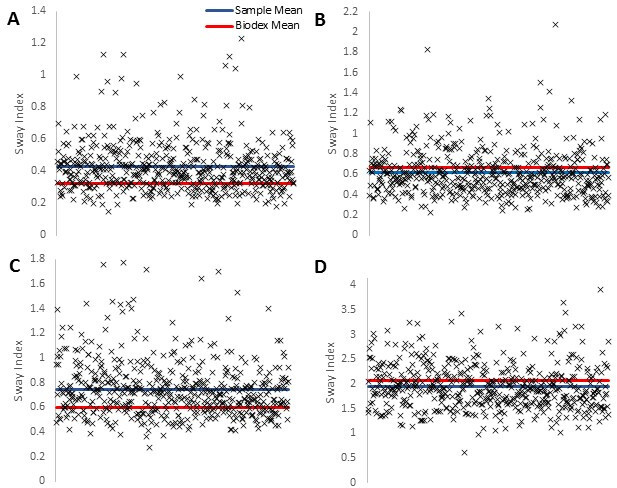
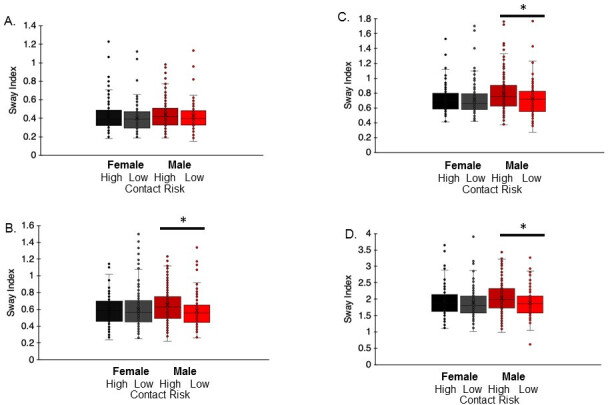
Baseline balance and self-reported sex, sport, and concussion history were assessed in 533 prospective collegiate athletes (45% female) during pre-participation physical examinations. Balance was measured using four stances from the modified Clinical Test of Sensory Interaction and Balance and quantified as Sway Index Scores with the Biodex Biosway Portable Balance System. Group averages are contrasted to data from the force-plate manufacturer. Individual variability around these averages was visualized and analyzed by sex and sport.
Male student athletes showed significantly more sway in the eyes open, soft stance condition than female athletes. These differences were maintained when concussion history was included as a covariate. Athletes, particularly male athletes, in the high versus low contact sport group showed significantly more sway in the eyes open, soft surface and the eyes closed, hard and soft surface stances.
There was substantial individual variability that was partially explained by sex differences and sport differences. The development of normative averages for sway may benefit from consideration of sex and sport. Further studies should characterize other factors that influence baseline balance in collegiate athletes.
2b.
个性化的基线测试需要耗费大量资源和时间。因此,使用标准数据来估算疑似脑震荡后的变化是一种很有吸引力的替代方法。然而,很少有经过同行评审的大样本研究可用于利用测力板技术得出准确的平衡标准平均值。
本研究旨在验证来自测力板制造商的标准数据集,并检查样本变异性的大小和性质。
横断面研究。
在533名前瞻性大学运动员(45%为女性)参加赛前体检时,评估其基线平衡以及自我报告的性别、运动项目和脑震荡史。使用改良的感觉统合与平衡临床测试中的四种姿势测量平衡,并通过Biodex Biosway便携式平衡系统将其量化为摇摆指数得分。将组平均值与测力板制造商的数据进行对比。通过性别和运动项目对这些平均值周围的个体变异性进行可视化和分析。
在睁眼、软支撑姿势下,男学生运动员的摇摆明显多于女运动员。将脑震荡史作为协变量纳入时,这些差异依然存在。在高对抗性与低对抗性运动组中,运动员,尤其是男运动员,在睁眼、软表面以及闭眼、硬表面和软表面姿势下的摇摆明显更多。
存在大量个体变异性,部分原因可由性别差异和运动项目差异来解释。考虑性别和运动项目可能有助于制定摇摆的标准平均值。进一步的研究应明确影响大学运动员基线平衡的其他因素。
2b。