Department of Medical Microbiology, Leiden University Medical Center (LUMC), Leiden, The Netherlands.
Department of Intensive Care, LUMC, Leiden, The Netherlands.
Mycoses. 2021 Jun;64(6):641-650. doi: 10.1111/myc.13259. Epub 2021 Mar 5.
A high prevalence of COVID-19 associated pulmonary aspergillosis (CAPA) has been reported, though histopathological evidence is frequently lacking. To assess the clinical significance of Aspergillus species in respiratory samples of mechanically ventilated COVID-19 patients, we implemented routine screening for Aspergillus in tracheal aspirate (TA).
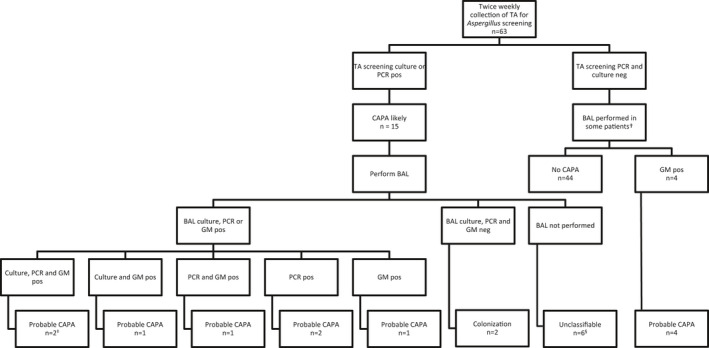
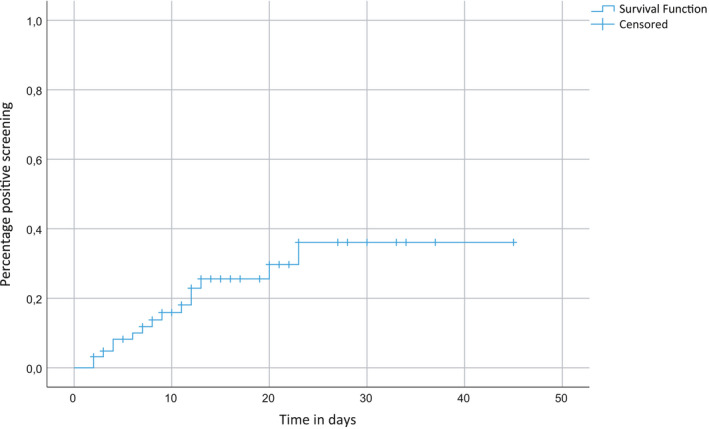
PATIENTS/METHODS: From all adult COVID-19 patients admitted to the intensive care unit (ICU), TA samples were collected twice a week for Aspergillus screening by PCR and or culture. Bronchoalveolar lavage (BAL) sampling was performed in patients with a positive screening result if possible. Clinical information was obtained from the electronic patient record and patients were categorised according to the recently published consensus case definition for CAPA.
Our study population consisted of 63 predominantly (73%) male patients, with a median age of 62 years and total median ICU stay of 18 days. Aspergillus species were present in TA screening samples from 15 patients (24%), and probable CAPA was diagnosed in 11 (17%) patients. Triazole resistance was detected in one patient (14%). Concordance between TA and BAL was 86%, and all TA culture positives were confirmed in BAL. We were able to withhold treatment in three of fifteen patients with positive screening (20%) but negative BAL results.
Positive culture, molecular detection and or antigen detection of Aspergillus species do not equal infection. Until we understand the clinical relevance of Aspergillus species detected in respiratory samples of COVID-19 patients, minimal-invasive screening by TA is a feasible method to monitor patients. Positive screening results should be an indication to perform a BAL to rule out upper airway colonisation.
有报道称,COVID-19 相关肺曲霉病(CAPA)的患病率很高,尽管组织病理学证据通常缺乏。为了评估机械通气的 COVID-19 患者呼吸道样本中曲霉属物种的临床意义,我们对气管吸出物(TA)中的曲霉属进行了常规筛查。
患者/方法:从所有入住重症监护病房(ICU)的成年 COVID-19 患者中,每周两次采集 TA 样本进行曲霉属 PCR 和/或培养筛查。如果可能,对筛查结果阳性的患者进行支气管肺泡灌洗(BAL)采样。从电子病历中获取临床信息,并根据最近发布的 CAPA 共识病例定义对患者进行分类。
我们的研究人群由 63 名主要为(73%)男性患者组成,中位年龄为 62 岁,总 ICU 中位住院时间为 18 天。15 名患者(24%)的 TA 筛查样本中存在曲霉属,11 名(17%)患者诊断为可能的 CAPA。一名患者(14%)检测到三唑类耐药。TA 与 BAL 的一致性为 86%,且所有 TA 培养阳性均在 BAL 中得到证实。我们能够在 15 名筛查阳性(20%)但 BAL 结果阴性的患者中停止治疗 3 名。
曲霉属的培养、分子检测和/或抗原检测阳性并不等同于感染。在我们了解 COVID-19 患者呼吸道样本中检测到的曲霉属物种的临床意义之前,通过 TA 进行微创筛查是监测患者的一种可行方法。阳性筛查结果应提示进行 BAL 以排除上呼吸道定植。