Division of Nephrology, Department of Medicine and the Ottawa Hospital Research Institute, University of Ottawa, Ottawa, Ontario, Canada.
Institute for Clinical Evaluative Sciences, Ottawa, Ontario, Canada.
Clin J Am Soc Nephrol. 2021 Mar 8;16(3):365-373. doi: 10.2215/CJN.12990820. Epub 2021 Feb 19.
The optimal ambulatory management of renin-angiotensin-aldosterone system inhibitor (RAASi)-related hyperkalemia to reduce the risk of recurrence is unknown. We examined the risk of hyperkalemia recurrence on the basis of outpatient pharmacologic changes following an episode of RAASi-related hyperkalemia.
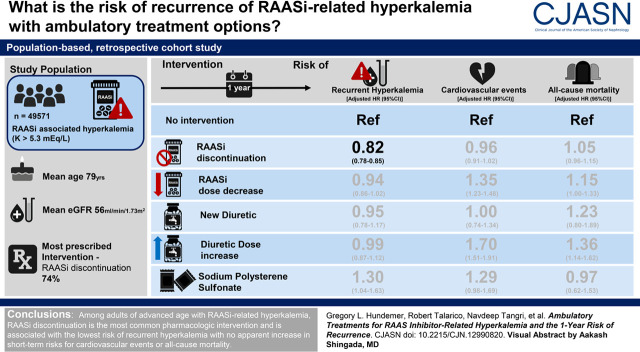
We performed a population-based, retrospective cohort study of older adults (=49,571; mean age 79 years) who developed hyperkalemia (potassium ≥5.3 mEq/L) while on a RAASi and were grouped as follows: no intervention, RAASi discontinuation, RAASi dose decrease, new diuretic, diuretic dose increase, or sodium polystyrene sulfonate within 30 days. The primary outcome was hyperkalemia recurrence, with secondary outcomes of cardiovascular events and all-cause mortality within 1 year.
Among patients who received a pharmacologic intervention (23% of the cohort), RAASi discontinuation was the most commonly prescribed strategy (74%), followed by RAASi decrease (15%), diuretic increase (7%), new diuretic (3%), and sodium polystyrene sulfonate (1%). A total of 16,977 (34%) recurrent hyperkalemia events occurred within 1 year. Compared with no intervention (35%, referent), the cumulative incidence of recurrent hyperkalemia was lower with RAASi discontinuation (29%; hazard ratio, 0.82; 95% confidence interval, 0.78 to 0.85), whereas there was no difference with RAASi dose decrease (36%; hazard ratio, 0.94; 95% confidence interval, 0.86 to 1.02), new diuretic (32%; hazard ratio, 0.95; 95% confidence interval, 0.78 to 1.17), or diuretic increase (38%; hazard ratio, 0.99; 95% confidence interval, 0.87 to 1.12) and a higher incidence with sodium polystyrene sulfonate (55%; hazard ratio, 1.30; 95% confidence interval, 1.04 to 1.63). RAASi discontinuation was not associated with a higher risk of 1-year cardiovascular events (hazard ratio, 0.96; 95% confidence interval, 0.91 to 1.02) or all-cause mortality (hazard ratio, 1.05; 95% confidence interval, 0.96 to 1.15) compared with no intervention.
Among older adults with RAASi-related hyperkalemia, RAASi discontinuation is associated with the lowest risk of recurrent hyperkalemia, with no apparent increase in short-term risks for cardiovascular events or all-cause mortality.
降低肾素-血管紧张素-醛固酮系统抑制剂(RAASi)相关高钾血症复发风险的最佳门诊管理方法尚不清楚。我们根据 RAASi 相关高钾血症发作后门诊药物变化,研究了高钾血症复发的风险。
我们对接受 RAASi 治疗的老年患者(≥49,571 人;平均年龄 79 岁)进行了一项基于人群的回顾性队列研究,这些患者出现了血钾≥5.3mEq/L 的高钾血症,并分为以下几类:无干预、RAASi 停药、RAASi 剂量减少、新利尿剂、利尿剂剂量增加或 30 天内使用聚苯乙烯磺酸钠。主要结局是高钾血症复发,次要结局是 1 年内发生心血管事件和全因死亡率。
在接受药物干预的患者中(队列的 23%),RAASi 停药是最常开的治疗方案(74%),其次是 RAASi 剂量减少(15%)、利尿剂增加(7%)、新利尿剂(3%)和聚苯乙烯磺酸钠(1%)。在 1 年内共发生了 16,977 例(34%)复发性高钾血症事件。与无干预(35%,参照)相比,RAASi 停药的累积复发性高钾血症发生率较低(29%;危险比,0.82;95%置信区间,0.78 至 0.85),而 RAASi 剂量减少(36%;危险比,0.94;95%置信区间,0.86 至 1.02)、新利尿剂(32%;危险比,0.95;95%置信区间,0.78 至 1.17)或利尿剂增加(38%;危险比,0.99;95%置信区间,0.87 至 1.12)则无差异,而聚苯乙烯磺酸钠的发生率更高(55%;危险比,1.30;95%置信区间,1.04 至 1.63)。与无干预相比,RAASi 停药与 1 年内发生心血管事件的风险增加无关(危险比,0.96;95%置信区间,0.91 至 1.02)或全因死亡率增加(危险比,1.05;95%置信区间,0.96 至 1.15)。
在接受 RAASi 相关高钾血症治疗的老年患者中,RAASi 停药与复发性高钾血症的风险最低相关,短期内心血管事件或全因死亡率似乎没有增加。