Maass Fabian, von Gottberg Philipp, Franz Jonas, Stadelmann Christine, Bähr Mathias, Weber Martin S
Department of Neurology, University Medical Center Göttingen, Göttingen, Germany.
Department of Neuroradiology, University Medical Center Göttingen, Göttingen, Germany.
Front Neurol. 2021 Feb 3;12:561158. doi: 10.3389/fneur.2021.561158. eCollection 2021.
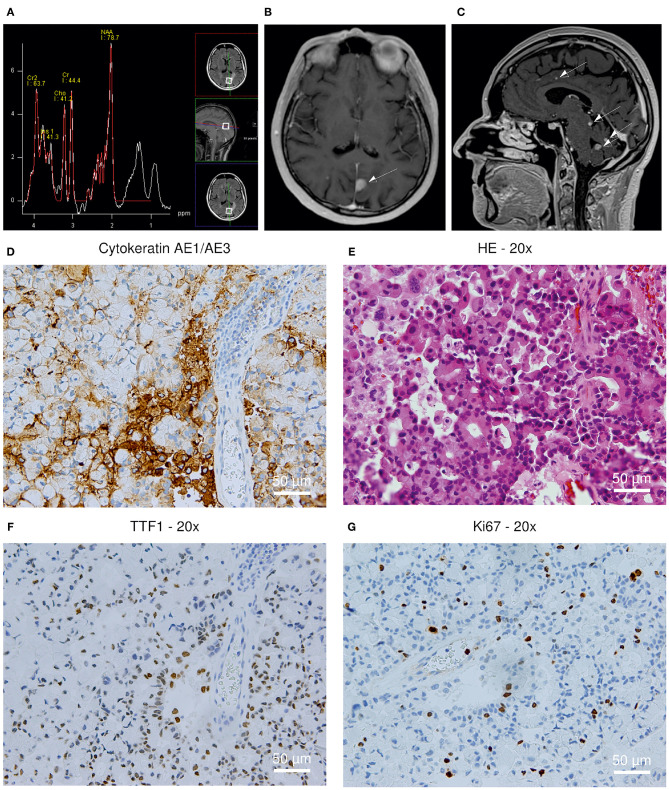
Fingolimod represents a highly effective disease-modifying drug in patients with active relapsing-remitting multiple sclerosis (RRMS). Its immunosuppressive effects can mediate adverse events like increased risk of cancer development or appearance of opportunistic infections. Progressive multifocal leukoencephalopathy (PML)-representing a severe opportunistic infection-has been only infrequently described during Fingolimod treatment. Here, we present a case of a 63-year-old women with pre-diagnosed RRMS who presented with new multiple cerebral lesions in a routine MRI scan, also including a tumefactive lesion in the left parietal lobe, eventually leading to the diagnosis of brain metastases derived by an adenocarcinoma of the lung. Additionally, a JCV-DNA-PCR in the cerebrospinal fluid revealed positive results, corresponding to a paraclinical progressive multifocal leukoencephalopathy. In conclusion, adverse events potentially associated with immunosuppression can occur during Fingolimod treatment. In this context, the occurrence of cancer and opportunistic infections should be carefully monitored. Here, we report a case in which JCV-DNA-PCR in the cerebrospinal fluid suggests asymptomatic PML and simultaneously lung cancer brain metastases developed. While it is rather unlikely that either event occurred as an adverse event of fingolimod treatment, a contributing effect cannot be formally excluded.
芬戈莫德是一种对复发缓解型多发性硬化症(RRMS)患者非常有效的疾病修正药物。其免疫抑制作用可引发不良事件,如癌症发生风险增加或机会性感染的出现。进行性多灶性白质脑病(PML)——一种严重的机会性感染——在芬戈莫德治疗期间仅有罕见报道。在此,我们报告一例63岁女性患者,其预先诊断为RRMS,在常规MRI扫描中出现新的多发性脑病变,包括左顶叶的一个肿块样病变,最终诊断为肺腺癌脑转移。此外,脑脊液中的JCV-DNA-PCR检测结果呈阳性,符合副临床进行性多灶性白质脑病。总之,芬戈莫德治疗期间可能会出现与免疫抑制相关的不良事件。在此背景下,应仔细监测癌症和机会性感染的发生情况。我们报告了这样一例病例,脑脊液中的JCV-DNA-PCR提示无症状性PML,同时发生了肺癌脑转移。虽然这两种情况都不太可能是芬戈莫德治疗的不良事件,但也不能完全排除其有促成作用。